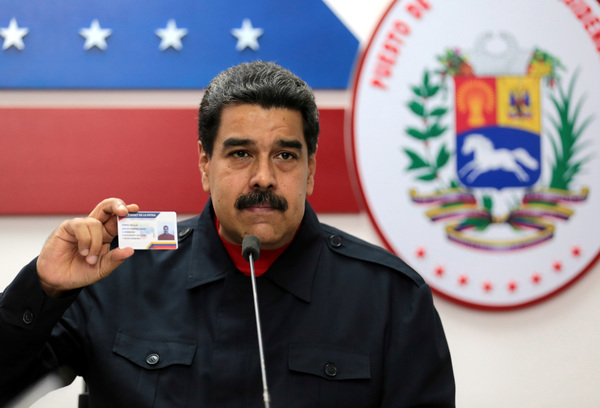
BOGOTA, Colombia _ Did Venezuelan President Nicolas Maduro just conjure up a cutting-edge solution for the nation's economic problems or create another distraction in his country's tanking economy?
After Maduro said his government would launch a national cryptocurrency called the petro to break through the U.S. "financial blockade," experts, including some of the government's advisers, debated whether it will work.
John Villar, a Caracas-based cryptocurrency entrepreneur who has been an informal adviser to the government, said the petro has the potential to solve several of the nation's problems.
Not only would it allow the socialist administration to skirt economic sanctions _ allowing money to flow around the U.S.-dominated financial system _ but also help weed out corruption.
While cryptocurrencies provide anonymity, the underlying blockchain technology also maintains a complete ledger of transactions, providing a degree of transparency that has eluded government finances, Villar said.
"This could make transactions traceable and auditable," said Villar, who was in Bogota attending the Latin American Bitcoin and Blockchain Conference. "This would be a way to fight corruption."
On Sunday, Maduro said the petro would be backed by the country's oil, gas and diamond reserves. But people close to the project said the details are still being debated.
"This is very much a work in progress," said Gabriel Jimenez, CEO of The Social US, a Venezuelan tech incubator that specializes in cryptocurrency applications and which also is advising the government on the project. "There is nothing that has been 100 percent settled upon."
While backing the digital currency with hard assets might give it the sheen of legitimacy, Villar said doing so will make the petro prone to graft.
In recent weeks, for example, the government has arrested more than 60 executives of state-run oil companies, some of them for lying about production figures. A digital currency whose value is backed by oil reserves could also be vulnerable to that type of "commodity fraud" and manipulation, Villar said.
There are reasons to be skeptical of the initiative. The government hasn't been able to defend the national currency, the bolivar, which has depreciated more than 3,000 percent against the dollar this year on the black market, according to the website DolarToday.com
If there's no faith in the government-backed currency, there's no reason to believe a currency backed by the government's commodities would inspire any more confidence, Villar suggested.
"If you have a currency backed by a commodity you're just creating another bolivar," he said.
Venezuela is staggering under triple-digit inflation and a cash crunch that has led to food and medicine shortages. As it has been hit with U.S. and European sanctions, the government has been trying to refinance debt as it teeters on default.
"What you have in Venezuela is hyperinflation, which won't be solved by introducing a new currency," Colombian Finance Minister Mauricio Cardenas told RCN radio Monday. "Venezuela's problems are fundamental and can only be corrected by adopting measures that will stabilize their public finances."
While the petro might not be a magic bullet, Jimenez said it might be a useful tool for Venezuelans who have lost faith in the bolivar and are looking for safe places to stash their cash.
The petro (like bitcoin) can be encoded so that more tokens can't be produced �� making it impossible for central bankers to devalue the currency by printing more.
In some ways the petro is an acknowledgement of what's already happening in the country. During the bolivar's collapse, many Venezuelans have turned to currencies like bitcoin, ethereum and dash to store value.
And the country's heavily subsidized electricity makes crypto "mining" operations that rely on banks of computers running 24 hours a day profitable. Even so, some operations have been shut down by the government on accusations of energy theft.
Even as Villar supports the idea of the petro, he said the government doesn't have to reinvent the wheel.
"We don't need a new cryptocurrency," he said. "They just need to allow us to use the ones that are out there."