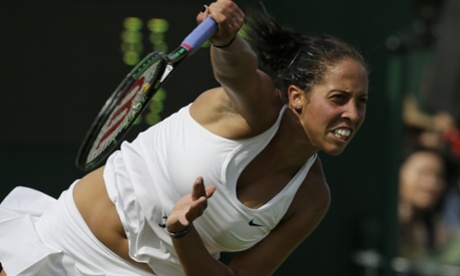
Though the dominance of Serena Williams gives the impression of American women’s tennis in rude health, the question frequently asked is, what happens after Serena? For many, the answer is Madison Keys.
Hoping to augment that belief, the right-hander powered her way into the third round with a comfortable win over the Russian Elizaveta Kulichkova.
The victory, achieved in 90 minutes on the backwater of Court eight, will have come as profound relief to Keys, who for all the hoopla sits outside the world top 20, albeit by one place, and has, as yet, only one title to her name. She suffered flu and crashed out of Eastbourne in the first round; a notable disappointment as her solitary title was won there last year.
She did not bring her A game on Thursday. With preparation limited, that was understandable. Fortunately her opponent proved a model of understanding by forgetting to bring a first serve.
Soon it became clear that even a below-par Keys cannot be overcome with increasingly hesitant second serves that merely invite her to display her daunting firepower. Kulichkova, ranked 109, spun them in, Keys capitalised, her afternoon’s pleasure heightened by the fact that the Russian could not cope with the American’s serves at all. The fast one down the middle line was too fast. The Russian hit a succession of them long or into the net. The highly spun second serve kicked up too high for Kulichkova to reply with any venom.
When the chance came to rally, Kulichkova gave a reasonable account of herself. But those opportunities did not come often enough. When she did land a first serve, she looked competitive. But they were the exception, not the rule.
Keys professed herself satisfied. “I think I played pretty well,” she said. “Better than the first round. It’s really important being able to win when you’re not playing your best or come into a tournament not having a lot of matches and struggling though some early rounds. The top players are really good at that. They can be playing their B or C game and still figure out ways to win.”
She took the first set in 35 minutes and only waywardness, rustiness perhaps, saw the encounter extend to 6-4. She broke Kulichkova at the first opportunity and secured break points in three out of four of the Russian’s subsequent service games. Keys seemed likely to dominate the second in similar fashion. Instead she morphed into her own worst enemy.
She broke her opponent’s service in the fifth game only to surrender hers soon after. She broke again to go 5-4 up to serve for the match, but sloppily lost her own serve again, another wound self-inflicted.
She rallied for the tie‑break, though, her own service recalibrated and aided once more by profligate serving from Kulichkova. To whoops from the Americans in the crowd, she took the tie‑break 7-3.
Her support is loyal and vocal, reflecting the hopes for her continued ascent. Serena Williams, after beating her in Australia, declared that Keys “can be the best in the world”. Brad Gilbert has gone further, saying she will become No1 in the next three years.
Sensibly her coach, the former Wimbledon champion Lindsay Davenport, who sat courtside is more measured, calling their project a work in progress.
A work Keys obviously enjoys. “This would be really hard if it wasn’t fun trying to get better every day,” the 20-year-old says.
Among the aspects she hopes to improve is her volleying. That should be fun, too. She has signed up to play mixed doubles with the colourful Australian Nick Kyrgios – the rising star who was forced after his first round match to explain to whom he directed the epithet “dirty scum” – himself or the umpire. “I am going to have a talk to him and tell him to be on his best behaviour,” she said.
The post-Serena discussion bedevils American tennis. Stars such as Sloane Stephens, Coco Vandeweghe, Bethanie Mattek-Sands and Alison Riske have all shone but then struggled to maintain momentum. Yet this is the most hopeful Wimbledon from a US perspective for many years: six American women won their first round matches, prompting the New York Times to write of them having “rampaged” through the draw.
Cause for optimism, says Mattek‑Sands, who observed: “We have a really strong contingent.” But the future hurdles will be higher than Kulichkova.