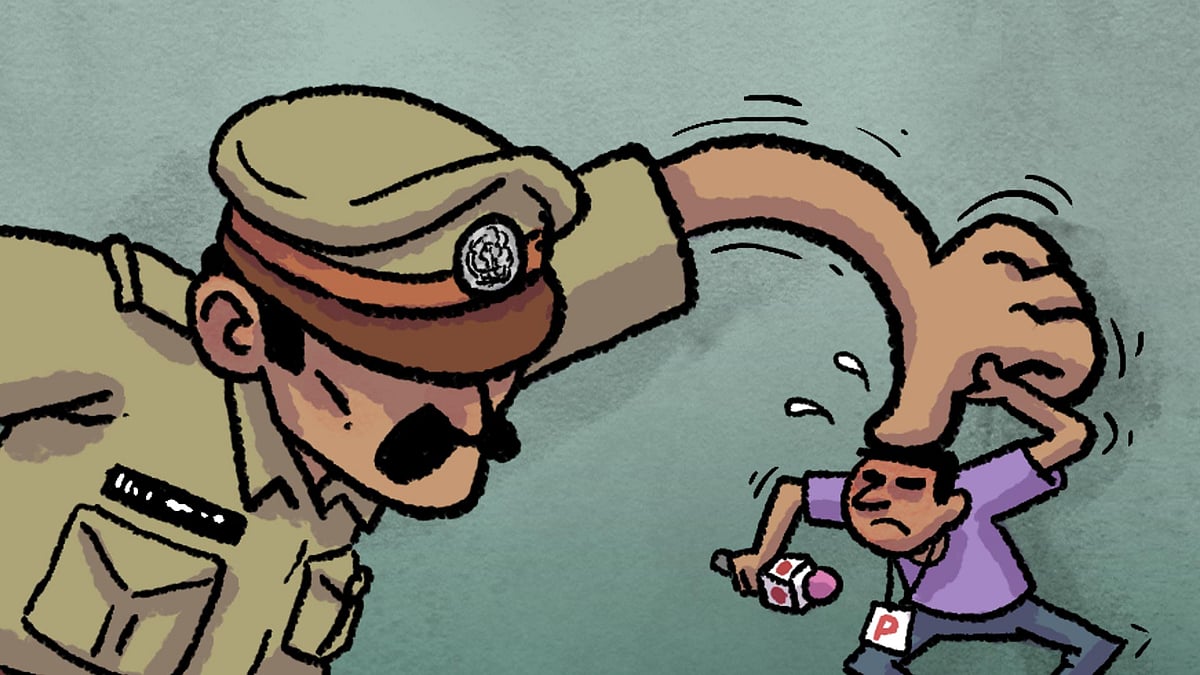
On December 20, the Mangaluru police arrested eight journalists from Kerala who were covering the protests against the Citizenship Amendment Act. After keeping them in police custody for over seven hours, the journalists were then sent to Talapady, a border town between Kerala and Karnataka, and told to “cross the border”.
The police claimed they thought the detainees were “posing” as journalists or did not possess “accreditation” from the Karnataka government.
The journalists, who work with three Kerala-based media houses, 24News, MediaOne and Asianet, said they were stopped by the police while on their way to interview relatives of two people killed in police firing on protesters.
A video posted on Twitter shows an exchange between a police officer and a reporter in Mangaluru.
The policeman says, “No…no. Please switch it [the camera] off. Show your accreditation card…prove that you are a genuine mediaperson.”
This is not acceptable .@compolmlr these journlalists have proper ID cards from their company. Not all journlalists on the ground have “accreditations”.
Many Journalists Questioned, Detained In Mangaluru, Cops Demand IDs @ndtv .
https://t.co/ZGGw7o3ikL pic.twitter.com/J60EJdU36I— Sneha Koshy (@SnehaMKoshy) December 20, 2019
When the reporter produces his identity card, the policeman says, “No, that is not accreditation…it is not government-issued. You don’t have access…only accredited journalists…Out!”
Meanwhile, the convener of the Bharatiya Janata Party in Karnataka, Balaji Srinivas, supported the police, calling the journalists “goonda elements”.
50 goonda elements from Kerala tries to enter Venlak hospital in Mangalore in the name journalists. Sources says the gang was carrying weapons and cameras to create ruckus. (Police sources)
— Balaji Srinivas (@BalajiiSrinivas) December 20, 2019
‘Made to squat for hours, treated like cattle’
The eight journalists work for television channels in Kerala. Mujib Rehman, a journalist with Asianet, said their ordeal lasted over seven hours.
On the morning of December 20, Rehman said, the eight of them broadcast reports for their respective channels. They then went to the morgue of the Wenlock District Hospital to get details on the two protesters killed in police firing.
“When we reached, we were first asked to report from outside the compound by the police,” he said. “But later, we were asked to produce our credentials. We produced the ID cards given to us by our respective companies. But they did not approve it and wanted only accredited journalists to cover the events.”
The police then took the journalists to a police van and made them sit inside for two hours, Rehman said. “Later, we were taken to Mangalore South police station and made to squat on the floor for four more hours. We were made to squat for hours, and treated like cattle.”
He added: “The entire time we did not have water or food. At 3 pm, they dropped us at Talapady.”
Anand Kottilla, a 24News correspondent, said he’s never had such a “bad experience” in his time as a journalist. “Some of us have also covered riots much bigger than this in Kerala and elsewhere,” he told Newslaundry. “We are from the Kerala media and the accreditation card was issued to us by the Kerala state government. The police in Mangaluru were asking for accreditation cards issued by the Karnataka government, which is not possible in terms of professional standards.”
One of the journalists, on the condition of anonymity, said they didn’t even realise they were being detained until the police snatched their phones and cameras. Another journalist, who was detained, said, “They made us to sit on the floor of the police bus instead of seats. The police behaved with us like we’re accused.”
Mohammad Hasheed, the Kasargod unit president of the Kerala Working Journalists’ Association, was the first to raise the alarm on the journalists’ detention. He contacted Kasargod police chief James Joseph.
The association’s state vice-president, PV Kuttan, then raised the issue at the state level. He contacted Kerala Chief Minister Pinarayi Vijayan, who spoke to his Karnataka counterpart BS Yeddyurappa. Later, Tom Jose, the chief secretary of the Kerala government, spoke to his counterpart in Karnataka and got the journalists released. That’s when the journalists were taken to Talpady and asked them to cross the border to Kerala, so they could not return to Mangaluru.
Mohammed Hasheed told Newslaundry: “According to the initial information I got, the Mangaluru police were planning to slam cases against the detained journalists from Kerala. The police in Mangaluru were very curt and brief with us and did not provide any reason for the detention when our association contacted them.”
On the phone from Thiruvananthapuram, ES Subhash, general secretary of the KWJA, said, “We are taking up the issue of the arrest of the journalists on a national scale. We are already in touch with the Delhi Union of Journalists and will soon appeal to the home minister and the prime minister for making the work environment for journalists safer.”
On December 22, the Kerala Union of Working Journalists organised a protest in Delhi against, among other things, the detentions in Mangaluru.
According to Srinivas Nayak Indaje, president of the Dakshina Kannada Working Journalists’ Union, a delegation from the union had met BS Yeddyurappa and apprised him of the hardships journalists face. Only a few journalists have received accreditation cards from the state government, Indaje said, and the rest are not recognised in situations like this.
“They need proper government identity cards to fearlessly and efficiently go on with their jobs,” Indaje pointed out.
On social media, senior journalists have condemned the police for detaining journalists who were just doing their jobs.
The police version
The Mangaluru police’s version of events is that “over 50 people” were detained for pretending to be journalists. The police told Newslaundry these people arrived in Mangaluru, ostensibly to cover the protests.
The police claimed the detainees said they were “on duty” and “demanded immunity” from the curfew that had been imposed after violence broke out between the police and protesters.
When asked for identity and curfew passes, which had been issued by the police commissioner PS Harsha, the police said the detainees failed to produce them.
On December 20, Harsha issued a statement: “Few people not having any accreditation cards issued by any authority, not from any formal media and in possession of many things unconnected to reporting are being questioned.” The police did not clarify the nature of these “things unconnected to reporting”.
Why were the journalists asked for Karnataka government-issued accreditation when they had press and identity cards from their respective media outlets? A police source told Newslaundry: “We were trying to keep in check the peddlers of fake news. They do the most damage. Many of them were social media handlers of various groups and they turn any news to the advantage of their chosen groups. But in the case to TV journalists, it is our duty to ask for their credentials.”
A senior police officer, on the condition of anonymity, said: “In our state, our information department issues accreditation cards, which are issued after giving due weightage to [the journalist’s] service, and experience…This becomes their valid identity card when dealing with government officials.”
The police claimed the journalists were “only detained”. “They were even offered food and water during their brief stay at the police station,” the official said.
(The authors are freelance journalists and members of 101Reporters.com — a pan-India network of grassroot reporters.)
Newslaundry is a reader-supported, ad-free, independent news outlet based out of New Delhi. Support their journalism, here.