David Nixon created his danced version of Madame Butterfly for Northern Ballet in 2002, and it has proved one of the company’s most popular works. The score, adapted by John Longstaff, retains the sweeping emotionalism of Puccini’s opera, and elicits an expressive choreographic text from Nixon.
The story is set in late 19th-century Nagasaki, where an American naval officer, Pinkerton (Kelley McKinlay), buys a young bride from a marriage broker. Nixon hints at, but does not dwell on, the grimly exploitative relationship between the colonisers and “geishas”, who were effectively child prostitutes. The choreography for Pinkerton and his fellow officers (Kevin Poeung, Sean Bates) is breezily classical, all long lines and clean-limbed leaps. It’s handsome stuff, and Nixon presents an adroit contrast between the Americans’ casual appropriation of stage space and the much more tightly contained performances of the Japanese characters.
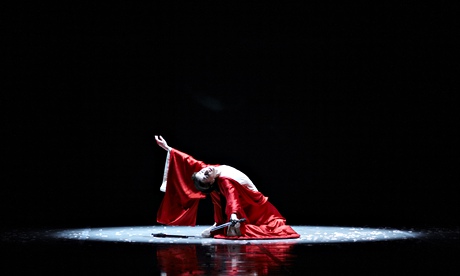
That the story will end in tragedy is clear from the start. McKinlay’s Pinkerton has a feckless surface charm which we pray for Butterfly (Pippa Moore) to see through, but her determination to believe in him is as heartbreaking as it is inexorable. Petite, with eyes of cornflower blue, Moore has been with Northern Ballet since 1996. Technically, she is quietly capable rather than spectacular, but as a dance actor she is resonant. In the opening scenes she conveys deep yearning through unblinking stillness. When Pinkerton kisses her, he prompts a rapturous physical unfolding, which proceeds in modest increments throughout the extended duet that closes the first act. Moore has the wit, the experience and the musical phrasing – an object lesson here for any aspiring ballerina – to hold back, and to keep on holding back. Her leitmotif is an arabesque stepped through into demi-plié, and in that repeated subsiding from taut verticality she describes the dashing of her love against the rocks of Pinkerton’s heedlessness. When Pinkerton’s wife, Kate (Lucia Solari), finally appears, entitled and expansive of gesture, Moore seems to freeze from the heart outwards. Her ritual suicide, performed in great slashing arcs of movement to Kabuki music, is chilling.
At times, Nixon overdoes the Japonaiserie. The heel walks, the coy fan-play, the bowing and shuffling. The flexed-foot motifs, in particular, have a faux-orientalism about them which, while falling short of the outright racism of the traditional “Chinese” dance in The Nutcracker, add little to the believability of Butterfly and her compatriots. That said, this is a well-made production that tells its story legibly and movingly, and shows off Northern Ballet’s dancers to fine effect. Nixon’s costume designs – softly draping silk kimonos, crisp white naval uniforms – are notably splendid.
Madame Butterfly is preceded by Perpetuum Mobile, a short work by Christopher Hampson to Bach’s violin concerto in E Major. Originally created for English National Ballet, it’s a detailed and carefully constructed piece, almost effusive in its politeness. The Northern dancers give it their best shot, but appear constrained by Richmond’s comparatively small stage and steep rake, with Mlindi Kulashe almost coming to grief. Javier Torres and Lucia Solari dispatch their leaps and turns with brisk efficiency (Solari is a demon pirouetter) and Abigail Prudames’s elegant line and cool phrasing catch the eye. But Hampson’s choreography, for all its diligence, never quite matches either the music’s carefree spirit or its sudden, sombre shadows, and he could have more fun than he does with its baroque ornamentation.
• Madame Butterfly tours to Bromley, Stoke, Aylesbury and Hull until 26 September