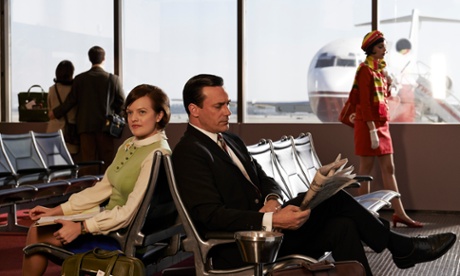
A show about the art of marketing, Mad Men, which began its final season on Sky Atlantic on Thursday, has itself proved a textbook in how to position a product.
Featuring a must-have character – 60s advertising executive Don Draper – it has represented, through seven seasons screened over eight years, the epitome of prestige TV. Visually stylish (with the artiest opening credits since James Bond), intelligently written and sensually performed, it has become a show that people like to pretend is part of their lifestyle even if it isn’t.
In 2007, when the first series was broadcast, it was 1960; viewers will leave the characters, when the 92nd and final episode is screened on 17 May, in 1970. This historical dimension forms part of the originality of Matthew Weiner’s series, as most American TV drama – in contrast to the history-obsessed British form – is set in the present.
The advantage of this timescale, in providing dramatic scenarios, is that Weiner’s characters have been able to do the sorts of things – smoking, drinking, sexism, racism – that in contemporary TV fiction would prompt a Twitter storm or complaints to the regulator.
If the title hadn’t already been used, the series might have been called Men Behaving Badly. Its major theme has been the ways in which white male power, a cocktail of testosterone and capitalism, caused damage in offices and homes in the past and, by inference, also does so in the present, though more covertly. Adulteration – of products, values and marriages – has been a recurrent plotline.
The genius of Mad Men is in the precision of its period detail – the hairstyles, hemlines, jargon, cars and furniture – and the opportunities that its complex characterisation gives to actors.
The key female character, Peggy Olsen, played by Elisabeth Moss, began as a shy young Catholic, a secretary and extramarital sex trophy for bosses who kept trying to ignore the evidence that she was cleverer and more creative than them.
The show belongs, though, to Jon Hamm’s Don Draper. Starting out as a walking billboard for top-pocket handkerchiefs, Brylcreem, bourbon and cigarettes, he turned out, like many superficially attractive packages, to be lying about what was inside.
Although no series as distinctive as Mad Men could be said to fit a formula, it’s striking that its rivals for the title of America’s best recent TV drama – Breaking Bad, The Sopranos and The West Wing – also featured middle-aged men who were lying about some aspect of their profession or health.
Although it is finishing when some of the most successful TV shows aren’t even shown on television – but, as with House of Cards, on Netflix or other streaming services – Mad Men, when it began in 2007, was part of a revolutionary form of TV distribution: made by the cable network AMC, it was the first Emmy-award-winning show that had not been screened by one of the big US networks.
Because of its non-conventional transmission, Mad Men’s US audience has been small, averaging around 2 million viewers – but almost every one of them seems to be a media or social media opinion-former.
With its high production values – and storylines spreading over a whole season – it has also proved, in its homeland and the UK, a perfect advert for the virtues of the box set. A frequent theme of the drama has been creative differences and the show experienced some of its own. At one point, there was a 17-month gap between episodes while Weiner fought with his bosses. Any media executives who try to stop him doing whatever he plans next, however, would be mad men.