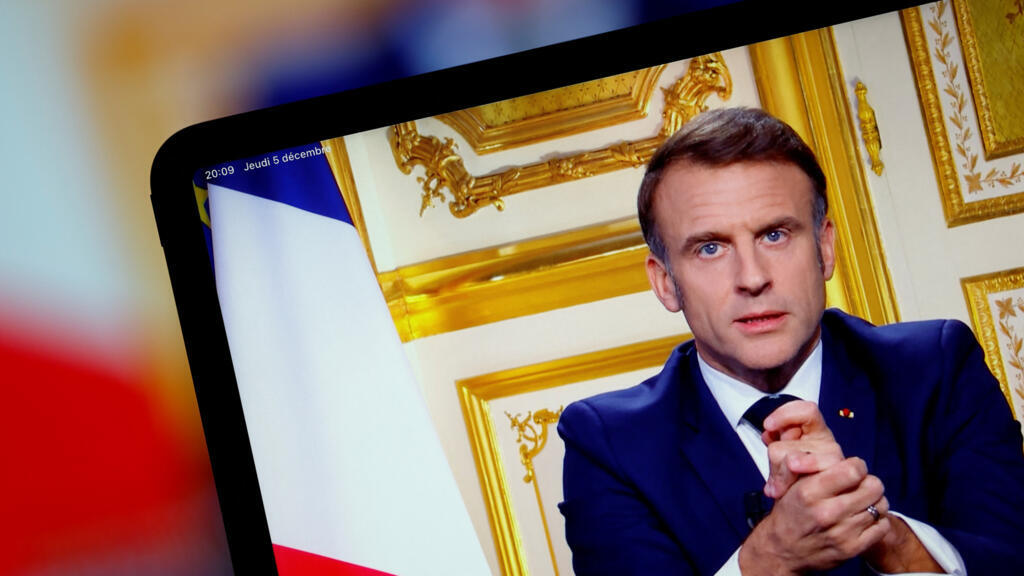
Facing low approval ratings and a fractured parliament, President Emmanuel Macron will use his New Year’s address on Wednesday night to try to revive momentum in the final stretch of his second term, setting out a last round of reforms.
With just 16 months to go until the next presidential election, Emmanuel Macron is in one of the weakest political positions of his two terms.
The televised address is a fixed moment in the political calendar and a chance for the head of state to relaunch the final projects of his second five-year term.
As tradition dictates, the president will address the nation at 8pm on 31 December, opening with his familiar “My dear compatriots”.
In a speech expected to last around 10 minutes, he will set out his roadmap for the year ahead, reflect on the challenges facing France and explain why he believes there are still reasons for hope despite political instability at home and an unsettled international climate.
This will be Macron’s ninth New Year’s address and his second-to-last. His entourage said he was still working on the speech on Tuesday and could continue to adjust it until the last moment.
The audience may be smaller than in previous years. Sixty-three percent of French people say they do not plan to watch the address, while the president’s approval rating has fallen to 25 percent, its lowest level since 2017, according to the latest Toluna/Harris Interactive poll.
Macron demands 'robust security guarantees' before any Ukraine territorial talks
Ukraine focus
The broad outline of the speech is already known. The war in Ukraine, which enters its fifth year in February, is expected to be at the centre of the address, underlining both the scale of the conflict and its long-term impact on Europe.
Beyond that, the message will stress determination. Macron wants to show that 2026 can still be “a year of action – a useful year”, as his entourage put it, even with a divided political landscape.
The tone is also expected to be carefully balanced. “Without falling into blind optimism,” the president wants to counter what his team described as a climate of “French bashing”, which they said is often driven by far-right figures who present themselves as patriots.
France wary of MAGA influence ahead of 2027 elections
'No to immobility'
Macron offered a preview of this approach on Tuesday in a one-minute video posted on social media. He looked back on the “joys and sorrows, successes and challenges” of the past year, along with its “hopes”.
He pointed to events such as the reopening of the towers of Notre-Dame and the success of two French Nobel Prize winners as signs of national resilience.
“France has continued to move forward during these months despite a difficult context,” his entourage said. Looking ahead, they promised that 2026 would be “the opposite of immobility”.
The remark was a clear response to former prime minister Edouard Philippe, who has argued that “the state is no longer viable” and has called for early presidential elections.
Macron’s room for manoeuvre remains limited. France has no parliamentary majority, every vote in the National Assembly is closely fought, and the 2026 budget is still unresolved amid a lack of agreement between the government and the Socialists.
France in turmoil: 'No one is willing to say the country needs to make sacrifices'
Domestic priorities
Despite these constraints, the president is expected to set out three main domestic priorities in his address: a return to national service, tighter rules for social media and legislation on end-of-life care.
Macron plans to bring back national service on a voluntary basis, an idea that has been relatively well received by public opinion.
On social media, he will refer to the conclusions of a series of round tables held across France and signal forthcoming announcements, “presumably in January”, on how platforms should be regulated for young people.
A former minister warned the issue carries risks. “Whatever the issue – digital majority at 15, for example – I don’t know which way the coin will fall,” the former minister said. “There could be a lot of opportunism.”
The sensitive question of end-of-life care is also entering a key phase. Draft legislation will be examined by the Senate from 20 January before moving to the National Assembly.
Debates are expected to be difficult, particularly in the upper chamber, where the Republicans, the largest group in the Senate, remains highly cautious about the creation of assisted dying.
(with newswires)