European leaders are gathering in Berlin to push a more confident, homegrown digital strategy as the continent races to keep pace with global artificial intelligence powerhouses.
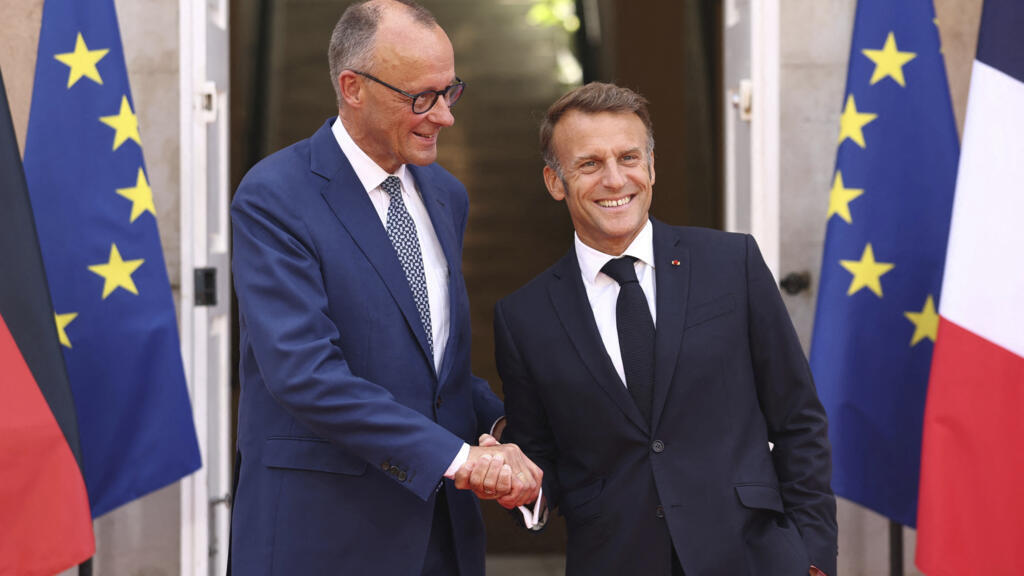
German Chancellor Friedrich Merz and French President Emmanuel Macron will join forces on Tuesday to make a fresh push for greater European digital sovereignty – and reduce the continent’s reliance on US tech giants – as the global artificial intelligence race accelerates.
The pair will set out their ambitions at a Berlin summit bringing together political leaders and key industry players, including executives from French AI firm Mistral and German software powerhouse SAP. Their meeting is set to underline that Europe can and should be shaping its own digital destiny.
With artificial intelligence set to become critical across a growing number of sectors, EU governments are coming under increasing pressure to assert more control over the technologies that will underpin everything from industry to public services.
Those concerns have only sharpened with the return of US President Donald Trump, whose scepticism towards longstanding transatlantic ties has caused unease in European capitals.
German Digital Minister Karsten Wildberger said on Monday that the summit’s “core message” would be that “Europe is ready to shape its own digital future, to reduce dependence”.
“We can make better progress by working together,” he added at a ground-breaking ceremony for an 11-billion-euro data centre outside Berlin – a project emblematic of the infrastructure Europe hopes will help it catch up.
The EU has come under fire for being too slow in the global race against the United States and China to dominate AI technologies. Brussels will this week propose rolling back some rules on AI and data protection, with the topic expected to feature prominently in Berlin. European companies struggling to keep pace have complained about regulatory hurdles, while American firms have also voiced frustration. Critics now fear the EU may be putting competitiveness ahead of citizens’ privacy.
France and Germany weigh future of joint EU weapons projects
Cloud computing, competition concerns
Another major theme of the summit will be efforts to build “sovereign” European cloud computing capacity. Supporters argue that homegrown cloud solutions would better safeguard Europeans’ data in a market currently dominated by US heavyweights such as Google, AWS and Microsoft.
Fostering more competition, improving collaboration between governments and industry, and designing “fair and efficient” digital markets are also expected to be high on the agenda.
Merz and Macron will deliver keynote speeches in the afternoon, and the event will also host digital ministers from across Europe. Later in the day, the two leaders will have dinner with British Prime Minister Keir Starmer, though a German government spokesman declined to share what the trio plan to discuss.
Several announcements on new digital initiatives are anticipated – part of a wider push to address Europe’s long-standing concerns over dependence on hardware suppliers from China and other Asian countries. From semiconductors to laptop components, the continent remains heavily reliant on imports.
A Bitkom survey found that around 90 percent of German companies importing digital goods or services consider themselves dependent on them – a statistic underlining the scale of the challenge.
Macron and Merz forge united front on trade, security and energy in Berlin
‘Europe must invest’ to stay competitive
Ralf Wintergerst, president of Germany's digital association Bitkom, said Europe must step up its investment in the digital economy without delay.
“Europe must not fall behind – today’s investments secure tomorrow’s competitiveness and jobs,” he told reporters. “If Europe does not want to become a museum of technology, we must ramp up investment significantly.”
But the road ahead looks steep. After years of sluggish economic performance, Europe’s tech sector remains dwarfed by its US counterparts. As of last year, European data centres had just 16 gigawatts of computing capacity, compared with 48 gigawatts in the United States and 38 in China, according to Bitkom.
Meanwhile, hefty new US investments in Germany – including billions of dollars from Google and a partnership between Nvidia and Deutsche Telekom for an industrial AI hub – have only underscored how dependent Europe still is on American innovation.
Despite this, a senior official from the French presidency stressed that the summit is not about picking a fight with Washington or Beijing.
Rather, it is focused on exploring “how we protect our core sovereignty and what rules need to be established, especially at the European level”.
(with newswires)