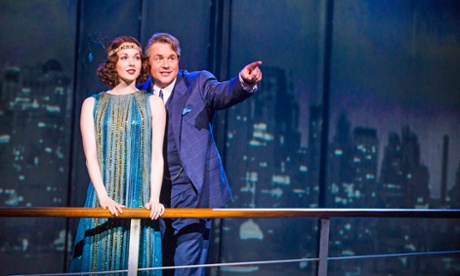
Ever since its Broadway failure in 1974, people have been trying to resuscitate this Jerry Herman musical. I can’t imagine a more lavishly devoted attempt than this by Jonathan Church, which has all the verve one associates with Chichester shows. But, despite revisions to Michael Stewart’s book and a bulldozing performance by Michael Ball, it remains a musical in which the tuneful parts are better than the dramatic whole.
The title figures are the silent movie-maker Mack Sennett and his bright, particular star Mabel Normand – spanning the years from 1911 to 1938, the show charts their rise and fall. A dazzling first half scores on two counts. It explores the complexities of the central couple’s amorous relationship in a haunting number in which the monomaniac Mack sings I Won’t Send Roses, to which the pragmatic Mabel responds in kind.
You also get a sense of the headlong exuberance of the two-reeler era, in a sequence where Mabel moves swiftly from being a windswept aviatrix to a galloping cowgirl and in a climactic number where Sennett’s bathing beauties don’t merely toss beachballs about but use them as choreographic weapons.
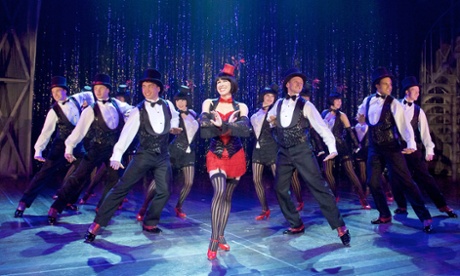
After the interval, however, the show seems to be marking time. A big number celebrating Mabel’s return to the Sennett studios, after a five-year defection, is an absurdly inflated affair in which Herman echoes his own title song from Hello, Dolly! Later tributes, to the Keystone Cops and the therapeutic values of tap, fail to advance the plot.
And the tragedy at the heart of the story, which is Mabel’s drug-dependence and early death, is cursorily dealt with. The implication that Sennett was to blame for his partner’s addiction is belied by the fact that there was a secret pusher in the studio.
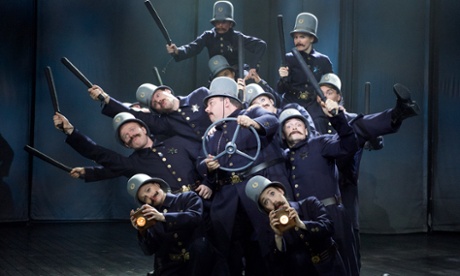
Although Francine Pascal’s revised book also tries to give the story an optimistic twist by suggesting that Mabel’s glory lives on through her movies, the truth is that her work is known only to a select bunch of cineastes.
A flawed show is flawlessly done. Ball, looking oddly like a young Orson Welles, not only captures Sennett’s obsessive devotion to comedy but sings with magisterial power. Rebecca LaChance as Mabel, the hash-slinger turned star, has the right mix of bubbly vivacity on set and vulnerability off it and Anna-Jane Casey lends staunch support as a Sennett sidekick turned tap dancer. Robert Jones’s designs, especially of a train hurtling through the plains, have a freewheeling beauty and Stephen Mear’s choreography is typically inventive. But one cannot dodge the basic fact that Herman’s buoyancy is ill-suited to a showbiz fable of doomed love.
- Chichester festival theatre, until 5 September. Box office: 01243 781 312. Then touring.