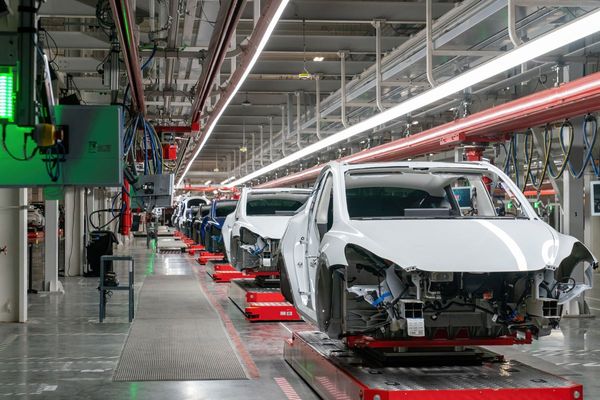
December 2013 was a month of stories confirming the unstoppable rise of the machine.
After further trials, the Defense Advance Research Projects Agency selected eight teams to receive funding to find new ways of replacing humans in hazardous situations. Amazon came up with the astonishing idea of using drones to deliver bestsellers to us in just 30 minutes and, closer to home, the UK government announced that it wants to make the country a world centre for the development of driverless cars.
These projects might be intended to transform warfare, emergency services, logistics and personal transportation but their impact could be much greater. This is because an essential ingredient for each of these technologies is autonomy.
Even though directions are given by a human the machine must be capable of quickly dealing with the unexpected on its own. That is also why the UK Government's announcement is as much about the need for enabling legislation as it is about cash. Insurers will want to know who is liable for what before covering driverless cars.
So where do we see the visible rise of the machine in everyday medicine? Up to now machines have mostly been out of sight in hospitals, operated and interpreted by highly skilled technicians and clinicians. While millions of us now rely on navigation systems every day to make decisions about where to drive, very few of us in good health use devices to show us how to stay that way.
According to Gartner's 2013 hype cycle of emerging technology, mobile health monitoring is five to ten years away from reaching its plateau and is currently in the trough of disillusionment. That resonates with the sense that the telehealth market has failed to deliver on expectations, despite the Department of Health's Whole System Demonstrator showing that "if delivered properly, telehealth can substantially reduce mortality, reduce the need for admissions to hospital, lower the number of bed days spent in hospital and reduce the time spent in A&E."
In order to move things forward, last year Qualcomm launched its $10m Tricorder XPRIZE challenge to develop a portable, wireless device to monitor and diagnose 15 diseases. Competitors offer a future in which consumer products to test for diseases such as anaemia, urinary tracts, type 2 diabetes and stroke will be as commonplace and unremarkable as pregnancy testing kits are now.
The rate of progress of these 'lab on a chip' technologies has thus led to the idea of Sun Microsystems co-founderVinod Khosla and others that eventually the majority of doctors will be replaced by machines.
His argument is that there is simply too much scientific data available for any human to be able to complete as accurate a diagnosis as a computer. An ageing population in which more patients have multiple illnesses compounds the challenge. The problem of too much data goes beyond diagnosis and applies to treatment, prescription and management as well, and it will increase as our knowledge of genetics opens up the possibility of truly personalised medicine. If the GP needs the machine to do his job, why not simply cut him out of the process?
The obvious answer is that whilst we have long accepted driverless trains on the Docklands Light Railway, few of us would be willing to fly today in a pilotless A380. In the Airbus the technology is there for the pilot to use, and we want the pilot to be in charge in an emergency. In the same way it is now hard to imagine a world in which patients might accept the word of a computer making a serious, life threatening diagnosis without a doctor being involved.
What does any of this mean for an NHS under pressure? Does it mean more demands on equipment budgets, or more litigation as lawyers use new sources of data to prove more ways to challenge clinical judgements? Will this new flood of data overwhelm a system that still struggles with information sharing at the most basic level? My own optimistic (non-clinical) view is that where these technologies are designed for consumers to use themselves, they will help them be better informed about the factors that affect their own personal health and the choices they can make to manage it.
Self-diagnosis based on a reliable scientific device rather than half an hour on Wikipedia might turn out to help rather than frustrate the GP. It may yet revolutionise public health whilst costing the NHS very little.
Content on this page is produced and controlled by Intelesant