Artificial intelligence research at the University of Newcastle aims to breathe new life into difficult scientific problems.
The project brings together deep learning - which is revolutionising artificial intelligence - and algebraic topology.
"By combining these two powerful areas, we feel that some previously hard-to-solve problems in material science may become manageable," Associate Professor Stephan Chalup said.
"As this combination is possible in any dimension, it opens the door to new insights in data analysis."
The university's Mathematical Machine Intelligence Group is working on the $411,000 project, with funding from the Australian Research Council.
The research involves "training deep artificial neural networks", so they can "analyse geometric structures in a similar way as human mathematicians would do".
"Most of our current artificial deep neural networks can be regarded as abstract simulations of sections of a visual cortex [part of the human brain]," he said.
"But they are still far away from having the capacity and functionality of a whole animal or human brain, with its many different modules."
Deep neural networks first became famous for their "outstanding ability to detect objects in images" on computers.
"Now they can often do this much better than humans. But they also can be used for acoustics, control tasks and an increasing number of other applications," he said.
"Deep neural networks work very well, are relatively easy to use and are a great tool in many application domains. In the right hands they are very useful."
They have already changed the world in areas such as medical imaging, environmental monitoring and language processing.
Artificial intelligence presents opportunities to "save energy, improve safety, assist in health, accelerate education and provide new industrial and business solutions".
"If we use the new AI tools wisely, they can help to solve many of our major challenges," he said.
"But, as we all know, there is also fear and concern about the changes that AI may bring to our lives."
The likes of Google, Apple, Facebook, Netflix and Spotify already use artificial intelligence to monitor, predict and manipulate behaviour.
"Already now some of the big companies analyse our search and consumer behaviour," Dr Chalup said.
"Recommender systems can predict what music or movies we will probably find entertaining.
"It feels like some of the big computers have collected and analysed more information about us than we can remember ourselves."
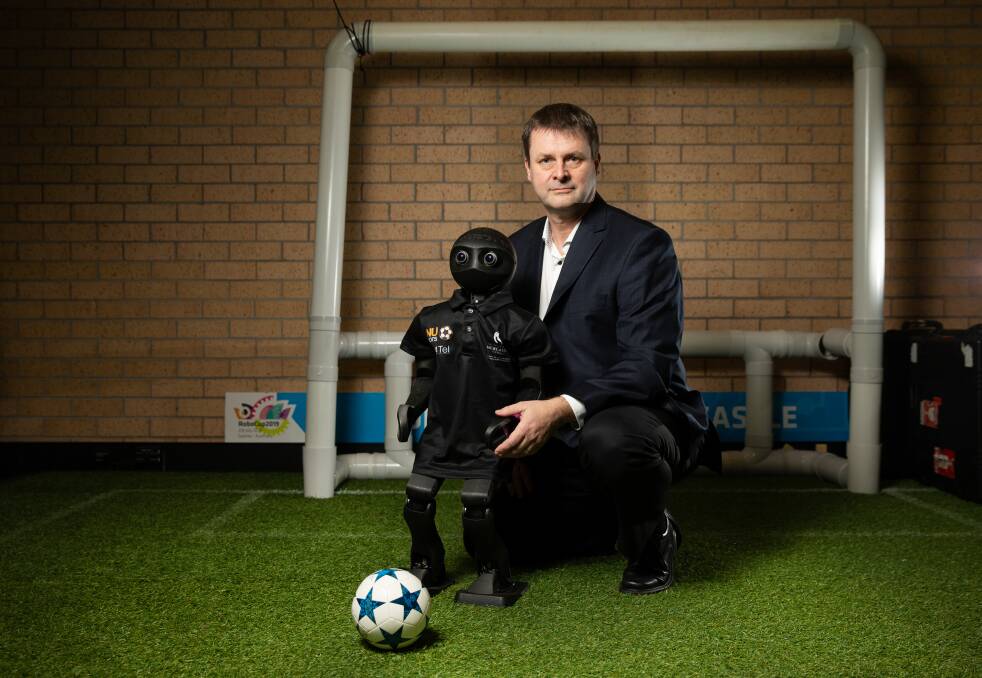
Dr Chalup discusses ethical and privacy questions around this technology with students and colleagues.
These questions include: Where can all this lead? How can we prepare? Is it necessary to introduce some restrictions?
"What news and reports can we trust if techniques like DeepFake can create near perfect illusions?
"What is the place for us humans in a future world where machine intelligence beats us not only in Chess and Go, but also turns out to be creative and far superior in music composition, building design, psychological counselling, education and conducting any kind of mathematics or science?"
Late physicist Stephen Hawking said artificial intelligence could be "the best or the worst event in the history of civilisation".
"It brings dangers like powerful autonomous weapons, or new ways for the few to oppress the many. It could bring great disruption to our economy," Hawking said.
Harvard cognitive scientist Steven Pinker, though, believes fear of AI is misplaced.
"There is a fantasy of a godlike artificial general intelligence that would be omnipotent, omniscient and have the power to solve any problem instantly," he said.
Professor Pinker said it was fanciful that AI would have "a thirst for infinite power and influence".
"There is no evidence that current AI is on such a trajectory," he said.
Dr Chalup believes now is the time to discuss how to prepare for the future and guide developments in AI.
"Do we have to pull the plug or can we find a way to channel our efforts in partnership with the developing AI?" Dr Chalup said.
"I do not have a fixed opinion yet about the future.
"It is important to discuss these topics, so that we are informed and can form opinions about how we want AI to change our society, with a view 20 to 30 years ahead."