

Dessert at Passover is always a problem.
You can make a nice fruit cup, of course, but then all you have is a fruit cup. Or you could make a poundcake with matzo meal, which isn't bad but leaves you wishing you were eating a poundcake that wasn't made with matzo meal.
The problem is that for Jews, Passover is a time to refrain from eating any leavened bread _ and that also goes for dessert items such as cakes and pastries. Ice cream is out, too, because observant Jews do not eat dairy products and meat products in the same meal.

That leaves fruit cup, poundcake made from matzo meal (it's ground-up matzos, which isn't the same thing as flour) and, by default, macaroons.
Macaroons are not to be confused with French almond-based sandwich cookies called macarons. Macaroons, with two Os, are chewy cookies made from shredded coconut, which is not prohibited during Passover. When served at the Passover seder, they almost always come out of a can.
And they're OK. They're fine. They're even kind of good, but here's the thing: You don't really want to eat them after Passover is over.
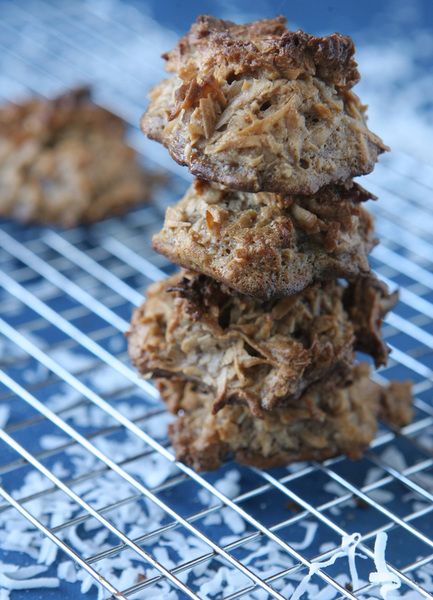
Macaroons are not just a Jewish food; they have been around for an unknown number of centuries. One source traces them to the year 791. Originally made from almond paste (the name is thought to come from "ammaccare," which means "to crush" in Italian), they were probably invented in Italy before being popularized in France.
A few decades ago, they were not hard to find in America, but not many bakeries sell them these days.
Which leaves the ones that come out of a can. Unless you make them yourself.

Homemade macaroons are wonderful. And best of all, they don't have to be in the old, familiar flavors (original vanilla, chocolate, chocolate chip) anymore.
So I made Rocky Road Macaroons, placing two mini-marshmallows in the middle and a walnut on top, drizzling chocolate over that and then sprinkling it with chopped walnuts.
Passover never tasted like this.

Rocky Road Macaroons taste like a real dessert, something you could serve any day of the year. Chocolate and coconut go well together anyway, as any fan of Mounds bars could tell you, and marshmallows make a perfect foil.
This recipe, along with most of the others I made, came from "The Macaroon Bible" cookbook, by Dan Cohen. Cohen runs a bakery in New York called Danny Macaroons, and it apparently sells nothing but macaroons. It's like the Baskin-Robbins of macaroons, with dozens of flavors that rotate with the season (plus some year-round favorites).
So if you're wondering where the idea for Chocolate-Stout Macaroons came from, it came from the book. But if you're wondering what Chocolate-Stout Macaroons taste like, let's just say they have a deep and rich flavor that is particularly satisfying.
The flavors of chocolate and stout are slight and subdued, but they add immensely to the overall experience.
Lovers of chocolate may well be drawn more to the two-fisted hit of Double Chocolate Macaroons. These have melted chocolate mixed into the macaroons, and then have more chocolate on top.
If you prefer salted caramel, of course you can make Salted Caramel Macaroons. I went with Cohen's recipe for the caramel on these, and, well, I had to try it several different times until I came up with a version that worked. Sort of.

The one I finally ended up with quickly hardened. I swirled it on top of the macaroons, and almost by the time I was done it had turned the consistency of hard candy.
It tasted great, but it was a little disconcerting that a macaroon should have that much crunch on the top. If you want Salted Caramel Macaroons that are chewy all the way through, you might be happier using a different caramel sauce.
Of course, to satisfy the traditionalist in me, I made regular vanilla macaroons. Actually, I made two versions of regular vanilla macaroons. One, the recipe from Cohen, has sweetened, condensed milk in it, which could not be eaten by observant Jews after a meal with meat in it.
The other, which I adapted from a recipe by Martha Stewart, is kosher in all circumstances. It's a little drier than Cohen's version and somewhat crisper, but it is no less delicious.
Either recipe can be used as the basis for making the more fanciful creations. Any way you make them, they will be a spectacular finish to a Passover meal.
Or the rest of the year, too. They're that good.