A powerful earthquake centered in the northwestern part of Chiba Prefecture hit the Tokyo metropolitan area at 10:41 p.m. on Thursday, registering upper 5 on the Japanese seismic intensity scale of 7 in Tokyo's Adachi Ward as well as Kawaguchi and Miyashiro, both in Saitama Prefecture.
It was the first time in 10 years that Tokyo's 23 wards registered a quake in the upper 5 level since the Great East Japan Earthquake of March 11, 2011.
The quake was known to have injured 53 people in six prefectures as of 11 a.m. Friday, according to a count by The Yomiuri Shimbun. A total of 16 East Japan Railway Co. lines in the Tokyo metropolitan area, including Shinkansen lines, were suspended or delayed between Thursday night and Friday morning, affecting about 368,000 passengers.
According to the Japan Meteorological Agency, the epicenter was 75 kilometers underground, with an estimated magnitude of 5.9. Tremors in the lower 5 level were felt in four prefectures that include the cities of Yokohama and Chiba. The agency warns of more tremors of up to upper 5 during the next week or so.
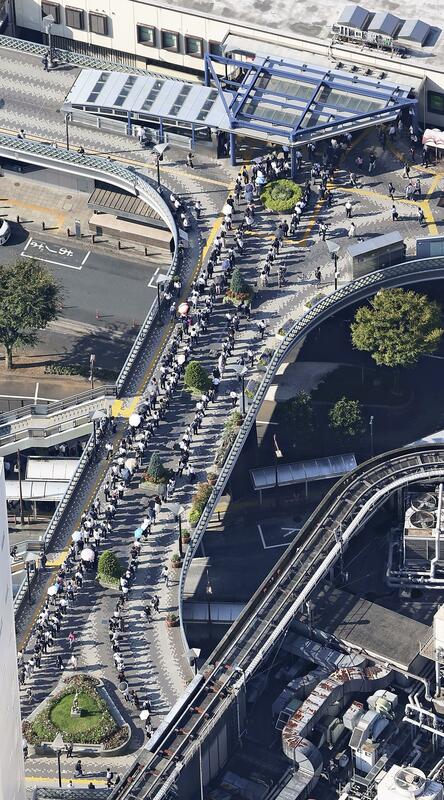
JR East said that it suspended train services on major lines in the Tokyo metropolitan area on Thursday night. Operations were gradually resumed by around 7 a.m. on Friday but at slow speed, which caused train delays. Some stations had to restrict the entry of passengers. Outside Kawaguchi Station in Saitama Prefecture, commuters including businesspeople and students formed a line of several hundred meters long. Some of them were calling their workplace over mobile phones, while others sat on the ground.
According to counting by The Yomiuri Shimbun as of 11 a.m. Friday, 14 people were injured in Chiba Prefecture, another 14 in Kanagawa Prefecture, 12 in Tokyo, 11 in Saitama Prefecture and one each in Ibaraki and Gunma prefectures.
In Adachi Ward, Tokyo, a train on the Nippori-Toneri Liner transit system derailed when it came to an emergency halt near Toneri-koen Station due to the quake, leaving three female passengers with head injuries.
In Kisarazu, Chiba Prefecture, an 81-year-old woman broke her right leg falling from her bed. In Fujimi, Saitama Prefecture, a 60-year-old woman broke her right arm after falling down stairs. In Zama, Kanagawa Prefecture, a man in his 60s suffered a cut to his head from a falling bookshelf.
According to the Cabinet Office, temporary shelters were set up in Tokyo, Kanagawa and Chiba prefectures for people unable to return home, and about 120 people stayed there.
The Health, Labor and Welfare Ministry said water leaks occurred at 26 locations in Tokyo, Chiba and Saitama prefectures due to broken water pipes.
The Land, Infrastructure, Transport and Tourism Ministry reported 28 cases of people stuck in elevators in Tokyo, Kanagawa, Saitama and Chiba prefectures, but all were rescued by Friday morning.
The Nuclear Regulation Authority said it did not find any abnormalities at nuclear power plants and facilities in areas hit by the quake.
Chief Cabinet Secretary Hirokazu Matsuno told reporters Friday morning that the central government would keep interacting with affected municipalities to gather information and would take all possible disaster management steps.
Read more from The Japan News at https://japannews.yomiuri.co.jp/