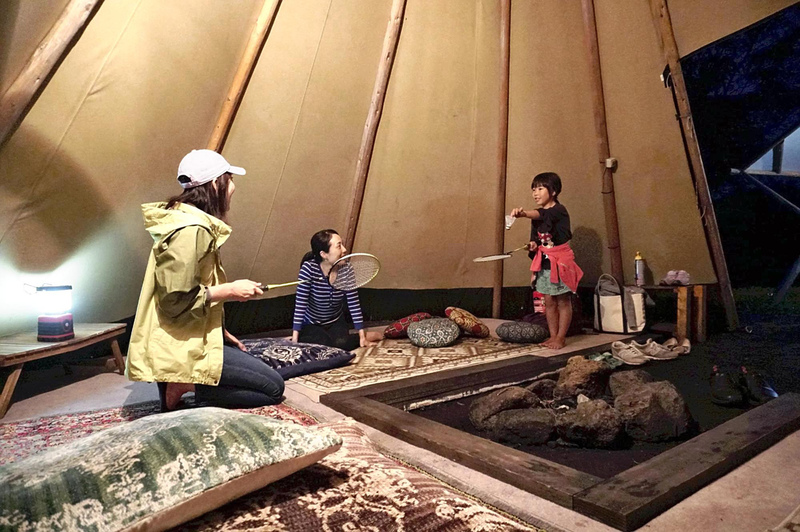
YONAGO, Tottori -- An increasing number of localities across Japan are developing facilities for luxurious camping -- recently dubbed "glamping" (see below) -- in an effort to reinvigorate their economy.
These high-end outdoor accommodations have been booming in the nation as their convenience and hotel-like services are a draw for users. The central government has also begun to study taking advantage of glamping to secure more foreign visitors.
In July, an outdoor facility named Stagex Takashima opened at Lake Biwa on a shore in Takashima, Shiga Prefecture. On the about 7-hectare site that commands a view of mountains to the west of the lake, 10 cabins and six permanent tents are scattered as overnight accommodation units. Families and other users were seen playing badminton and tossing a frisbee on a large lawn.
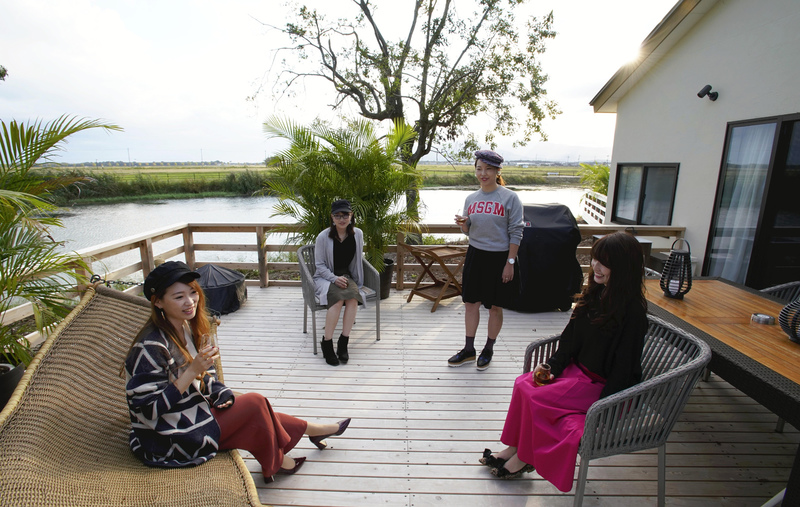
Every accommodation unit has beds and sofas. Each cabin is equipped with a bath and air conditioning. Barbecues showcase locally sourced vegetables and meat.
Sonomi Yamada, 29, from Amagasaki, Hyogo Prefecture, visited the site with four of her colleagues.
"We can enjoy a barbecue in a natural environment without making preparations in advance," she said. "It's just like holding a get-together of women at one of our homes, and it's full of fun."
The facility stands on the grounds of a former Michi no Eki roadside rest area. The city government closed down the Michi no Eki in April 2016 as the number of visitors stagnated. A real estate developer in Osaka Prefecture then refurbished the rest area into a glamping facility. Use of the facility is not cheap as the room rate for one night starts at 48,000 yen (about 430 dollars). Dinner is not included, but the facility has had almost no vacancies on weekends.
"We are able to highlight our difference from other camping sites around Lake Biwa by emphasizing our upscale tastes," said an official of the city government's tourism promotion section.
In Japan, glamping facilities mostly remodeled from existing camping sites appeared around 2010. In 2015, at the foot of Mt. Daisen in Hoki, Tottori Prefecture, FBI Daisen, a glamping facility with a cafe bar, opened and soon became a topic of conversation. A website for reserving glamping facilities was set up in March this year and 55 facilities were registered on the site as of the end of August.
In Akaiwa, Okayama Prefecture, the city spent about 75 million yen (about 668,000 dollars) to build five cottage units equipped with kitchens, toilets, showers and air conditioning at the Yoshii Ryuten automobile campsite. Rental of the facilities began in May. Heating appliances are also placed in the cottages for the winter, a season normally with fewer visitors. The city government will also consider providing locally sourced ingredients for barbecues.
In Tokyo, the metropolitan government in March invited bids for a glamping facility in the town of Okutama. On idle land of about 4,500 square meters at the foot of a mountain commanding a view over Lake Okutama, five tents were built with luxurious interiors comparable to high-end hotels. On Tokyo's Hachijojima island, a glamping experience event has also been held.
These efforts are intended to promote Tokyo's islands and western Tama region -- areas rich in nature -- to visitors from abroad with the 2020 Tokyo Olympics and Paralympics in mind.
"We want to send the message out to the world that visitors can escape the noise of the city and have a luxurious time without leaving Tokyo," said a metropolitan government official.
The Environment Ministry also set out a plan to promote glamping as part of its Visit! National Park project, a program to invite more visitors to Japan's national parks, targeting well-off people. The ministry aims to increase the number of foreign visitors to national parks to 10 million in 2020, double the number from 2015.
-- Glamping
A word combining "glamorous" and "camping." Thought to have been created in Britain around 2005, its main features are cottages and permanently established tents so users can save time and not have to bring and set up their own tents. Beds and sofas are also provided for a comfortable stay. Some sites are staffed for the preparation of barbecues or camping fires.
Read more from The Japan News at https://japannews.yomiuri.co.jp/





.jpg?w=600)