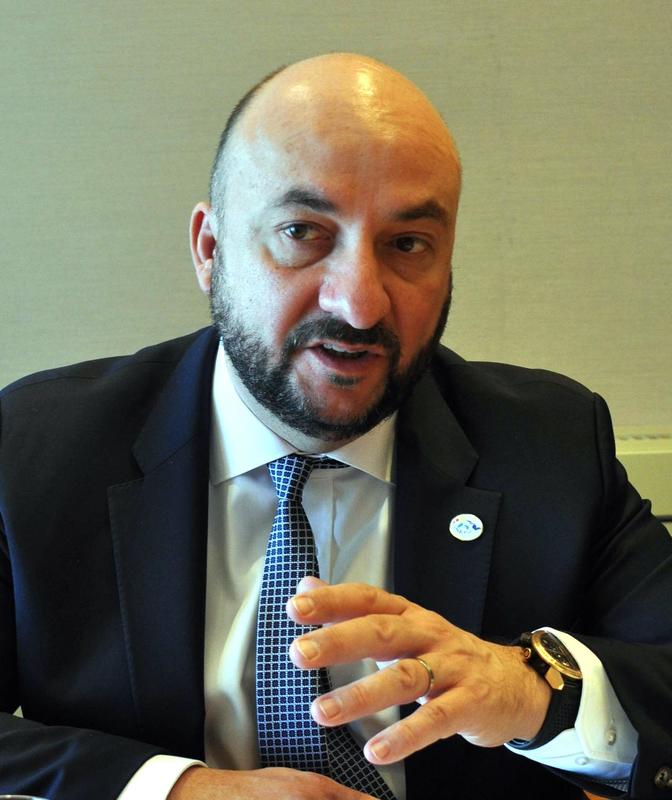
Luxembourg, a leading financial center in the European Union with about 600,000 people and the highest GDP per capita in the world, provides a unique legal and business environment for investors and companies to explore and use space resources. During his stay in Tokyo to attend the second ministerial-level International Space Exploration Forum (ISEF2), Luxembourg's Deputy Prime Minister and Economy Minister Etienne Schneider spoke with The Japan News about his nation's strategy to be a hub for the emerging space resource industry.
The following are excerpts from the interview.
The Japan News: The situation today in which private companies enter space businesses one after another is far beyond what people imagined at the time of the 1960s space treaty, so what kinds of international rules are needed?
Schneider: We should make it clear that economic or business activities in space are possible, and that the appropriation of minerals in space is possible -- that needs to be clarified. We all are doing business in space without having a legal base ... we should go one step further and find rules how companies, but also how countries, can develop their activities in space. We need regulation and that is what we put in place as well. So we have a regulator which needs to give you the agreement to go and do business in space. So we want to, as soon as we meet -- as soon as a company comes to Luxembourg and they tell us that they want to go into space in order to have activities in space, they have to get an agreement from our regulator.
Q: Luxembourg enforced a new law making it possible to explore space resources in August 2017. Do you think the business environment is proceeding for private companies to invest in space exploration without any concerns?
A: Absolutely. What was important to us is to give certainty to investors. Because if you look at these new space companies, when they need to go to the money market, they need venture capitalists. But these venture capitalists ask you one question -- are you allowed to commercialize what you find in space?
The actual international law does not -- there is no regulation about this. There is only the space treaty of '67 which says that everything belongs to humankind. If you bring stuff down from space to Earth, and it belongs to everybody, that is no business model.
We checked the United Nations' law and we made a parallel to the United Nations law in the international seas which says that a nation is not allowed to possess the international sea but you are allowed to go and fish and commercialize the fish. That is exactly what we did with space -- you are not allowed to go on an asteroid and declare that this belongs to your country, but you are allowed to go there and take resources and use them and commercialize them.
Since we decided this, there are many companies which already decided to settle down in Luxembourg. We have more than a hundred companies in the pipeline, which want to cooperate with Luxembourg to bring the activities to Luxembourg. And that is very important, that shows you that these companies, in order to develop, they need a legal framework. And the countries which go into the direction to have a legal framework will be the countries where all these activities will go to.
Q: Why has a small country like Luxembourg strongly pushed ahead with space development policy? Did your country's successful experiences of international satellite businesses influence you?
A: Small countries like Luxembourg always have to reinvent themselves. We always need to find new business models, because it is quite difficult for a small country to, let us say, have their own big industry and live on that forever. We had a very important steel industry in Europe until the 1970s and there was the big decline, and we had to find new ways in order to develop our economy. Then we decided to become a financial center, which was a great challenge as well at that time. Nobody believed in Luxembourg becoming a financial center, we had nothing to be a financial center. But everything started as well with a legal framework which we put in place in order to make it happen.
Now the Luxembourg financial center is one of the most important in the world and especially the fund industries, the second-biggest in the world nowadays. So, in the 1980s, we needed to diversify our economy to be less dependent on the financial sector. Then we developed new sectors, and one of these new sectors was the satellite business.
And there again, the government had the idea together with private investors to launch a satellite company, which was a very risky business at that time. When they had their first launch of a satellite, no insurance company wanted to give insurance on the launch, so the government gave this insurance. And this insurance the government gave was the amount of nearly 5 percent of our total annual budget for one satellite launch. So that was an enormous bet which we did as a country. But it paid out because SES is now one of the biggest commercial satellite companies in the world. Due to the presence of this company in Luxembourg, there are many other space companies which settled down in the country.
We are quite sure that all these new space economies that will happen, that will be the next frontier, that will be the next big business, and we want to be part of this. That is why we try to promote it, that is why we try to support start-ups in this business. That is why the government of Luxembourg is very much committed in order to develop this segment.
Establishing space agency
Q: What is the prospect for programs from now on?
A: I think the next important step for us is to put in place this investment fund dedicated to space business. That is what we want to realize until this summer, so that all these companies know that they do have the support of the government for their initiative. They do have the opportunity of a government which might invest into the company. They know that we have put in place the research and development aids we can give to these companies.
And they know that there will be investment funds which are focused on new space business and that is a little bit the mix of all you need in order to develop your activities in space in a successful way. So, our next step is the creation of these funds and the space agency. But the space agency is not to be compared with the normal space agencies you know, the space agency which would be only focused on the commercial use of space. Not exploration but exploitation. Exploration is very expensive ... but exploitation -- there will be a return on investment and that is what we focus on.
For sure this year, we hope to be able to do this in summer as well together with the investment fund. One which would be a public-private partnership between investment funds and the government in order to support these companies.
Q: What is Luxembourg's secret for success in such kind of activities?
A: You need the political will and determination to do so, and once you have that, you just need to put in place the needed infrastructure, be it regulatory, be it legal, be it financing. So every time we decide to develop an activity, we really fully support all these companies, and I think that this cooperation between business and the government is very important.
Of course being a small country is much easier than being a big country. That is really much easier because we are able to meet all these companies, we are able to discuss with them, and then we just decide to take the needed action. If you are a big country, your government, your ministers, they don't have the possibility to listen to all of these actors or to meet all of them, because it is just too big. And that is different in a small country. So we are very hands-on as members of government, we are very hands-on in the daily business of these companies.
Q: Are you thinking at all about discussing the issue of space debris at the United Nations level?
A: Absolutely. It is really important to us because we should not copy the same errors we did on Earth when we developed our economy over here. And then what's more, we are pushing very hard on a circular economy, and we are using everything. So space debris can be a resource as well in space. If we are talking about, for instance, 3-D printing, the material is flying around you, the material you need in order to do the 3-D printing is flying around you. You just need to collect it, to grind it and to reuse it. So there are so many opportunities about space debris. There is a danger on the one side because all the hits it can have with, for instance, satellites, but on the other side, it's a valuable resource which is flying around us. We should make an opportunity out of this problem. We already addressed this question on the international level and we hope that we will find a regulation about that so that every country will be responsible for the debris it has or it produces in space.
Q: The ISEF2 took place in Tokyo. What do you think about meetings like ISEF2?
A: I think first of all that this meeting is very important because it shows that more and more countries are interested in space exploration, space utilization. Because until now, I had many discussions with scientists, which were talking about the opportunities which are there in space, but what they need in order to proceed is the political support.
Q: Last year, Luxembourg and Japan concluded a memorandum of understanding about space development. What role do you expect the Japanese government to play? What do you expect from Japanese companies in contributing to space development?
A: I think when we did the analysis about what is happening worldwide, we saw that Japan is a very, very important spacefaring nation, that you have a huge knowledge about space and about the technology needed in order to develop what we want to develop as well. So, I was very much pleased that we've been able during the state visit to sign this agreement together with your country and to get the support of your government as well in order to collaborate together.
So the collaboration not only with JAXA but also the direct collaboration with the government is important. Why? because we need more countries where the political decision makers share the same ideas in order to make things happen, in order to make regulation change and to make regulation fit with the activities we want to develop.
(This interview was conducted by Japan News Staff Writer Etsuo Kono.)
-- Etienne Schneider
Deputy Prime Minister and Economy Minister of Luxembourg
Schneider joined the government in 2012 as minister of the economy and foreign trade. Following the legislative elections of October 2013, Schneider was appointed deputy prime minister and minister of the economy in December that year. He was born in 1971 in Dudelange, Luxembourg.
Read more from The Japan News at https://japannews.yomiuri.co.jp/