The ancient human ancestor, named “Lucy”, who roamed the planet more than three million years ago, may have died after falling from a tree, scientists in the US have suggested.
A high resolution X-ray CT (computed tomography) study of the female hominid, indicates she suffered fractures to her right humerus - not typically seen on fossils - with compressive fractures observed throughout the skeleton, researchers said on Monday.
The injuries were consistent with those "caused by a fall from considerable height when the conscious victim stretched out an arm in an attempt to break the fall," John Kappelman, a University of Texas anthropology and geological sciences professor who led the study, said.
"This compressive fracture results when the hand hits the ground during a fall, impacting the elements of the shoulder against one another to create a unique signature on the humerus," he added.
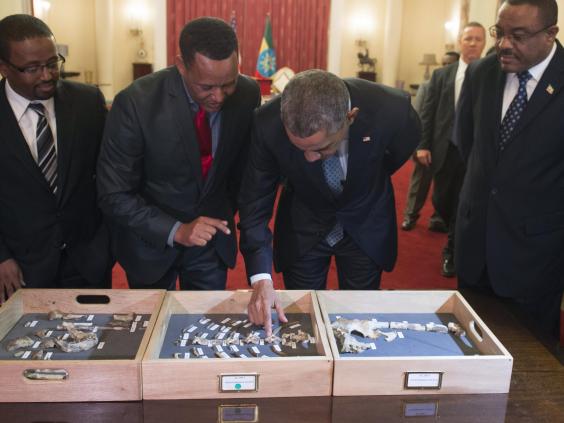
Dr Kappelman said the scan revealed multiple broken bones but no signs of healing, suggesting the injures occurred around the time of death.
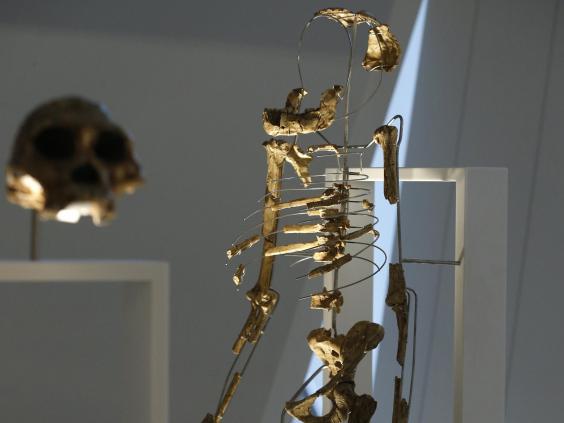
Lucy’s well-preserved fossil remains were unearthed in the Afar regions of Ethiopia in 1974. The find was significant as it allowed scientists to establish that ancient human ancestors walked upright before evolving a large brain.
Lucy was a member of Australopithecus afarensis - an early human species that lived in Africa between four million and three million years ago.
The earliest humans, like Lucy, walked upright and used their long arms to climb trees. Lucy is believed to have been a young adult when she died.
University of Texas researchers, including Dr Kappelman, completed the first high resolution CT scan of Lucy in 2009 when the fossil toured the US.
The study resulted in 35,000 CT electronic slices, which were then studied by university researchers.
Dr Kappelman's study, published in the journal Nature, also offers a recreation of Lucy's death, which speculates that 3-foot-6-inch tall Lucy fell from a height of at least 40 feet and hit the ground at 35 mph.
He believes she landed on her feet before twisting and falling, while fractures on her upper arms suggest she attempted to break he fall, he said.
Some scientists have discredited the theory attributing the cracks in her skeleton, which have been well documented, to the fossilisation process and natural forces, such as erosion.
Tim White, a paleoanthropologist at the University of California, Berkeley, called the study's conclusion a "misdiagnosis".
The Texas researchers "appear to have focused only on the cracks that they could attribute to an imagined fall, ignoring the additional abundant cracks," he told the Associated Press in an email.
For Dr Kappelman, however, the discovery has humanised the small, partially complete skeleton.
"When the extent of Lucy's multiple injuries first came into focus, her image popped into my mind's eye, and I felt a jump of empathy across time and space," Dr Kappelman said.
"Lucy was no longer simply a box of bones but in death became a real individual: a small, broken body lying helpless at the bottom of a tree."
Additional reporting by agencies