
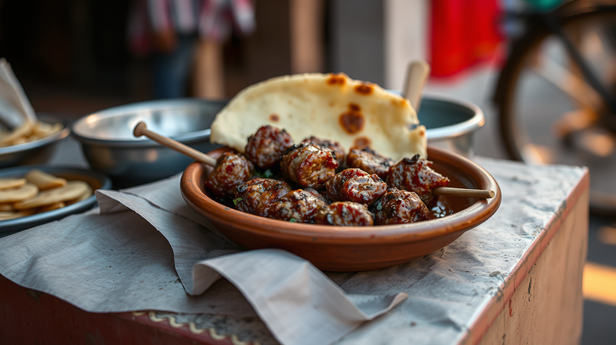
The Galouti Tells You Everything Before You Take a Seat
The galouti kebab was invented for a Nawab who had lost his teeth. That is not a legend, it is a design brief. The cooks of the Awadhi court in the 18th century ground meat so fine, with so many spices folded in so many stages, that the kebab dissolved before it needed to be chewed. What came out of that constraint was not a compromise. It was one of the most precise bites in Indian food. You find it at Tunday Kababi near Akbari Gate, where the recipe has not been written down and the masala count sits somewhere above 100 ingredients. You eat it on a small plate with a torn piece of roomali roti and you understand, in about four seconds, why Lucknow cannot be an afterthought on a Rajasthan loop or a quick detour off a Delhi-Varanasi train. The city's food did not grow out of abundance. It grew out of obsession.
Nawabi Restraint Is a Cooking Philosophy, Not a Style
The word Nawabi gets applied loosely, to anything ornate, to any dish with a cream finish, to hotel buffets that want to sound regal. In Lucknow it means something exact. The Awadhi kitchen ran on dum, the technique of sealing a pot with dough and letting heat work slowly from below and above. No stirring. No tasting mid-cook. The cook had to know the dish before it was done. That kind of confidence only comes from generations of repetition inside a court that rewarded subtlety over spectacle. The biryani that comes out of this tradition, specifically the Lucknowi biryani, which is lighter than the Hyderabadi version and cooked with the meat and rice in separate layers, is not trying to overwhelm you. It is trying to be noticed slowly. Visitors who arrive expecting the punchy, red-oil heat of other regional cuisines sometimes feel, on the first bite, that something is missing. What is missing is aggression. The dish is not aggressive. Give it a few minutes and a second helping, and the spicing opens up like a room you walked into too fast.
The Streets Run on a Different Clock
Lucknow's food city does not fully wake up until late morning, and it does not stop until well past midnight. The breakfast culture alone justifies a separate trip. Nihari, slow-cooked mutton shank in a bone marrow broth, is a morning dish here, eaten with kulcha at places like Idris ki Nihari in the old city, which opens before most people have had their chai. The logic of eating nihari at 8 a.m. sounds strange until you understand that it was originally a post-Fajr meal for the Nawab's household, something warming and dense after the early prayer. The street food does not follow a tourist schedule. It follows a city schedule. If you are in Lucknow on a tight itinerary, one night, a morning train out, you will miss the nihari, you will miss the late-night sheermal at Wahid's, and you will leave thinking you have been to Lucknow when you have only passed through it.
Chikankari and Chai Are Not the Point, But They Are Part of It
A food trip to Lucknow is not only eating. The city's identity is layered in a way that makes the food make more sense when you walk the lanes of Chowk between meals. The embroidery shops, the attar sellers, the crumbling havelis, they are the same culture that produced a court cuisine built on patience and detail. Chikankari embroidery is Lucknow's other great export, and the same hand that pulls a needle through 40 counts of fabric for six hours to produce a single motif is the same sensibility that put 100 spices into a kebab for a toothless Nawab. The aesthetic is consistent. Walking Hazratganj in the evening, stopping at a mithai shop for makkhan malai, a seasonal winter sweet made of whipped cream and morning dew that dissolves before you finish looking at it, you are not doing tourism. You are tasting a city's self-understanding.
Why the Separate Trip Is Not Optional
Most Indian food travel happens inside larger itineraries. You eat well in Jaipur on the way to Jodhpur. You try the chaat in Varanasi between the ghats and the temples. The food is good. But Lucknow's culinary identity is too internally coherent to absorb on the side. The Awadhi kitchen has a logic, the dum technique, the Nawabi restraint, the morning nihari, the late-night sheermal, the galouti as a design solution, and that logic only becomes legible when you have time to follow it from one meal to the next. A single day gives you impressions. Three days gives you the argument. The city is not performing for you. It is doing what it has always done, at its own pace, for its own reasons. You either show up ready to follow, or you miss what it is actually saying.
The galouti was built for someone who could no longer eat the way he used to. The city that invented it never stopped refining the recipe. That is the thing about Lucknow's food, it was never made for the passing visitor. It was made for someone who intended to stay.