Humour, a brave but often deadly word when attached to classical music, was the theme of this year’s Lucerne festival. Alongside the properly solemn masterpieces from the canon there were performances of several works usually regarded as amusing, including Saint-Saëns’s The Carnival of the Animals, Hindemith’s parody overture to Wagner’s The Flying Dutchman and Britten’s Albert Herring. You have to be attuned to the genre to be sure to get the wit. Take Richard Strauss’s tone poems: how to tell when a heavy brass chorale is not a funeral march but in fact a rib-tickling Teutonic joke?
Lucerne has other reasons to be cheerful. Bereft following the death of Claudio Abbado last year, the festival has appointed Riccardo Chailly as successor to conduct the world-class Lucerne Festival Orchestra, made up of top international players who come together especially each year. (Chailly, also in charge at La Scala Milan, will step down early from his Leipzig Gewandhaus post next year.) There are, too, plans to build an opera house in the lakeside city, which will be determined by a local referendum. (Will London do the same for its proposed new concert hall?)
Perversely I attended two events that prompted different degrees of sorrow. Symphony orchestras on summer tour – the Vienna Phil, the West-Eastern Divan, the Boston Symphony – have moved around the big European festivals these past weeks, hopping from the BBC Proms to Salzburg to Lucerne and elsewhere. The SWR Symphony Orchestra Baden-Baden and Freiburg gave an acclaimed Prom last month and repeated their success with a Lucerne date in the handsome, white KKL concert hall where the famously excellent acoustics (by Russell Johnson) rather outshine those of the Albert Hall.
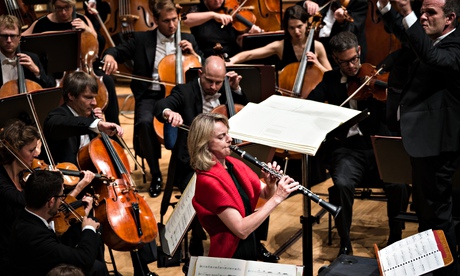
The only change from the Prom programme was that Boulez’s … explosante-fixe was replaced by the world premiere of a clarinet concerto by the Budapest-born Márton Illés (b1975). Written for the virtuoso player Sabine Meyer and entitled Re-akvarell, the work astonishes in its restless, bubbling originality and its multiple layers of different textures shaded in a dense aural cross-hatching. The close of the middle movement, to take one instance, has the entire orchestra fluttering like a whirr of distant insects, with the clarinet rising out in a ghostly clatter. Written for huge orchestra, with piano, accordion, harp and three percussionists, it revels in what Illés calls “marvellous multiphonics, squeals, overtones and undertones”. Closing in melancholy mood, it ends with a slow Hungarian dance traditionally played at the end of a ball when only a few couples are left on the dance floor. Illes’s piece alone was worth the journey.
After an invigorating account of Bartók’s Concerto for Orchestra, SWR’s music director François-Xavier Roth returned to the stage. This, he said with emotion, was the orchestra’s last visit to the Lucerne festival – as it had been, too, to the Proms. At the end of the coming season, owing to funding cuts, this outstanding orchestra, especially skilled at playing contemporary music, will disband and be merged, along with the Stuttgart Radio Symphony Orchestra, into a single SWR Orchestra. So two radio orchestras become one. Musicians lose their jobs. Natural wastage, that terrible expression, will prove unnatural and painful. After a tender Schubert encore, the audience left the hall in silence, visibly moved, as if a death had been announced in the middle of a party. For anyone concerned about the future of the BBC orchestras, this was a circumstance we never want to face.
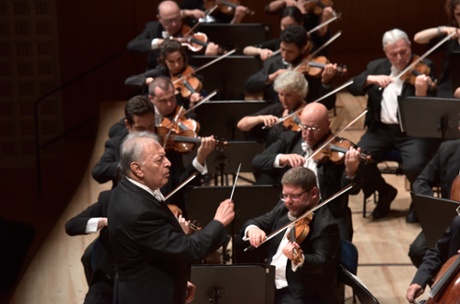
The Israel Philharmonic Orchestra, also in Lucerne last week, is on a 15-concert tour of nine European countries. This schedule does not include a trip to the BBC Proms. Their last appearance, in 2011, prompted disruptive protests. By tacit agreement no one has rushed to repeat the experience. A senior member of the Proms team told me that the IPO had neither suggested a concert nor been refused one. In Lucerne there was no fuss and no visible security. The IPO’s music director for life, Zubin Mehta, conducted Tchaikovsky’s “Pathétique”. If it was hardly the most searing or impeccable account, it had a moving, world-weary depth of feeling. This may or may not have been because it was the fifth time the musicians had played it in little more than a week, a downside of orchestral tours.
Founded in 1936 as the Palestine Orchestra with 75 Jewish musicians from European orchestras, this month the Israel Philharmonic embarks on its 80th season. The political turmoil of the region provides the inevitable backdrop to its history, as recounted on the orchestra’s website and worth reading. If in recent years it has sounded whiskery, the IPO is making efforts at renewal. Some 40% of players have retired in the past five years. New principal posts (for bass and oboe) are currently advertised. The original journeying from eastern Europe to Israel and then, for some, to America is starting to happen in reverse. A new young Connecticut-born leader, David Radzynski, 28, is part of that pattern. His European-born father, a composer, fought in the six-day war in 1967 then went to the States in search of a job. For his son, Israel is now his newly adopted country, his place of work. The orchestra includes the following thought-provoking sentence on its website: “The IPO also contributes to the absorption of new immigrants and includes in its ranks many new immigrant musicians.”
Mehta, 79, deserved his own cheer. Having just had an operation, he was in a wheelchair, with ice on his knee in the time leading up to and straight after the concert. Yet he walked, albeit slowly and with extreme care, on to the platform as required, with no limp, and stood to conduct, from memory. It was impossible not to think, too, of his lifelong friend and colleague Daniel Barenboim, who once jokingly attributed their close kinship to the fact that neither he nor the Indian-born Mehta were Europeans. Last week the Iranian authorities barred Barenboim from conducting the Berlin Staatskapelle in Tehran because of his Israeli citizenship (he also holds Palestinian and Argentinian citizenship). The freighted relationship between music and politics cast a long shadow, even in the bright Swiss sunlight.
- This article was amended on Monday 7 September. An editing error turned clarinettist Sabine Meyer into an oboe player. And Daniel Barenboim was barred from conducting the Berlin Staatskapelle in Tehran, not the Berlin Philharmonic.