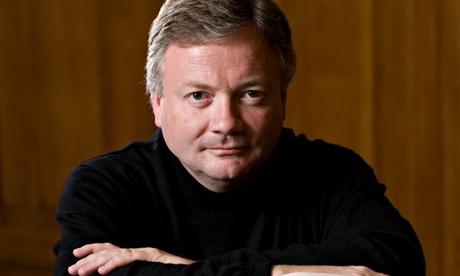
This winter’s flu, it would seem, is still very much with us. Donald Runnicles succumbed to it shortly before he was scheduled to conduct the London Symphony Orchestra and Chorus in a pair of French choral works, Debussy’s La Damoiselle Elue and Duruflé’s Requiem, separated by Debussy’s La Mer. His replacement was David Hill, best known for his work with the BBC Singers and the Bach Choir. Fauré’s Pelléas et Mélisande was substituted for La Mer; the choral works went ahead as planned.
Fauré is often cited as a major influence on Duruflé, though the latter is in fact more indebted to Debussy, in particular his deployment of modal harmonies and the melodic contours of plainchant in his treatment of religious subjects. Debussy’s sensuality, though, is poles apart from Duruflé’s austerity, and La Damoiselle Elue, a setting of Rossetti’s The Blessed Damozel, characteristically elides religion with transgression, as the Damozel, unhappy in heaven, yearns erotically for the lover she has left behind on earth. Nicole Cabell brought operatic intensity to her big central solo, in sharp contrast to Kelley O’Connor’s dispassionate, if tentative, Narrator and the aloof choral calm.
Written in Vichy France, but not performed until 1947, when it assumed iconic status as a memorial to the fallen in the second world war, Duruflé’s Requiem is at once an acquired taste and difficult for its performers. Steady rhythms are offset with continuous metrical irregularity. It can easily sound forced, though Hill allowed it to evolve naturally and with great ritual solemnity. The majestic choral singing was first rate and wonderfully majestic. O’Connor struck form in the Pie Jesu. Duncan Rock was the noble, hieratic baritone. Fauré’s Pelléas, meanwhile, beautifully shaped and textured, reminded us what a fine piece it is, and that we hear it all too infrequently.