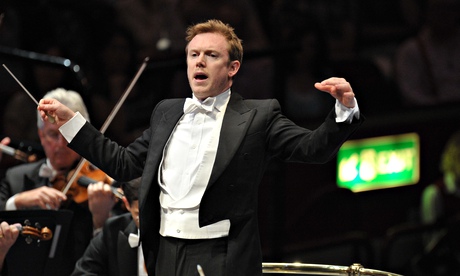
Daniel Harding is very much a thinking conductor. He takes a considered view of a piece and he doesn’t do routine, both of which are all to the good. So there was plenty to grapple with in his take on the complex music-drama of Mahler’s Ninth Symphony with the London Symphony Orchestra. The question is how far it all added up.
Harding’s approach to the opening andante took some time to reveal its hand. A refusal to linger over orchestral detail signified a broadly conceived interpretation that generally seemed set on holding at bay the morbidity that often surrounds Mahler’s last completed symphony. The dialogue between the flute and the horn in the shadowy recapitulation section embodied this, its beauties trumping its spookiness.
The ländler second movement underlined the affirmative worldliness of the approach, which was full of an almost carefree brio and elan. This was not, Harding seemed determined to assert, the music of a man whose life was closing in on him. There was even more of that take in the darker rondo-burlesque third movement, fabulously played by the LSO, where the manic defiance had tremendous life and spirit, suggestive of Mahler’s New York rather than his Vienna, and Harding taking the final pages very very fast indeed.
The problem with Harding’s death-defying interpretation of the symphony is that it has to be reconciled with the long adagio with which it ends. This is not impossible, and Harding certainly nurtured the big affirmative outburst before the descent into the coda. Yet that coda – infinitely gentle, spare, and fading away to nothing – is not to be denied. The violas were allowed to give a little push to their final pulsing phrase. But, albeit by this unusually life-affirming route, we had still reached the sense of void which is this symphony’s uniquely powerful conclusion.