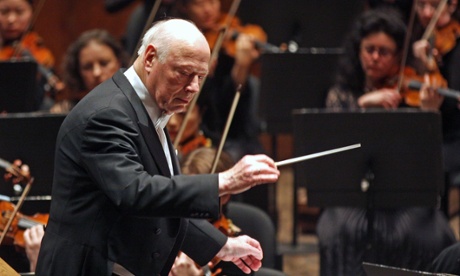
When Bernard Haitink gave his downbeat to the London Symphony Orchestra, it was as though he had cast an instant spell. There was no visible demand for the subtle dynamics and impeccably modulated tempi that flowed from the LSO players for the next two hours in music by Mozart and Mahler. But when this conductor and this orchestra get together, the high-level musical organisation seems instant and profound in a way that few can rival.
Haitink chose Mozart’s G major violin concerto, K216 for this concert, and Alina Ibragimova paid him the compliment of learning the piece for the occasion. The performance had Haitink’s restrained imprint on it from the very start, but Ibragimova brought characterful attentiveness to every bar of the opening allegro. The adagio was spun out in a long lovely line by conductor and soloist, and Ibragimova gave a very personal quietness and depth to the brief, introspective cadenza.
Perhaps some classical statto can say whether Haitink has conducted more performances of Mahler’s first symphony – including the first recording of it in my LP collection as a student – than any other living conductor. It is a fair bet that he has. As Haitink has aged, his Mahler has more firmly resisted the neurotic side of the composer’s music in favour of its balance, colour and unity. This approach was particularly striking in this older man’s reading of a younger man’s symphony. It was perfectly realised in the deftly controlled opening bars, in which the little wind phrases blossomed rather than exploded out of the long open A across seven octaves in the strings, with everything moving forward, not held back in suspense. And it was still there as Haitink marshalled order out of the turbulence when those opening phrases returned in glory at the close.