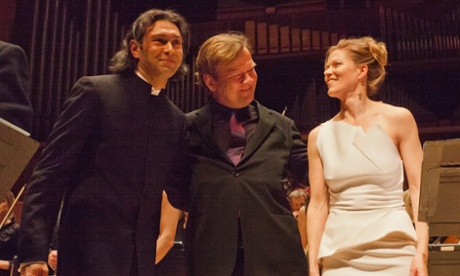
Vocal works of any kind are scarce in Magnus Lindberg’s 30-year output, and those involving a solo voice are rarer still. So Accused, for soprano and orchestra, whose premiere launched Lindberg’s residency with the London Philharmonic, is very much a new departure. Composed as a star vehicle for the phenomenal Barbara Hannigan, it carries the subtitle “Three Interrogations”, which certainly signals what Accused is not – a straightforward orchestral song cycle – but doesn’t explain what Lindberg really intends his half-hour score to be, though it was hard to be sure he really knows himself what he has written.
The texts – records of interrogations taken from three very different historical epochs, in French, German and English – certainly have dramatic potential. The first is an extract from the questioning of a woman imprisoned during the French revolution, the second a Stasi interview from East Germany in the 1970s of someone (gender unknown) found reading a copy of the West German magazine Der Spiegel, while the third comes from the apparently inconsequential cross-examination of one of the witnesses in the trial of Bradley (now Chelsea) Manning in 2013.
In these exchanges, the soprano is both the accused and the accuser; the orchestra is “the court”. But one of the problems with Lindberg’s vocal setting is that it does not distinguish between the two roles. Much of the orchestral writing, which is certainly not atonal, but not quite tonal either, and uses a quote from De Falla’s ballet El Amor Brujo as an unexplained recurrent motif, is generalised mid-Atlantic rhetoric, too. Though she handles the coloratura writing, especially in the Manning section with her usual nonchalant, silvery ease, Hannigan’s dramatic gifts are never exploited; the political dimension of the work is never articulated either. Alongside Debussy’s Prélude à l’Après-Midi, Wagner’s Tristan Prelude and Scriabin’s Poem of Ecstasy, all kept at a distance and distinctly on the cool side by Vladimir Jurowski, a sense of “so what?” when Lindberg’s piece ended was hard to avoid.