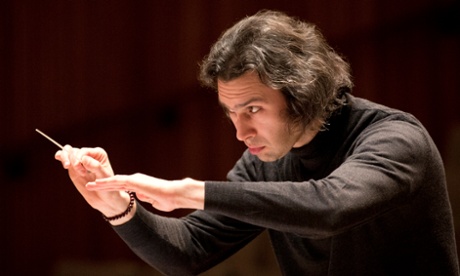
There was just a single work in the first concert of the London Philharmonic’s new season at the Royal Festival Hall, but it was an unmistakable statement of intent. Vladimir Jurowski may not have paraded his credentials as a Mahler conductor very obviously in his eight seasons so far with the LPO, but no one takes on the Seventh Symphony unless they are seriously committed to the cause, and to understanding the whole of Mahler’s achievement.
It’s easy to understand why Jurowski may be so fascinated by the Seventh, a work that provides the clearest connection between Mahler and the expressionist world of the Second Viennese School, music that he conducts so well. There was lots about his take on the Seventh that seemed deliberately designed to emphasise those connections, too, often at the expense of some of the music’s other qualities, such as irony, charm and affection. Discontinuities seemed to be emphasised; textures were kept as lean as possible.
From the tenor horn solo with which the symphony opens to the blaze of brass and percussion with which it ends, everything was immaculately played by the LPO. But nothing cohered, and Jurowski’s approach, his refusal to find compromises in music that leaves so much exposed and unresolved, did not help matters. Even the opening, with its primeval stirrings, lacked mystery and magic, and the main allegro, when it arrived, was kept severe and unsmiling.
In another context, the curt treatment of the central scherzo and the Nachtmusik movements on either side of it might have been effective, but neither the opening movement nor the always problematic finale, with its frieze-like procession of ideas that veer from banality to transcendence, was made convincing enough to create that context. The whole symphony seemed like a work-in-progress, a canvas on which the paint was still wet and some areas were left blank.