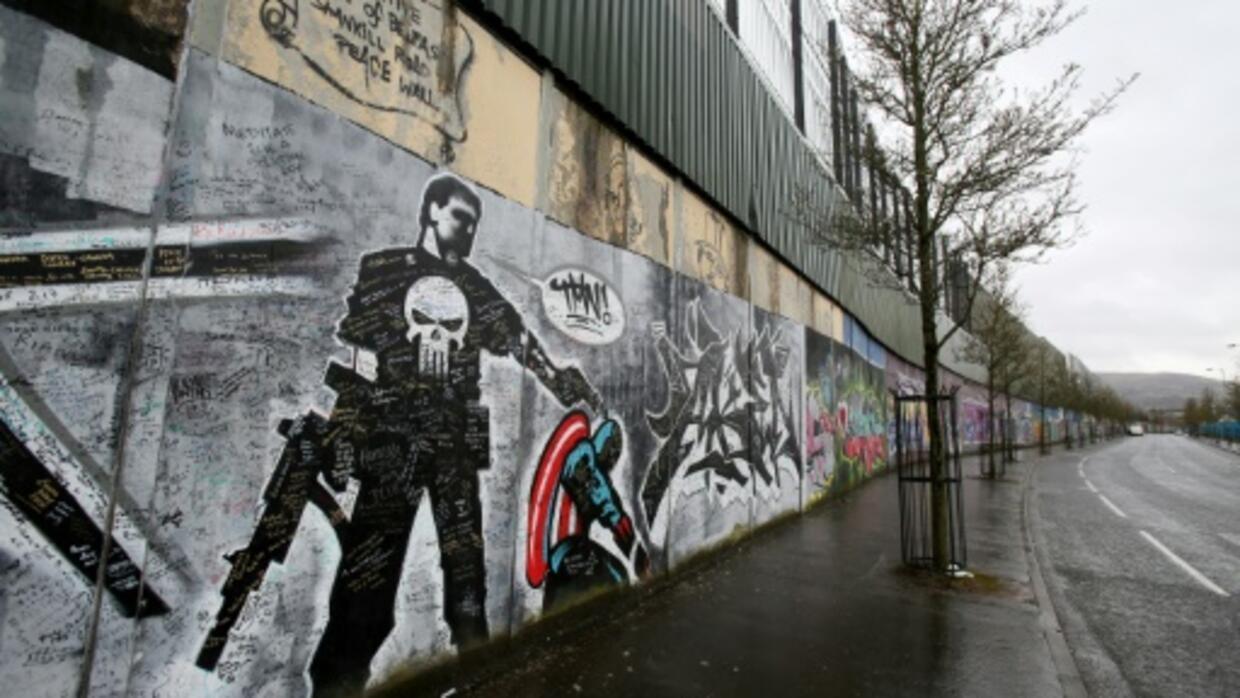
The groups say they are not planning a return to violence, but the announcement underscores rising tensions over the trade deal agreed between Britain and the European Union days before the UK made an economic split from the 27-nation bloc on 31 December.
The Loyalist Communities Council, which represents several banned paramilitary groupings, said in a letter to Prime Minister Boris Johnson that the new trade rules undermined the basis of Northern Ireland’s 1998 Good Friday accord, and they would no longer support it until there was “unfettered access for goods, services, and citizens throughout the United Kingdom.”
The letter said opposition to the measures would remain “peaceful and democratic.”
Jeffrey Donaldson, a lawmaker with Northern Ireland’s Democratic Unionist Party (DUP,) said Thursday that there was “no sense that loyalist paramilitaries were going to revert to violence in opposition to the Northern Ireland Protocol.”
DUP MP Sir Jeffrey Donaldson says unionist support for the Good Friday agreement is "diminishing rapidly".https://t.co/H6YWLOKV8S pic.twitter.com/yblzlmsNHx
— Belfast Telegraph (@BelTel) March 4, 2021
The UK-EU trade deal establishes tariff- and quota-free exchange of goods but sets up veterinary and customs checks and other obstacles to the previously seamless commerce between Britain and the bloc. Contentiously, it also imposes new checks on some trade between Northern Ireland and the rest of the UK.
Northern Ireland has special status because it shares a border with EU member state Ireland. An open Irish border has helped underpin the peace process built on the Good Friday accord, which ended decades of violence involving Irish republicans, British loyalists and UK armed forces, in which more than 3,000 people died.
But the new checks have unsettled the delicate political balance in Northern Ireland, a part of the UK where some people identify as British and some as Irish. They are opposed by pro-British Unionists, who say they drive a wedge between Northern Ireland and the rest of the UK.
Northern Ireland authorities temporarily halted veterinary checks and withdrew border staff from ports last month after threatening graffiti appeared referring to port workers as targets.
Northern Ireland businesses, meanwhile, say they are struggling to cope with the new red tape. To ease the burden, Britain announced Wednesday it was unilaterally extending until October a temporary “grace period” waiving checks on agri-food goods entering Northern Ireland. It had been due to end March 31.
That drew a rebuke from the European Commission Vice President Maros Šefčovič, joint head of a UK-EU committee on Northern Ireland, who said it was “a violation” of the legally binding Brexit divorce agreement.
“This also constitutes a clear departure from the constructive approach that has prevailed up until now,” he said in a statement.
I'll be speaking to @DavidGHFrost tonight on the implementation of 🇪🇺🇬🇧agreements. I'll be raising our strong concerns on the respect of the IE/NI Protocol, following today's announcements.
— Maroš Šefčovič🇪🇺 (@MarosSefcovic) March 3, 2021
As ever, we remain firm on our political and legal obligations.https://t.co/iKgNEaWdeM
The British government insisted it was merely taking “temporary technical steps … to provide more time for businesses such as supermarkets and parcel operators to adapt to and implement the new requirements.”
But Irish Foreign Minister Simon Coveney said the UK’s behavior showed the EU was dealing with a partner “that they simply cannot trust.”
(With AP)