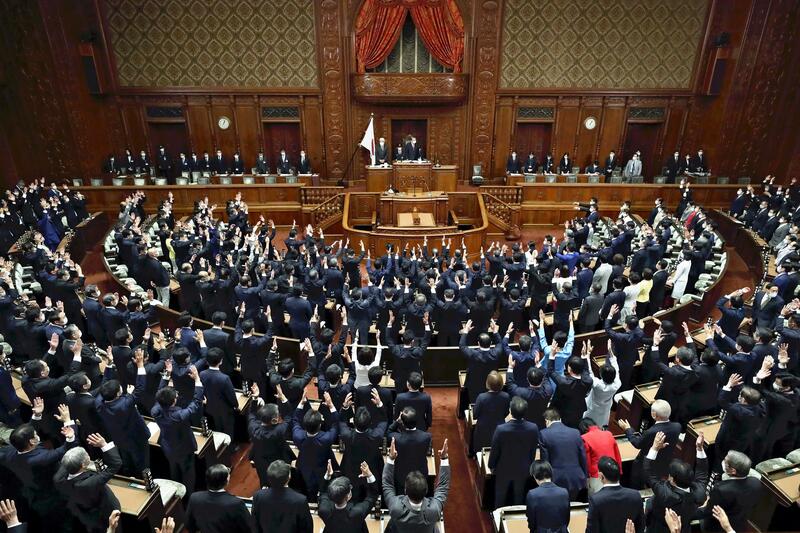
The House of Representatives was dissolved Thursday, paving the way for a general election.
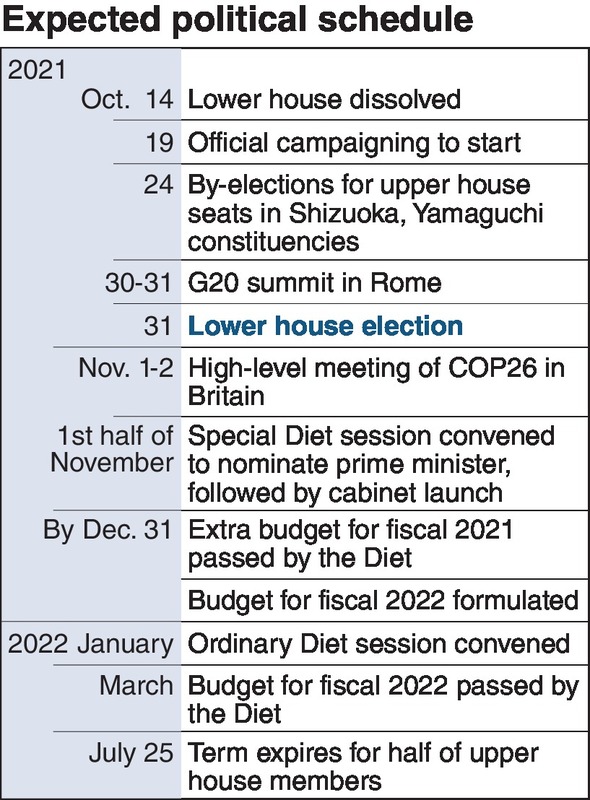
After the dissolution, the government held an extraordinary Cabinet meeting where it officially approved holding the election on Oct. 31, with official campaigning to kick off on Tuesday. There will be only 17 days from the dissolution to the election, the shortest such period of time since the end of World War II.
The election battle between the ruling and opposition parties has effectively begun, focusing on issues such as the novel coronavirus and economic policies.
The government approved the dissolution of the lower house at an earlier Cabinet meeting on Thursday morning. Prime Minister Fumio Kishida sought the dissolution, and all the Cabinet members signed a document approving it.
After an Imperial rescript for the dissolution was signed and sealed by the Emperor, lower house Speaker Tadamori Oshima read out the rescript to officially dissolve the chamber during a plenary session that began at 1 p.m.
The dissolution came 10 days after Kishida launched his Cabinet, another postwar record for swiftness.
The upcoming lower house election will be held for the first time in four years since October 2017, when former Prime Minister Shinzo Abe was in office. It will also be the first time under the current Constitution for a lower house election to be held after the term for lower house members expires. The members' term ends next Thursday.
In addition, this will be he first major national election since the novel coronavirus pandemic began.
The lower house has a total of 465 seats, which consists of 289 seats in single-seat constituencies and 176 in proportional representation blocs. Prior to the dissolution, the ruling coalition had 305 seats in the chamber with the Liberal Democratic Party holding 276 and Komeito with 29.
When assuming the LDP presidency in September, Kishida set a goal for the ruling coalition to secure a majority in the chamber, which would constitute at least 233 seats.
The current Constitutional Democratic Party of Japan, the largest opposition party, was created in September last year through the merger of groups including the party of the same name and part of the Democratic Party for the People. The CDPJ held 110 seats before the dissolution.
For the upcoming election, the CDPJ has coordinated with other opposition parties including the Japanese Communist Party and the remainder of the Democratic Party for the People to jointly support a single candidate in more than 200 out of the 289 single-seat constituencies.
The upcoming election is likely to give voters the choice between a government led by the ruling coalition or by the opposition parties centering on the CDPJ.
"I greet today with a very solemn heart," Kishida told reporters at the Prime Minister's Office on Thursday morning. "Through the election, I want to make a firm appeal to the people about what we are trying to do and what we are aiming for."
"I've had a very intense schedule for the past 11 days [since I became prime minister on Oct. 4]. But strangely enough, I don't feel tired. I feel fulfilled," he said.
Read more from The Japan News at https://japannews.yomiuri.co.jp/