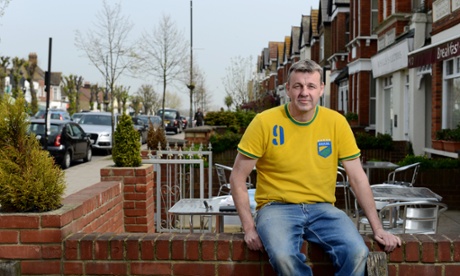
The lunchtime rush at the Chingford takeaway has subsided, and 25-year-old fast-food worker Saif comes out to chat. “He can talk for England,” prods one of his friends and, sure enough, Saif has no shortage of opinions. He says the workers of Britain need a pay rise. “It’s not gone up,” he says. “But the cost of things have gone up, so it’s a struggle.”
This is a Tory stronghold, the kingdom of Iain Duncan Smith. At the last election, the secretary of state for work and pensions won a decisive 52.8% of the vote in Chingford and Woodford Green, a near-13,000 majority over his Labour competitor. But Tory England is not all booming, leafy suburbia. Work is the route out of poverty, says the coalition, and yet according to a study by the TUC, Duncan Smith’s constituency in north-east London has the fifth highest proportion of low-paid workers in Britain. Nearly half of its workers are paid less than a living wage, a far worse record than even communities scarred by deindustrialisation, such as the Rhondda Valley, the TUC says.
Saif, who won’t vote for the Conservatives, scoffs at the idea work is an automatic route out of poverty. “It’s not true. Firstly there’s not enough jobs. Everyone wants jobs, so many young people are on the street, taking drugs, because they can’t get a job. And for people in work, you often can’t pay the bills. It’s hard to live off your wage.”

Politicians, he believes, don’t represent people like him. “They stand up for the high ranking, not for people like us, the middle-class people,” he protests. “They never come and look after people working in Sainsbury’s and Tesco.” He wants a “new government representing the middle-class people” like him. “There’s only a few people up there, but the majority is us people,” he says. He has his own manifesto: “We need a pay rise and more opportunities for new young people to get jobs, lower university fees so we can get more educated people.”
Like most voters in the constituency, 49-year-old Tony – a postman for 28 years – voted for Duncan Smith last time. “Personally I’m not into politics, I’ve not got time to watch it,” he tells me. His reasons rest more on family tradition than anything else. “I was just following the sheep; family and that, that’s the only reason,” he says.
He tells a familiar story of wages that seem to cover less and less: “I think it has got worse, gradually, you just notice more and more.” But that’s not his number one priority. Tabloid stories focusing on unsympathetic examples of benefit claimants have clearly made an impact. “We need to sort out the benefits system – that’s definitely my top one,” he says. “There’s people just getting way too much. You read about it in the press all the time, it just depresses you, the horror stories about people going on holiday and buying this TV and buying this car.”
Not that his vote is necessarily a foregone conclusion. “Ed Miliband? Could give him a go. It’s all you can do, isn’t it?”

The story of falling living standards is as familiar in Duncan Smith’s backyard as it is anywhere else. Jerry will soon turn 50, and is coming to the end of his career as a firefighter at Chingford station. He perches outside a pub: the “pubs are OK, don’t mind the drinking in the pubs, not this end mind, down the working-class end”. North Chingford is “very nice and very expensive”, he tells me.
Originally from Islington, Jerry resents being unable to afford to live where he grew up. “It’s becoming like Paris, with workers living on the outside where they can fit in,” he complains. “London’s become a city of gastropubs. That’s what annoys me the most. I can’t live where I want to live.
“It really hit me hard, to be honest. We haven’t had a pay rise for three, if not four, years.” He’ll vote Labour – though with something of a heavy heart, as the “lesser of two evils” – but why is Chingford and Woodford Green such a safe Tory seat? “Working-class people who’ve moved out here, they’ve got money, they think they should vote Tory. I think they’ve been hoodwinked by the Thatcher years – it seems to be when you’ve got money, you’ve got to vote Tory, you forget where you came from.”
When Nicola Sturgeon, the SNP leader, made an explosive impact in the leaders’ debate, one of the most popular searches on Google was from English voters asking if they could vote for her party. Billy Lyons, 26, is among those who would vote SNP if he could: Welsh-bred and now living in Woodford, he graduated from drama school two years ago. He is part of Britain’s growing army of zero-hours contract workers.

For a long time, he worked at a call centre in Canary Wharf where, he says, the employer, not the workers, benefited from the zero-hours contract. He describes it as a minimum-wage job with unrealistic targets: those who failed to meet the targets were often sent home by lunchtime. After travel costs, they “may as well have not worked”. Workers were left in tears, panicking about how they could pay London’s often extortionate rents, he tells me.
Rachel, 32, hasn’t registered to vote: a businesswoman who runs her own landlord services company, she would vote for Russell Brand if she could. “I went to school here, grew up here,” she says. “It used to be OK when I lived here as a kid, but got a bit rough. It’s all the new bars, people are a bit rowdy, like any place.” She is not surprised the constituency has so many low-paid workers. “Everyone’s quite working class here and slogging their guts out really, and everything’s expensive.” She is scornful of the idea that work is the antidote to poverty. “Some people don’t have a chance or a choice, I don’t think. Inflation goes up, people’s pay stays the same. Of course poverty goes up. It’s hard graft out there.”

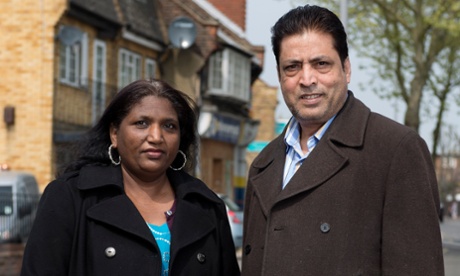
Nesrine doesn’t want to give her exact age – “over 50” – but she is finding it tough in Duncan Smith’s Britain. I meet her outside an abandoned pub where old furniture is being sold. She’s accompanied by her husband, both are of proud Pakistani Christian extraction. She worked as a receptionist, but when an operation on her husband’s back went wrong, she was forced to give up work to care for him.
“We’re struggling to make ends meet,” she says. Low-paid and unemployed people such as Nesrine are now often paying council tax because of cuts to benefits, and she finds what she receives in social security difficult to survive on. Her children can’t find secure work: her son has a degree in biomedical science, but has been told that he will not get an appropriate job until he has work experience, trapping him in a vicious circle, and his family are unable to pay for a master’s degree.
“It’s very sad that people who were born in this country can’t get jobs,” she tells me, and they both wave at a group of young Muslims outside an Islamic centre across the road. One of them is 25-year-old Zaman, a supervisor at Nando’s, who also hails from Pakistan. As he speaks to me, bearded young men face Mecca and pray. “I’ve seen a lot of people on minimum wage,” he says. “They’re struggling like hell. I came here with my wife and child, and on minimum wage, even after working for 40 or 50 hours, you still get, what? £200, £300?”
A young trainee GP – unwilling to give his name – tells me of his frustration. “I constantly meet people in low-paid and insecure jobs, going from job to job. Because of housing policy especially, people have to be rehoused all over the borough, all over London, and are really having a lot of trouble.”
That morning he saw a man who had been rehoused in temporary accommodation all over the capital, taking him away from the carers who were looking after him. “There’s no coordinated care, it’s all been broken up.” The old support structures have fallen apart, partly because of the decline of extended families, he feels.
Much of his job ends up being social work rather than medical treatment. But he is frustrated at how disengaged and ill-informed many of the people he looks after are. All too often their anger is directed not at those with power, but at other people struggling. “A lot of people who feel they’re not getting support because it’s going to someone else,” he tells me.
Chingford and Woodford Green may be true blue, a seat that has always decisively opted for the Tories. But the blights and tensions of modern Britain are as clear here as they are anywhere.