Your book Only Ever Yours explores a society wherein women are raised only for the pleasure of men. Do you think a future like this is actually plausible?
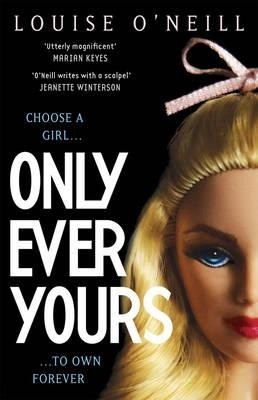
I certainly hope not. While I am fairly confident that we won’t one day find ourselves designing women primarily for their beauty, I also want to ensure that things don’t disimprove. In The Beauty Myth, Naomi Wolf wrote about the “Iron Maiden”, an inherently unattainable ideal of beauty that women are encouraged to try and attain, and are subsequently psychologically punished by their inability to do so. She wrote that in 1991, and it still holds true today. I would argue that the world in which Only Ever Yours is set is not as far-fetched as you might assume. Every single aspect of the world and incident that occurs within the narrative was inspired by true-life events. Jezebel and xoJane were particularly useful sites for inspiration!
You have spoken about your own struggles caused by the pressures of society, something increasingly familiar to young girls in the present day. How do you feel books exploring feminism help to challenge these pressures and familiarise girls with feeling comfortable in their own skin?
When I was as teenager, I instinctively knew that I felt uncomfortable with certain attitudes and behaviour that I saw around me but I didn’t understand that discomfort. It was only when I started reading feminist literature from The Handmaid’s Tale to The Beauty Myth and Backlash that I realised that it wasn’t just my imagination. Those books helped me to develop the necessary vocabulary to articulate my discomfort and I think that’s the power of books that explore feminism.
In a previous interview with The Guardian, you mention all of the things which you did whilst you still identified yourself as a feminist. Do you feel that this is a common problem today, and why?
Yes, I believe many young women still struggle with some of the issues that I raised in my article. We live in an undoubtedly patriarchal society, one that conditions both men and women to believe that men are inherently superior. A lot of this is subconscious but when even our use of language is derogatory to women (don’t be such a girl, etc) it’s no wonder many young women have internalised misogyny. It would be difficult not too – none of us live in a vacuum. It might not be as blatant as in Only Ever Yours but we are trained in our own way to be appease men and to keep them happy.
You have said that it was extremely difficult to be a feminist in 2000, and it’s still completely not innate these days. What struggles do you think feminists face nowadays?
I suppose one of the main issues that feminists face today is intersectionality – feminism is for all women, whatever their race. Many women of colour feel excluded by the main stream feminist movement and that is something that needs to be addressed.
You have mentioned Margaret Atwood as amongst your inspirations for Only Ever Yours. Why do you feel literature and writing is important for communicating feminism and addressing the issues facing women?
I feel that writing can give others a vocabulary with which to express themselves. I also believe that feminist literature creates a sense of community. When I read about another woman who has faced a similar struggle to me, I feel less alone, less ‘crazy’. It validates my experience, in a way.
Although you are yourself familiar with the ideas of feminism and this is reflected in your book, do you feel that the pressures and dynamic of girls themselves, such as their competitiveness, contribute to the issues faced by women in society?
I don’t believe that girls are inherently bitchy or competitive. We are trained to be so. The media is constantly pitting women against one another, ‘celebrity cat fights’, and the depiction of girls in movies and books is often that they are spiteful or cruel to one another. These are the models we are given upon which to model our own behaviour – is it any wonder that girls feel they must compete with one another?
Also, there is often a sense with women that there isn’t enough. When there is a lack of opportunities for women in a professional capacity, perhaps this generates a ruthless competitiveness. I think this is changing though – I believe women in their late twenties and early thirties are much more willing to cooperate with their female colleagues than previous generations.
In Only Ever Yours social media is used to post hateful messages such as ‘Fat women should be made obsolete’. Do you think that social media is a benefit or an obstacle for feminism today?
In some ways, it’s very useful because it assists in the easy and rapid dissemination of feminist ideas in a way that would have been impossible twenty years ago. On the flip side, I have been genuinely concerned by some of the vitriol spewing out from social media accounts – it’s vicious. I think it’s about education, teaching young girls what is and isn’t acceptable, and encouraging them to be kinder to themselves and to one another.
How did your experiences volunteering at a childrens’ orphanage in Kolkata and your experiences as an intern at Elle Magazine influence your perception of women in society?
While I was working in Kolkata I read a book called May You Be The Mother of A Hundred Sons and it was the first time I had been exposed to the idea that the gender balance was skewed towards men in India due to the high rate of death amongst female babies. That horrified me – that a culture could so devalue the worth of a female that her parents would leave her to die through neglect.
At Elle, I think I began to really question the power of the media, and the impact the fashion industry had upon young women due it’s obsession with youth, extreme thinness, beauty. It wasn’t Elle in particular, but more the fashion industry as a whole.
The contrast between the two of these worlds and yet some of the inherent similarities made me start to think more about how women are perceived
Why did you decide to focus your book on young women in particular – do you think that the pressures which society puts on women today is more affecting to them than to older women?
I think that many older women still feel susceptible to The Beauty Myth but it’s more affecting to teenagers because at that time (and into your early twenties), your brain is still forming. I don’t know enough about the science to explain that but it’s fact. I think that some young women are more susceptible to the pressures that society puts upon them because it’s a time of great change, physically and emotionally, and we all feel vulnerable and uncertain during any period of change. Throw in hormones and you have a recipe for disaster!
Why do you feel that it is important to explore dystopian societies in which the issues facing women at present are enlarged and accentuated, like in Only Ever Yours?
Sometimes we become so accustomed to the world in which we live that we fail to see the problems within it. We become immune, de-sensitised. Dystopian literature exaggerates problematic elements of our society so when we think ‘well, that’s ridiculous, it’s too far-fetched’, but suddenly we can link it to our own, everyday existence, it throws that problematic element into sharp relief. It helps us to look at our world in a new light. Isn’t that what literature is supposed to do?
Join Louise O’Neill TODAY for a live Twitter chat about feminism.
Louise O’Neill @oneilllo and a host of other authors – including Holly Smale @Holsmale, Siobhan Curham @SiobhanCurham (author of True Face and inventor - we think - of the word “fake-booking”), Sarwat Chadda @Sarwatchadda (author of the Ash Mistry series – yes he’s a MAN), SF Said @whatSFSaid (also a man, and author of Varjak Paw and Phoenix), Arabella Weir @ArabellaWeir (author of The Rise and Rise of Tabitha Baird and Anita Naik @AnitaNaik (agony aunt and author of How to Be A Girl) – are taking to Twitter to talk about feminism with @GdnChildrensBks. Join us on Sunday 8 March between 7-8pm, using #Gdnteenfeminism, or send in your questions early to childrens.books@theguardian.com.