It is odd that two of the Premier League managers most closely associated with giving youth its chance – Louis van Gaal and Mauricio Pochettino – should be the ones giving Gareth Southgate the most grief over whether to include Luke Shaw and Harry Kane in the England Under-21 squad for this summer’s European Championship.
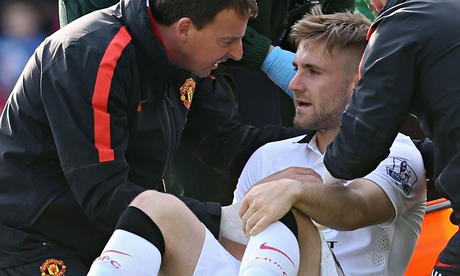
Yet in their own way, or perhaps in their own self-interest, Van Gaal and Pochettino are only trying to protect their own young players. Shaw has struggled with injury all season whereas Kane has blossomed, so perhaps there was more justification for United wanting their full-back rested than Spurs merely trying to cut down their leading scorer’s close-season commitments to fit around promotional tours to Malaysia and Australia. Kane goes, Shaw stays at home, but club-versus-country issues are always complex and Southgate knows that in his job he cannot please everyone.
At least the Under-21 manager resisted the temptation to pack his squad with established internationals such as Raheem Sterling, Jack Wilshere and Ross Barkley, preferring instead to stick with the players who came through the qualifiers and upholding the principle that under-21 football is about development of players for the senior squad.
Once in the senior squad, the argument goes, a player’s development is complete, or at least it is then up to the senior squad coaching staff to progress his game further. Quite naturally this is also a contentious issue.
Some people believe the exact opposite, that England should send as strong a squad as possible to the Czech Republic in the hope of progressing to the final and maybe even coming back with a medal. Such an experience, it is suggested, would count for far more than simply keeping the same group together through the qualification-tournament cycle. Young England players could do with the confidence boost of performing well in a tournament, and with luck the same squad could form the basis of successful senior squads for years to come.
There is no right and wrong answer to this. You choose which direction to take and try to stick to it. A personal opinion is that it is part of Southgate’s job to create as many future (senior) internationals as he can. England managers are always complaining that the talent pool is shrinking, so it seems to follow that the best plan is not to sacrifice young hopefuls who have been performing well at the lower level in order to accommodate bigger names parachuted in from above.
Once you have made it, you are in Roy Hodgson’s camp, and there should be no coming back for opportunistic reasons. The more young players Southgate can bring through the better it will be for the English game, not just the national team. Plus – the by now obligatory caveat with anything pertaining to England – it is safer and more sensible for Southgate to stick with the players who have brought him this far.
There is absolutely no guarantee that the likes of Wilshere, Sterling and the rest would have presented England with the passport to success many seem to imagine. More likely they would have looked tired, jaded, ineffective – as England internationals generally do in summer tournaments – and then the Under-21s would have had to cope with all the disappointment and finger-pointing their senior counterparts have to handle every couple of years.
Considering football is a young man’s game – at least that used to be one of its most frequently-aired cliches – the issue of youth development is a thorny one at club as well as international level. Ask Jamie Carragher, who apparently felt sick to the pit of his stomach on hearing of Sterling’s alleged desire to leave Liverpool. Sterling is 20, and has been at the club five years since being plucked from relative obscurity – although Tottenham and Everton were tracking him – at Queens Park Rangers. Since he broke into the first team Liverpool have been involved in the Champions League for just one short-lived campaign, and when they visited Real Madrid in the group stage at the end of last year Sterling found himself on the bench alongside his captain Steven Gerrard.
Without wishing to delve into any of the contractual or financial aspects of the player’s current situation at Anfield – you will find plenty of that elsewhere this week – one question suggests itself. Would Manchester City do that, for a player they may be buying for £40m or more this summer? It remains to be seen whether Sterling will turn into the player everyone hopes he might, but if you were in his position, aged 20, what would you be thinking?
That in turn leads to Paul Pogba, and the question everyone is asking about what happened in 2012: what on earth were Manchester United thinking? This question will return at greater amplification should Pogba win a Champions League-winner’s medal next month, should he subsequently turn up at a bigger club than Juventus, join Manchester City or, as is still just about conceivable, should United buy him back at an absurd price.
Confirming the player’s departure at the start of the 2012-13 season, Sir Alex Ferguson said he had signed for Juventus “a long time ago, as far as we are aware. It is disappointing, I don’t think he showed us any respect at all. If players are going to carry on that way they are probably better doing it away from us.”
Pogba was 19 at the time, and had played just three times for United’s first team. According to Carragher, who takes broadly the same line over Sterling, the player was getting too big for his boots. “Sir Alex Ferguson doesn’t often get it wrong with youth players, he was one of the masters at bringing young players through,” the Sky pundit said. Not this one.
As Thierry Henry usefully pointed out, Ferguson brought Paul Scholes out of retirement to play ahead of Pogba, something the French player might have viewed as the last straw. With a Champions League final to come, and Europe at his feet, few could argue with Pogba’s decision-making, especially at 19.
Some of Ferguson’s late-term decisions, however, now look a little less astute. “If we hold Pogba back he’s going to leave, and he’s got great ability,” Ferguson said a year before the player left. Credit the United manager with some foresight then, but Pogba appears to have been more interested in the now rather than the past or the future, and who can say he was wrong?