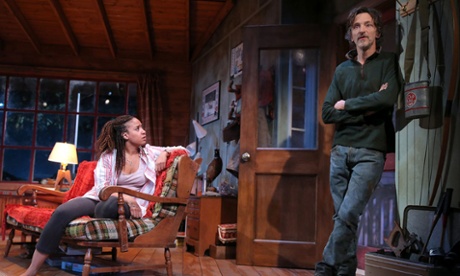
On dark nights, you could perform a hell of a chiller on the stage of David Auburn’s Lost Lake. The set is the living room of a cabin an hour or two outside of New York City, a decrepit, creaky sort of place. The hot water doesn’t work, the phone is disconnected, a dead tree branch looms over the walkway, and the unstable owner rolls up at all hours of the day and night, ready to a menace a single mother and the children in her care.
But Auburn, the author of Proof and The Columnist, isn’t a sensationalist. And that’s a good thing. Probably. In Lost Lake only a coffee mug comes to a bad end. And if blood is spilled, it’s quickly washed away, the wound bandaged. The terrors in this play are the terrors of ordinary living.
Veronica Barnes (Tracie Thoms), has come to the cabin to give her son and daughter and daughter’s friend a week outside the city. Surely there are swisher vacation rentals than this ramshackle two-bedroom, but money is tight and not everyone in this small town will rent to an African American woman. So when she and the owner, Terry Hogan (John Hawkes), come to tentative terms, she writes him a check for the deposit. Before the week is out, these two lonely people and their rattletrap hearts will have forged a hesitant, faltering kind of friendship.
Auburn is a pessimist when it comes to human relations, but also a romantic. He wants to think that we can heal and sustain one another, even as he doubts it. This to-ing and fro-ing, which feels pretty sad and pretty real, lends a bit of emotional color to this cattail-slight drama, directed with typical finesse by Daniel Sullivan.
As Veronica, Thoms manages to convey a capable woman, destabilized by chance and choice. But she’s not exactly a subtle actor. Her expressions and gestures feel overlarge for the space and her performance is a constant validation of how hard she’s working. John Hawkes, best known for his work on the HBO series Deadwood and a handful of indie films has a different style, more vital, more limbed in. His Hogan, whom Veronica calls a “creepy backwoods oddball freak”, is a man who never seems to have grown into his body and this gangliness conveys an awkwardness in dealing with the world, a restlessness that can’t find repose.
The turns their relationship takes aren’t exactly predictable, but they’re definitely not melodramatic or lurid. When Hogan makes the mildest of passes, Veronica looks at him in disbelief and says: “You’re kidding, right?” But as this serious, sedate play continues, impatience rears. Couldn’t Auburn offer just a little more story, a little more excitement, maybe just the tiniest thrill?