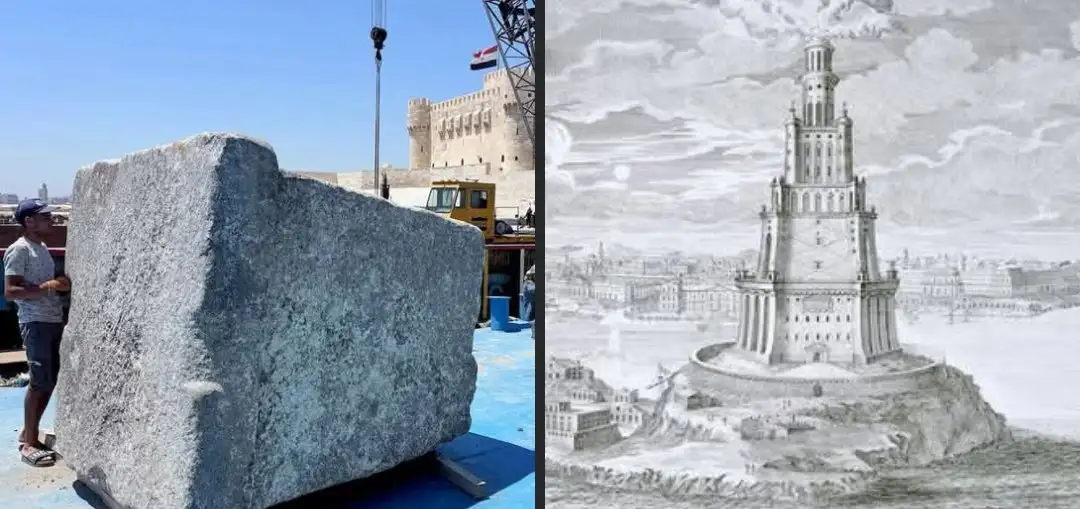
For centuries, it stood as a beacon visible from miles away, guiding ships into one of the world's busiest ancient ports. Then earthquakes brought it down, and its remained vanished beneath the Mediterranean Sea. Now, more than 700 years later, parts of the legendary Lighthouse of Alexandria are rising again.
Archaeologists have recovered 22 massive stone blocks from the submerged ruins of the ancient monument, a structure widely recognized as one of the Seven Wonders of the Ancient World, according to reports. The discovery marks a major milestone in an ambitious effort to digitally rebuild the lost wonder and uncover what it truly looked like.
ALSO READ: Ketan Agarwal Lohagad Fort Pune death
Giant pieces of the Lighthouse of Alexandria brought back to the surface
The recovery operation was conducted as part of the PHAROS Project, an international initiative involving France's National Center for Scientific Research (CNRS), Egypt's Ministry of Tourism and Antiquities, and the Dassault Systèmes Foundation.ALSO READ: Rip Wheeler Dutton ranch shake-Up explained
Among the recovered pieces are enormous architectural elements from the monument's main entrance, including lintels, door jambs, thresholds, and paving stones. Some of these blocks weigh between 77 and 88 tons, highlighting the extraordinary scale of the ancient structure.
The newly recovered stones had remained underwater off Egypt's Mediterranean coast for centuries, hidden beneath the waves after the lighthouse's collapse.
What was the Lighthouse of Alexandria?
The Lighthouse of Alexandria, also known as the Pharos of Alexandria, was built in the early third century BC during the reign of Ptolemy I and designed by Greek architect Sostratus of Cnidus.Located on Pharos Island at the entrance to Alexandria's harbor, the tower stood more than 330 feet tall, making it one of the tallest human-made structures of the ancient world. It served as a crucial navigational landmark for ships crossing the Mediterranean and remained in use for more than 1,600 years.
A series of powerful earthquakes eventually damaged the structure, with a devastating quake in 1303 largely responsible for its destruction. Over time, many of its stones were repurposed in the construction of the nearby Citadel of Qaitbay, which still stands today on the historic site.
The PHAROS Project is solving a 2,000-year-old mystery
The goal of the project extends far beyond recovering ancient stones. Researchers are using advanced photogrammetry technology to scan each block and create highly detailed 3D models. These digital replicas will help experts determine exactly where each piece belonged within the original monument.The process resembles assembling a massive historical puzzle that has remained incomplete for centuries.
Over the past decade, archaeologists have already digitized more than 100 architectural fragments still resting beneath the sea. The newly recovered blocks will now join that growing digital archive.
How technology could rebuild a lost wonder
The digital reconstruction will combine the scanned blocks with historical evidence gathered from ancient coins, mosaics, manuscripts, and written descriptions left behind by ancient travelers and chroniclers.By bringing together archaeology, engineering, and advanced modeling technology, researchers hope to create the most accurate reconstruction ever attempted of the Lighthouse of Alexandria.
For historians, the project offers a rare opportunity to better understand one of humanity's greatest engineering achievements. For the public, it could provide the closest look yet at a monument that disappeared from the skyline centuries ago but never vanished from history.
As more pieces emerge from the Mediterranean, the story of the Lighthouse of Alexandria is being rewritten—one giant stone block at a time.
For more news like this visit The Economic Times.