French beauty giant L'Oreal is betting on the "skinification" transformation trend to crown Thailand's professional haircare market, which is valued at up to 3.5 billion baht annually.
The skinification trend integrates treating hair and scalps with the same precision as facial skin, using artificial intelligence (AI) to repurpose potent skincare ingredients for haircare to promote hair growth directly from the scalp foundation.
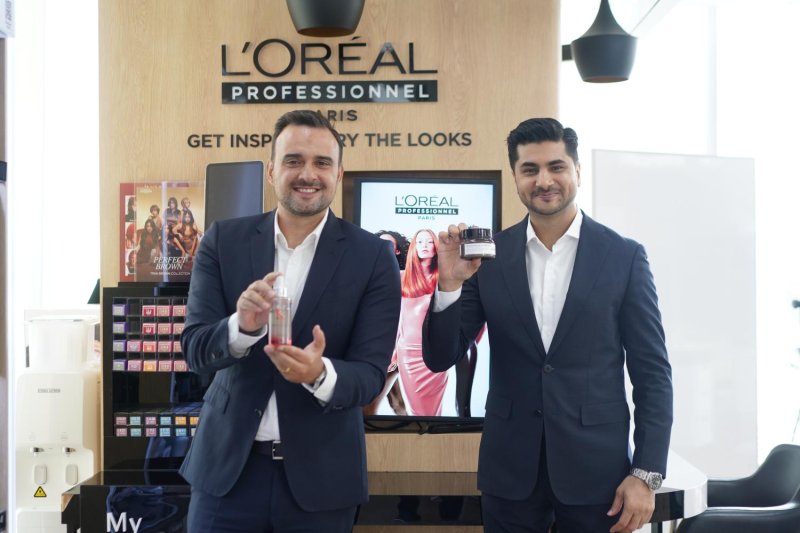
"We are leveraging a structural shift in consumer behaviour, targeting high single-digit growth in the local professional haircare market this year through AI-driven innovation and a massive regional education push," said Tiago Carvalho, general manager of the professional products division at L'Oreal South Asia Pacific, Middle East, North Africa.
For decades, the "crown of beauty" was maintained with a simple routine of shampoo and conditioner. But in the post-pandemic era, a new trend is reshaping the industry: the "skinification of hair". Consumers are now treating their scalps with the same level of sophistication as their facial skin, a shift that the L'Oreal professional products division is banking on to cement its leadership in Thailand and beyond, Mr Carvalho said.
"Hair has always been an incredible source of identity and self-esteem," he said. "What we are seeing now is an increasing appetite for haircare because scalp concerns are rising due to climate change, pollution, and emotional disruptions to well-being".
SKINIFICATION TREND
The trend represents a move towards more sophisticated routines. Where consumers once stopped at basic washing, they now demand serums to balance the scalp and high-performance masks for deep fibre reparation, Mr Carvalho said.
This shift is particularly pronounced in Southeast Asia and Thailand, where environmental factors like high humidity drive the demand for specialised anti-frizz and deep repair treatments.
"In Thailand's professional market, valued at 3-3.5 billion baht for products alone, the opportunity is vast. When service value in the country's 30,000 salons is factored in, the industry's total economic footprint could be 10 times larger," he said.
L'Oreal, which holds a 27% global market share in professional products with nearly €5 billion in annual business, remains the undisputed leader in Thailand after 30 years on the ground.
The company's strategy rests on three pillars: innovation, education, and the salon experience.
The company's commitment to education is massive. Globally, they interact with 3 million stylists, and in this region alone, they work with 70,000 salons.
Recently, Bangkok played host to over 400 stylists from 10 countries -- stretching from Vietnam to Morocco -- for a masterclass that blended technical skills with digital savvy.
"We elevate hairdressers not only with technical skills but with training on how to operate in social media and manage their businesses financially," Mr Carvalho noted, highlighting the brand's role in supporting small and medium enterprises (SMEs).
ALL-AGE PORTFOLIO
To capture a fragmented market, L'Oréal is diversifying its brand portfolio in Thailand, with Kérastase, the world's leading luxury haircare brand, targeting the high-income segment.
For L'Oreal Professionnel, the core brand focused on technical excellence for salons and home use. A newly launched, accessible brand designed to capture the Gen Z demographic with the mantra "all hair types, all humans".
The professional market globally operates on two spectrums: technical products, used by stylists for salon services (B2B); and at-home care products.
Professional products are sold in salons or via selected retailers online. These feature the most developed technologies and concentrated formulas.
Currently, consumer at-home products represent roughly 60% of the overall market, while salon services account for 40%.
"At L'Oreal, we are slightly more weighted toward the consumer side -- around 70% -- as we are very strong in placing professional products in the hands of consumers. A styling-focused brand driven by viral TikTok content and instant transformation," Mr Carvalho said.
Aun Zaidi, general manager for professional products division at L'Oreal Thailand, said the future of the salon experience is increasingly digital. L'Oreal is deploying AI-powered tools like 'K-Scan' for deep scalp analysis and 'Colour ID', which allows customers to virtually try out hair colours before the first drop of dye is applied.
Furthermore, he said Thailand has become a global source of inspiration for its rapid adoption of content-to-commerce. By training stylists to become influencers on platforms like TikTok, L'Oreal is ensuring that the professional industry remains relevant to a younger, tech-savvy audience.
RESILIENT GROWTH
Despite global macroeconomic pressures, Mr Zaidi said the professional hair sector remains remarkably resilient. In Thailand, L'Oreal expects the market to grow at a high single-digit rate, outperforming the global average of a low single-digit rate.
"The challenge is fragmentation -- both of salons and brands," Mr Zaidi admitted. "But it keeps us awake. We must continuously prove to our partners and consumers that science-backed innovation is the best choice for their routines."
As the beauty industry continues to evolve, L'Oreal's blend of traditional hospitality and modern technology suggests that the crown of beauty will remain firmly in professional hands.