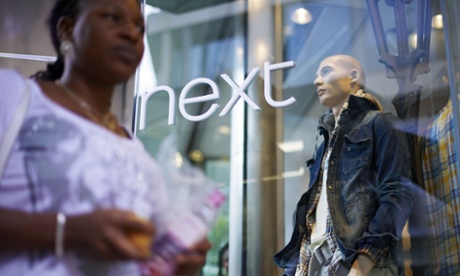
Next shareholders should not despair: their chief executive, Lord Wolfson, may be “very cautious” about the year ahead but that represents only a modest downgrade on his normal mood in March.
This time last year, he thought Next’s pre-tax profits would be £730m-£770m. In the event, Wolfson unveiled £782m on Thursday – and that was achieved even with a mild weather-related warning last autumn.
For all that, Wolfson is correct when he says prospective returns are low by Next’s standards. The bottom of his profits range for the current year is £785m, or almost no growth. And the top end, £835m, would represent a 6.7% improvement, the weakest rate for four years.
What’s up? Tough comparatives, he says, but that’s always the case for Next, plus some fashion collections that are “not as strong as they were at this point last year.” Top marks for honesty, but the other ingredient may be one he didn’t spell out – the sense that consumers aren’t spending as freely as would have been expected after the plunge in petrol prices.
In the medium-term, Next has nothing to worry about. The online business is growing overseas and there is a potentially lucrative adventure, Label, selling other people’s brands. And the special dividends should keep flowing because the share price, even after a 4% fall, still sits well above Wolfson’s disciplined limit for buy-backs.
In fact, it’s the rest of the high street that should be worried. A non-vintage year for Next suggests there will be disappointment elsewhere.
Forecasting doubts
Neil Woodford, the vastly experienced fund manager, makes an obvious but important point: if you make only small tweaks to the Office for Budget Responsibility’s main economic assumptions, chancellor George Osborne’s projection of a small budget surplus in 2018/19 evaporates and becomes a large deficit.
Woodford suggests a dose of reality is required. Don’t assume, as the OBR does, that inflation returns to the Bank of England’s 2% target. It won’t happen any time soon, thinks Woodford. He plugs 1% into his model and reckons even that figure may prove optimistic.
He also notes that real GDP growth in the UK was 1.8% per annum between 2010 and 2014. That’s the figure he uses, not the OBR’s projection of 2.3% to 2.4%. The result: the deficit continues to reduce but at a much slower rate and does not produce a surplus. Indeed, the cumulative difference when projecting out to 2019/20 in £120bn, which is more than a rounding error.
One could call it the law of small numbers – seemingly tiny differences in figures matter when the annual deficit starts at £91bn. And when even the Bank of England’s chief economist says the next move in interest rates could be a cut, not a rise, the only sensible response is to take all economic assumptions with a dose of salt.
Sky’s costly catch
Sky’s share price has risen 10% since it “overpaid” last month for its next set of Premier League rights, demonstrating that investors’ greater fear was football being wiped from the screens. Chief executive Jeremy Darroch will feel vindicated in agreeing to pay the colossal sum of £4.18bn over three years, about £1bn more than the City expected.
But the bill, which represents a £600m-a-season increase in Sky’s Premier League costs, still has to be paid. So there was an air of inevitability about the price rises announced on Thursday– £1 a month to £47 for the sports-plus-basic package and £3 to £36 a month for the entertainment channels, where Sky has also been investing heavily.
Is that enough to make viewers switch off? Probably not. Customer loyalty at Sky is the best it has been for a decade.
But pricing power is not inexhaustible. With other content costs rising, analysts at Jefferies think Sky will struggle to increase its UK earnings before interest and tax through the next two Premier League cycles – in other words six years.
Sky may confound that expectation, and Darroch can also look to the German and Italian businesses for growth. But Premier League football itself looks increasingly like a treadmill, and it’s not obvious how Sky could ever jump off.
Green speaks up
Apologies to Lord Green. It was said here incorrectly on Tuesday that he had cancelled a speech the following day at St Michael’s Cornhill church in London. In fact, the former chief executive and chairman of HSBC gave the speech, as we reported. It was another speech next week at Queen Mary University of London that had been cancelled.