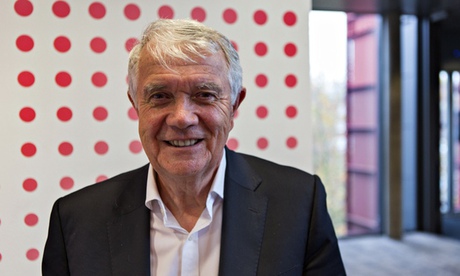
He has been called Teflon Terry and Lord Fix-it, the ultimate mandarin called in by successive governments to help sort out thorny issues from the state of British broadcasting to freedom of information and hunting with dogs. Yet Baron Burns of Pitshanger, the outgoing chairman of Channel 4, now finds himself, if not quite outfoxed, then “disappointed” by the government’s handling of the review into the future of the state-owned, commercially funded Channel 4.
In an interview after six years as chairman, Burns, made a peer for his services to the Treasury, says there would be little financial gain in a planned privatisation. “It’s very difficult to see what the financial benefit is for the government, whereas it is possible to see some of the harm that could be created for the whole creative sector in the UK.”
Essentially, he says, the value of Channel 4 in encouraging the independent sector and fulfilling a remit centred on harder-to-reach audiences such as minorities could be lost for a relatively paltry sum, estimated at £1bn. “The reason that Channel 4 works so well is because we run this whole place focused around the remit … My hesitation about privatisation is whether you can achieve this mixed remit.”
Now 71, Burns, who credits Tory chancellor Geoffrey Howe with changing the course of his career by appointing him to the Treasury in 1979, saves his sharpest words for culture secretary John Whittingdale, who worked for Margaret Thatcher as political secretary. The long-serving MP has a “certain amount to learn” about government. “I think too many kites are flown, there is too much chatter about things that have got to be rigorously analysed before giving an opinion on it,” says Burns, whose voice retains elements of the measured academic he once was as well as his county Durham upbringing.
The minister’s kite-flying has been particularly “premature” over the BBC, he argues, with Whittingdale suggesting that the corporation could still face more financial penalties after accepting the £700m burden of free licence fees, as well as Channel 4. “You’ve got to be careful of the language you use,” adds Burns, who worked for successive chancellors from 1979 to 1998. “And some of the people close to [Whittingdale] who may be doing some of the talking, need also to be very careful.”
After two months of talks about options for Channel 4, a leaked report in September – photographed while being carried into Downing Street – suggested that the government was indeed looking at privatisation. Burns describes this as a “game-changer”.
When Channel 4 senior management first met the new culture secretary after the election, he told Burns in private what he went on to say in public; that there were no plans to privatise Channel 4 but “never say never”. Burns smiles as he calls these “politicians’ words”.
Burns, the architect of a far-reaching review of the BBC during the last renewal period in 2003, says it is “not unreasonable” to consider radical change, yet the process has been “clumsy”.
“I just hope the outcome will be better than the process so far.”
A report masterminded by Burns laid out the benefits of a not-for-profit future as a company limited by guarantee for Channel 4. This would take the broadcaster off the public books but shareholders would expect no financial stake and profits could continue to be spent on programming.
Most media analysts including Claire Enders credit Burns and the management team led by David Abraham with bringing the channel into the black, when the last management team had to ask for state money to survive. (Perhaps ironically, the chairman at the time, Luke Johnson, is now rumoured to be among private equity groups and US media companies running the rule over Channel 4.)
“I think we’ve done sufficient over recent years to show that [Channel 4] is an organisation that can stand on its own two feet,” says Burns. “It can deliver award-winning television and it can do those things that we have been asked to do in terms of remit. It is a bit demoralising that, despite having achieved all of that to somehow or other have this notion that, well, this could all be done rather better.”
Whittingdale also stressed the importance of the remit, which would affect any sell-off price, at the Edinburgh TV festival.
Given the lack of financial or public value in privatising Channel 4, why does the government seem keen to focus on privatisation? Could it be ideological? “I don’t like the word ‘ideological’. That implies, erm, that they are just tied up with belief … They … seem to believe that you can retain the remit for Channel 4 while privatising it.”
This son of a colliery blacksmith from County Durham is a cross-bencher and not easy to define politically, yet he used a rare appearance in the Lords recently to back the government over tax credits. Not just because of the principle that the “House of Lords should not involve itself with financial matters” but because the welfare burden was too high.
He is also charged with chairing the controversial inquiry into freedom of information legislation, and although he says there are no “plans” to water down the provisions, he blames the press for misrepresenting the review. “The press of course is the body which has the biggest conflict of interest in this … They are scarcely the people in the best position to make these judgments.”
He is, however, a good example of the sort of pro-public service peer likely to cause problems if the government does go ahead with the primary legislation needed to privatise Channel 4.
His last few months before his contract ends at the end of January have also involved a somewhat unseemly row over whether it should be extended. Earlier this year, regulator Ofcom suggested that Burns stay on for an extra year to provide continuity amid potential turbulence. It was only after this story leaked that the government said it would be looking for a new chairman.
“It was badly handled,” admits Burns, who stepped down earlier this year as chair of Santander UK. The government decision to appoint someone else “should have come much earlier”.
He has “obviously” asked himself if the desire to replace him “means anything for Channel 4”. Then the leaked document stressing the “focus” on privatisation appeared.
Burns is actually quite sanguine about the future of both Channel 4 and the BBC. Responsible for advising Labour’s Tessa Jowell in 2003, whose suggestions for BBC governance have now largely become accepted wisdom given the widespread criticism of the “disaster” that is the BBC Trust, he says: “It’s right that every 10 years there’s a rigorous examination.”
Does he think the government believes in public service broadcasting? “The government as a whole? Yes I do.”
And John Whittingdale, a man who chaired a cross-party report into the future of the BBC that Burns admired earlier this year? “I’m sure he does believe in public service television; whether he believes in the same sort of public service television as some of the rest of us is another matter.”
Curriculum vitae
Age 71
Education Houghton-le-Spring Grammar, University of Manchester, London Business School
Career 1980 chief economic adviser, Treasury, head of government economic service 1991-98 permanent secretary, Treasury 1998 made Lord Burns 1999 chairs financial services and markets joint commission 2002 chairman, Abbey National 2003-05 leads government’s BBC charter review 2004-05 chairs review of FA 2010 chairman, Channel 4