20 July 1936: Nationalists, led by rogue generals, instigate a revolt in the Spanish zone of Morocco and in the Canary Islands. The Guardian says ‘a revolt on the Right was always expected’ given the fragility of the state following recent elections that returned a Republican leftist coalition.

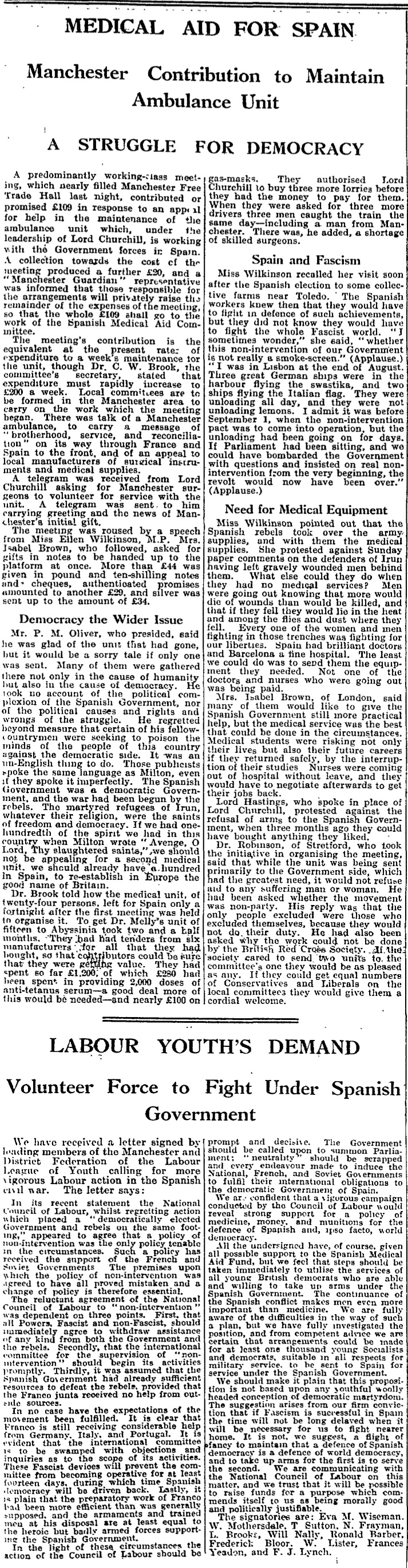
7 September 1936: In Manchester the paper reports on local efforts to support the Spanish government, including providing medical supplies.
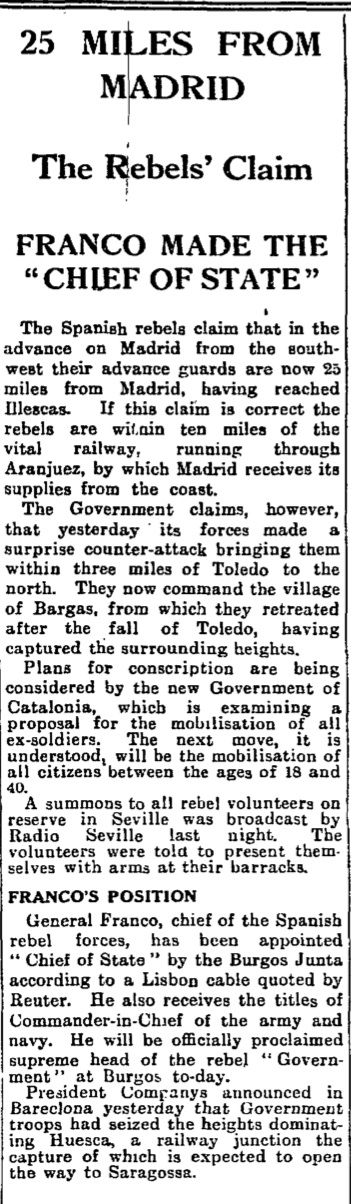
1 October 1936: As the rebels advance on Madrid Franco is declared Chief of State by his forces. Despite the rapid advance, government forces will repel Franco’s forces from the capital until eventual surrender in 1939.

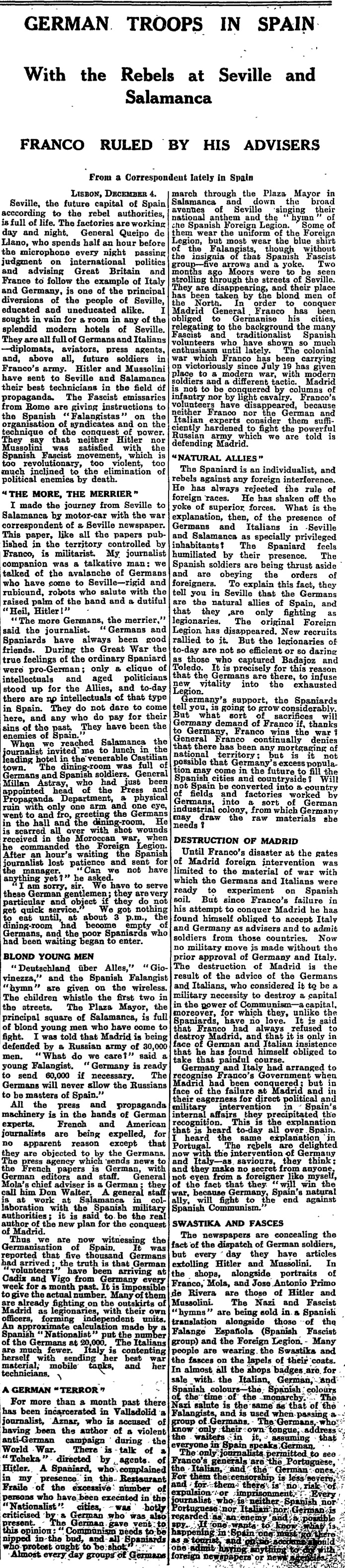
14 December 1936: German troops are reported to be operating in Spain. In rebel-held Seville, German and Italian fascists are on hand to advise their Spanish counterparts ‘on the technique of the conquest of power’.

14 April 1937: The paper publishes two letters on the civil war. The first is from a British citizen who has joined the International Brigades fighting fascism in Spain, and condemns his government’s neutrality; the second letter urges readers to consider adopting displaced and orphaned Spanish children.

30 April 1937: The city of Guernica is savagely bombed by Germany’s aerial Condor legions, one of the first instances when mass aerial bombardment is used against a civilian population.

29 August 1938: Following a series of military advances Franco declares ‘Nationalist Spain has won’ and urges the unconditional surrender of his opponents.
29 October 1938: The International Brigades receive awards for their service before returning home. The Republicans had disbanded these forces in the hope of receiving greater cooperation from British and French governments.

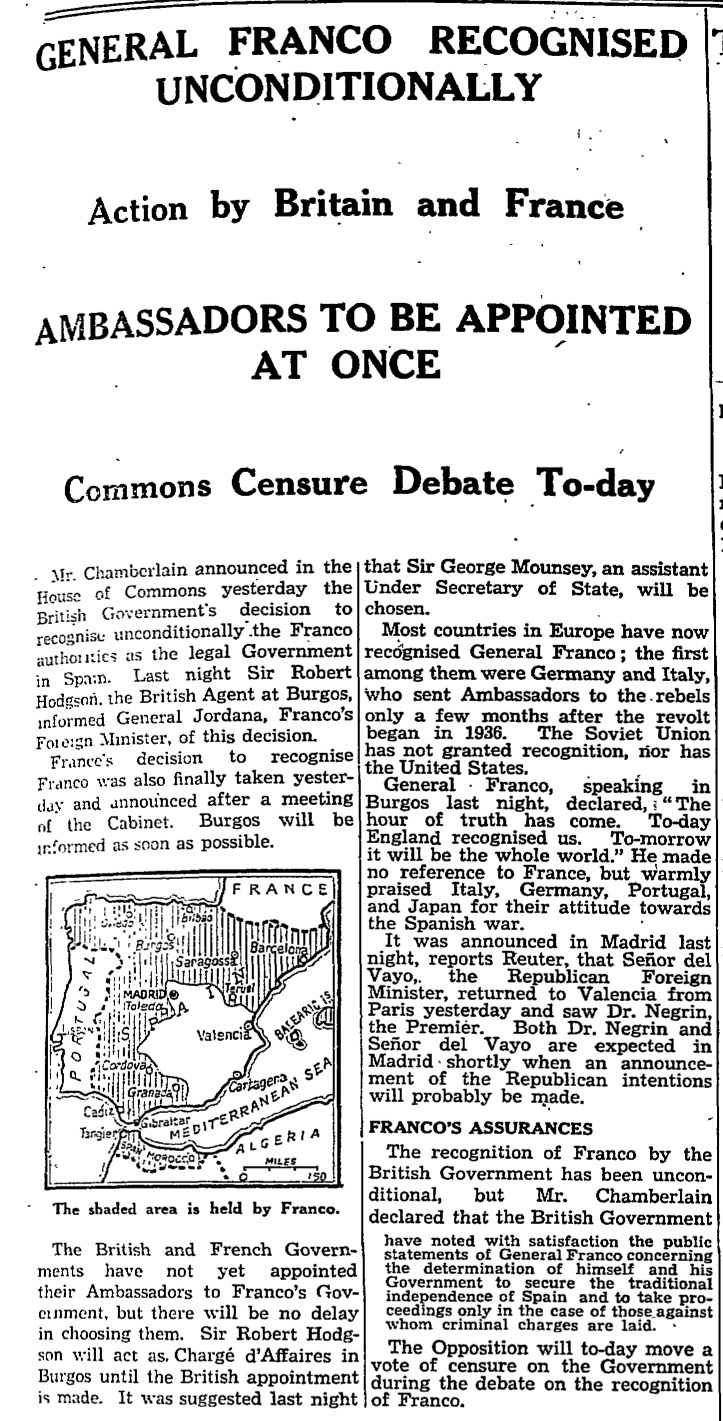
28 February 1939: Britain and France formally recognise the Franco regime. The Guardian prints a map showing Franco’s territorial gains.
29 March 1939: Franco enters Madrid, heralding the end of the war.

30 March 1939: Anti-fascist demonstrators protest outside a meeting of the ‘Friends of National Spain’. The Guardian notes that ‘during the playing of the Spanish Nationalist’s anthem several of those present, including the chairman, raised their hands in the Fascist salute’.
23 September 1940: Following the fascist victory, the Guardian runs a piece by W Horsfall Carter on Spain’s imperial ambitions.
7 November 1975: As Franco lies on his deathbed his appointed successor, the Crown Prince Juan Carlos, sets about the difficult process of steering Spain back towards democracy in defiance of the dictator’s wishes.