Fearing that a song about ejaculation might offend listeners, the BBC banned Relax by Frankie Goes to Hollywood from being aired in 1984. The British public, keen to hear the single, rushed out to buy it from record shops, sending it shooting up the charts. It stayed at number one for five weeks.
A Marlon Brando and Maria Schneider sex scene in which butter was used as a sexual lubricant had to be shortened before the film Last Tango in Paris (1973) was allowed to be screened in UK cinemas.
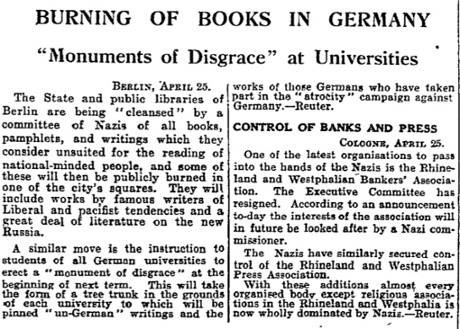
Following a directive by Joseph Goebbels, Nazi propaganda minister, books deemed “un-German” were torched in Berlin in 1933. Some were rescued and displayed in Paris a year later.
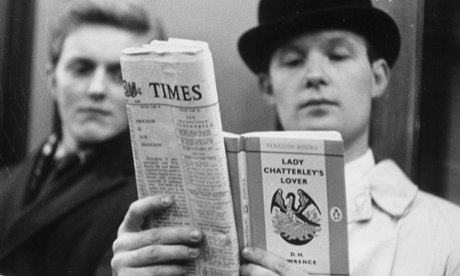
In 1960, Penguin books won a famous legal victory allowing it to publish DH Lawrence’s erotic novel, Lady Chatterley’s Lover. The book had been banned from UK book shops and libraries because of its explicit scenes and ‘salty’ language.
For several decades, beginning in the 1960s, Mary Whitehouse, an evangelical Christian and self-styled moral crusader from Wolverhampton, made a name for herself by campaigning against ‘filth’ being screened on TV.
The editor of Gay News, Denis Lemon, was convicted in 1977 under the Blasphemy laws following his decision to publish a poem which spoke of a Roman centurion’s homosexual love for Christ.
In 1973, an uncut version of A Clockwork Orange was withdrawn from cinemas by its director Stanley Kubrick following criticism that it glorified violence. Anthony Burgess, author of the book A Clockwork Orange, also complained, but he moaned that the film wasn’t violent enough.
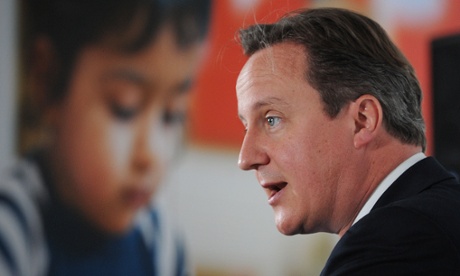
An initiative backed by David Cameron that encouraged UK broadband providers to make new customers ‘opt in’ for access to online pornography didn’t meet with great approval in 2013.