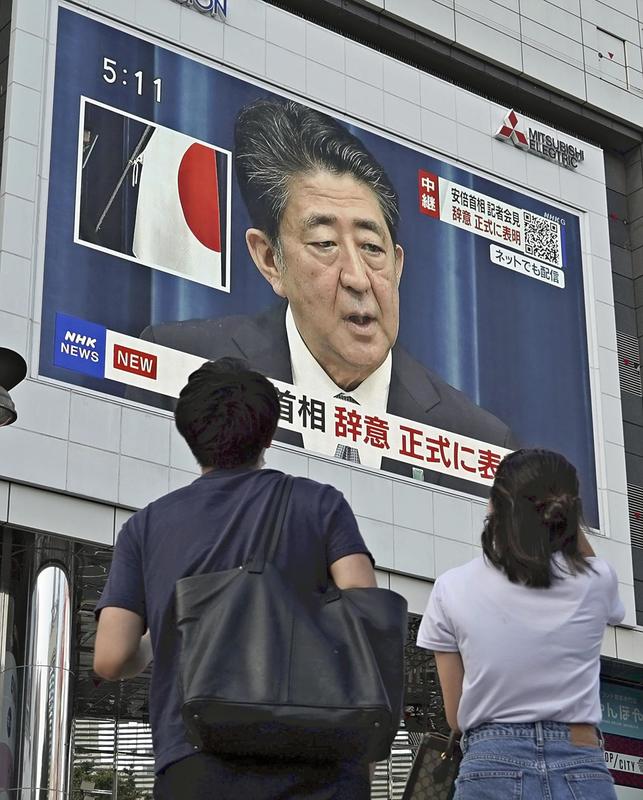
They say that history repeats itself. Unfortunately, that has come true as Prime Minister Shinzo Abe was forced to resign because of his worsening chronic illness. Despite his condition, the prime minister himself was probably the most unwilling to do so. He was the longest-serving prime minister in Japan's constitutional history, breaking the record for consecutive days in office.
Regardless of whether his resignation was right or wrong, the positive and negative of aspects of the Abe administration needs to be addressed. This is essential to understanding how the Abe administration has won five national elections and remained in power for seven years and eight months despite heavy criticism from the opposition and some in the media since the second administration.
Abenomics has been constantly criticized for its role in widening income inequality. However, there is no doubt that the economy has recovered and employment has improved significantly compared to that under the Democratic Party of Japan. The new coronavirus has cast a pall over the country, but the policies that have been implemented up to that point should be duly appreciated.
When it comes to foreign policy, the North Korean abductions and the Northern Territories issue remains completely unresolved. But it can be said that Japan has demonstrated an unprecedented presence in international politics, using Abe's personal relationship with U.S. President Donald Trump as leverage.
Japan's ability to achieve a certain degree of success in both domestic and foreign affairs was based on the stability of its government, which was achieved mostly because of strategically made appointments.
Reflecting on the criticism of the first cabinet, which was criticized for being a "Cabinet of friends," the new administration strengthened the framework of the government by placing important members of the Cabinet and the Liberal Democratic Party in key positions, both high-profile figures and veteran politicians. Deputy Prime Minister and Finance Minister Taro Aso, Chief Cabinet Secretary Yoshihide Suga at the Prime Minister's Office, and LDP Secretary General Toshihiro Nikai at the LDP provided the unifying force.
The weakening of the opposition has been cited as the reason for the Cabinet being able to maintain an approval rating of more than 50%, making a long-term government possible. However, the prime minister also took up issues that divided the nation. These issues are: the law to protect specially designated state secrets; the review regarding the right of collective self-defense and security legislation; and the legislation designed to penalize preparations for such crimes as terrorist attacks.
The opposition to all of these laws, including the security legislation, has been strong in the polls but the administration only suffered a temporary drop in approval ratings. This showed that even if there is opposition, as long as those who are leading the country stand firm on the necessity of the legislative changes, the people will support it to some extent. The fact that this "decisiveness" has gradually waned seems to have led to momentum weakening.
As for approval ratings, the response to the so-called "Mori-Kake" issue and the "Cherry Blossom Viewing Party" had a far greater impact. Why? It was his honesty that was challenged, and the public believed that the answers were insincere, which is supported by the fact that the main reason for his disapproval was because his honesty was called into question.
The government's response to deal with the coronavirus was highly criticized. However, it must be understood that the administration was battling an unknown virus, which caused the government to hesitate. It was inevitable that mistakes would be made.
It was important to be honest when explaining the intentions behind the policy and to protect the people, but this was lacking in the prime minister's approach. I hope that his successor will be able to manage the government and learn from the positive and negative aspects of Abe's long-term administration.
Read more from The Japan News at https://japannews.yomiuri.co.jp/