Prakash Javadekar, minister of environment and forests, announced Indian rupees 200m (£2m) for the conservation of five endangered species, including the water buffalo, on 8 July 2015. This effort is the latest to aid the recovery of the bovine species.
India is the world’s largest exporter of beef, and meat of domestic water buffaloes called carabeef make up all of it. However, the fate of their wild progenitor has been on a long downhill slide. According to the IUCN red list, the species was once found across Asia, and is now confined to India, Nepal, and a few countries in South-east Asia.
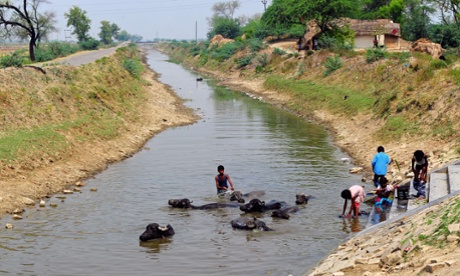
India has the largest population of wild buffaloes, an estimated 3,000, mostly in the north-eastern state of Assam and a smattering in central India. That might sound like a lot, but they are beset with problems. Water buffaloes need water to wallow and grazing land. They are losing both.
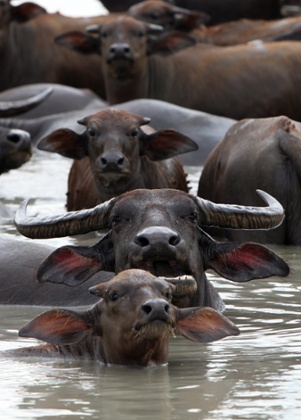
There are other problems. When domestic buffaloes graze in the same area as wild buffaloes, they inter-breed. Nobody knows how many wild buffaloes are of pure stock, and hybrids are common. Compared to domestic buffaloes, the wild species is heavier set with great sweeping horns. Since the degree of hybridisation may vary, it would be impossible to assess if the animals are of pure stock by merely looking at them.
Wild buffaloes also contract diseases from domestic animals such as rinderpest.
The population in central India is much worse than the north-east. A population crash between 1966 and 1992 reduced their numbers by about 80%. By the 1980s, there were fewer than 100 in Chattisgarh, formerly a part of Madhya Pradesh, and by 1992, there were less than 50. Today, the central Indian population is no more than 200.
The biggest problem they face is political instability. These forests are the hideout of armed Naxalite rebels. Forest officials cannot patrol these forests nor can conservationists safely work here. Conservation actions are restricted and don’t go far enough.
In 2013, Maharashtra notified 18,100 hectares (about 45,000 acres) in Kolamarka, the most densely wooded area of the state, as a water buffalo sanctuary. Two herds of about 18 are thought to exist here. Across the border in Chattisgarh, where the water buffalo is the state animal, Indravati national park has about 30 buffaloes. Udanti sanctuary has ten and only one cow.
Scientists at National Dairy Research Institute cloned Asha, the lone Udanti cow, in December last year. Although a scientific achievement, cloning cannot replace on-the-ground conservation: preserving habitat and maintaining purity of the wild herds.
A recent camera trap photograph of a herd in Kolamarka is cause for cheer. Camera traps set to capture giant squirrels, Maharashtra’s state animal, got a photograph of a herd of 3 to 5 cow buffaloes. The district conservator of forests Prabhunath Shukla told Indian Express that the photograph was taken sometime between January and May this year.
Until far-reaching conservation measures can be taken, camera trap images provide the only glimpse into the fate of these large bovines.