Supermarkets and convenience stores are trying to reduce the amount of time and effort spent on payments, introducing such features as self-checkout via smartphone and payment methods that don't use cash registers at all. Long lines at cash registers may no longer be the norm in the near future.
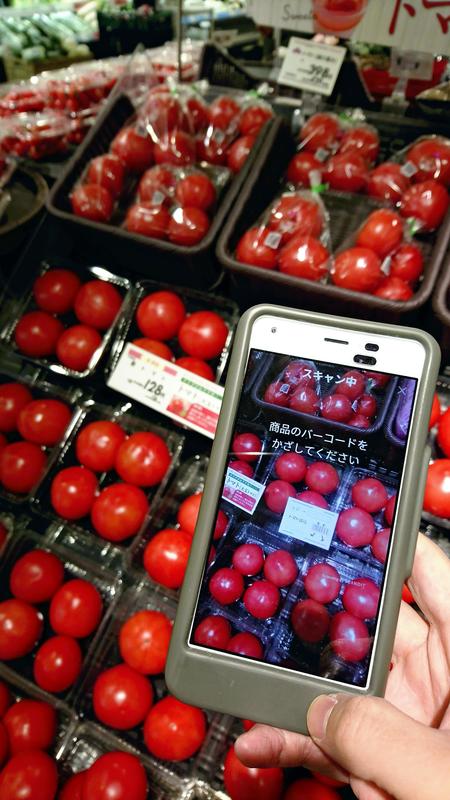
On Wednesday, Aeon Retail Co., which operates large-scale Aeon supermarkets, unveiled to the press its new "Regi go" payment system. It allows shoppers to register their purchases on smartphones and make payments without waiting at a cash register.
Shoppers choose a product and scan its bar code with the camera on a smartphone lent out by the shop. They then send data regarding their choices from the smartphone to the cash register and make a payment. The shopper doesn't have to wait for a shop employee to scan the items, and they can check their product list on the smartphone before making the payment.
"Self-checkouts" in which shoppers scan bar codes themselves at cash registers have been growing in popularity, and Aeon's move is aimed at reducing shoppers' waiting time even further.
Aeon Retail has conducted a trial run since last spring at two stores in Chiba, and Regi go payments currently account for 20% of their sales. The number of items purchased by customers using Regi go is 15% higher than that of customers who pay at ordinary cash registers.
Aeon Retail said the new system can help prevent customers from forgetting items they had planned to buy.
The company aims to introduce the new system at 20 stores mainly in the Tokyo metropolitan area by the end of fiscal 2020. It also intends to develop an app that allows customers to make payments via their own smartphones.
Eliminating cash registers
Efforts to eliminate cash register payments are also under way.
Earlier this month, Lawson Inc. launched an experiment of operating a store without a cash register. Customers use a smartphone app into which they've input their private information before entering the store. When a customer picks up an item, multiple cameras on the ceiling and a weight sensor on the shelf identify the item. The customer leaves the store, and the payment is automatically settled with a preregistered credit card.
Amazon.com Inc., which operates "Amazon Go" convenience stores in the United States under a similar system, opened its first supermarket without a cash register in Seattle on Tuesday.
However, supermarkets have a larger store area than convenience stores, and they handle a wider variety of products that requires more sensors, among other necessary measures. These elements increase the cost of introducing the system at a supermarket, and its success or failure will be a focus of attention.
Vending machines only
Seven-Eleven Japan Co. has said it will start a trial at a convenience store in which items are sold only through vending machines during late-night business hours. Vending machines for handling such items as rice balls and frozen foods are set up, and the company will examine the sales at the store and consider future developments.
Seven-Eleven Japan said the experiment would be conducted at a store in Nerima Ward, Tokyo, which is directly managed by the company.
During the day, the store is open as a regular convenience store, but only six vending machines will be available from midnight to 6 a.m. Cigarettes will also be sold if the customer's age is confirmed by a Taspo IC card used to purchase cigarettes from vending machines. Alcohol is not sold at the store.
The company said staff would be there to clean the store and perform other tasks for the time being, but the burden of customer service will be reduced.
Read more from The Japan News at https://japannews.yomiuri.co.jp/