It has been a month since the Cabinet of Prime Minister Yoshihide Suga was formed on Sept. 16. The following is the fifth and final installment of a series analyzing Suga's brand of politics.
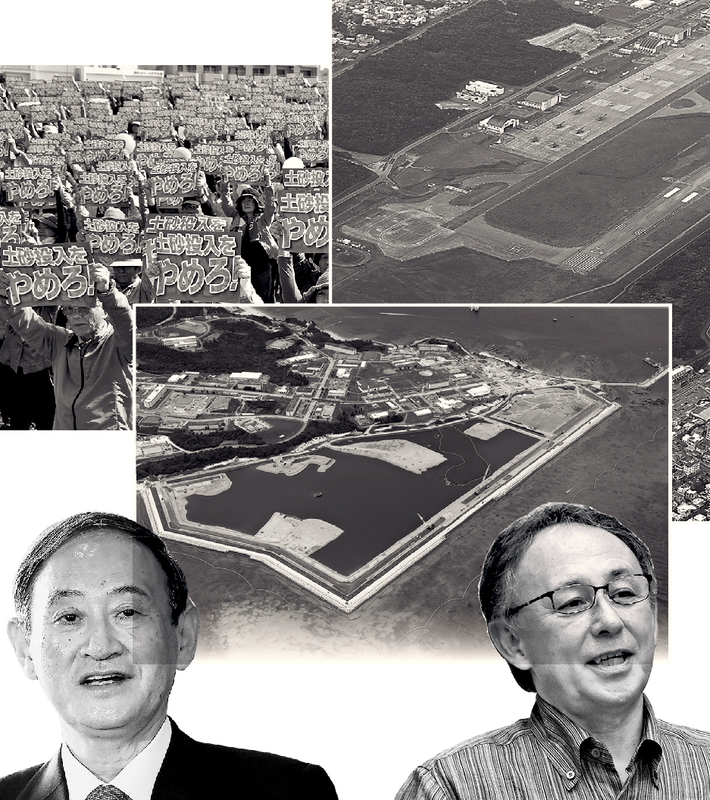
On the morning of Oct. 7, Prime Minister Yoshihide Suga met Okinawa Gov. Denny Tamaki in the reception room of the Prime Minister's Office. It was the first meeting between the two since Suga assumed the post of prime minister.
"I'd like to maintain close cooperation," Tamaki said.
Suga replied: "Sounds good to me. Let's work together."
The meeting lasted only about five minutes, but at the very end of the meeting, their attendants were asked to leave and Suga and Tamaki talked one-on-one.
Suga has a special attachment to Okinawa as he had been involved in the U.S. base issue as chief cabinet secretary.
Also, when the Japanese and U.S. governments agreed in 1996 on the return of the U.S. Marine Corps' Futenma Air Station in Ginowan, Okinawa Prefecture, to Japan, the chief cabinet secretary at the time was Seiroku Kajiyama, whom Suga regards as his political mentor. Suga said he had directly heard Kajiyama say that he had tackled the air base relocation issue with such resolve that his political life was at stake.
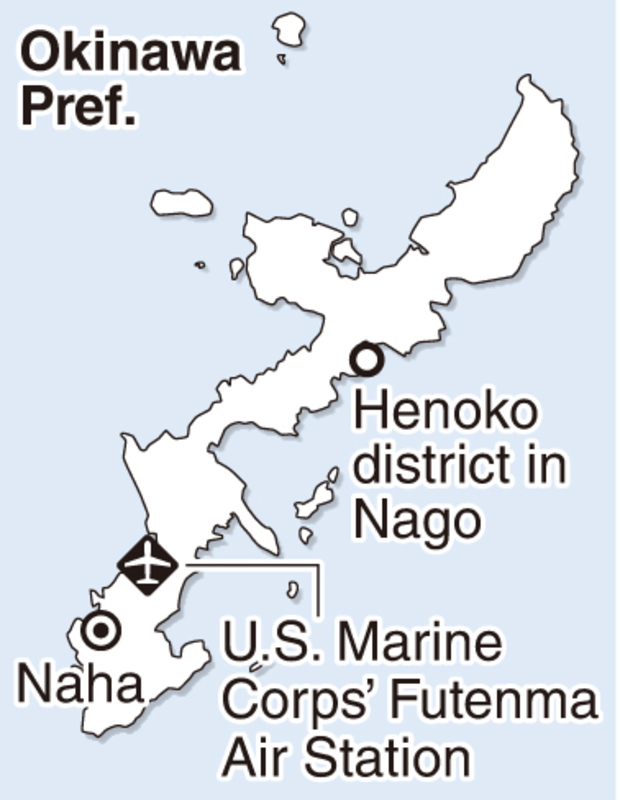
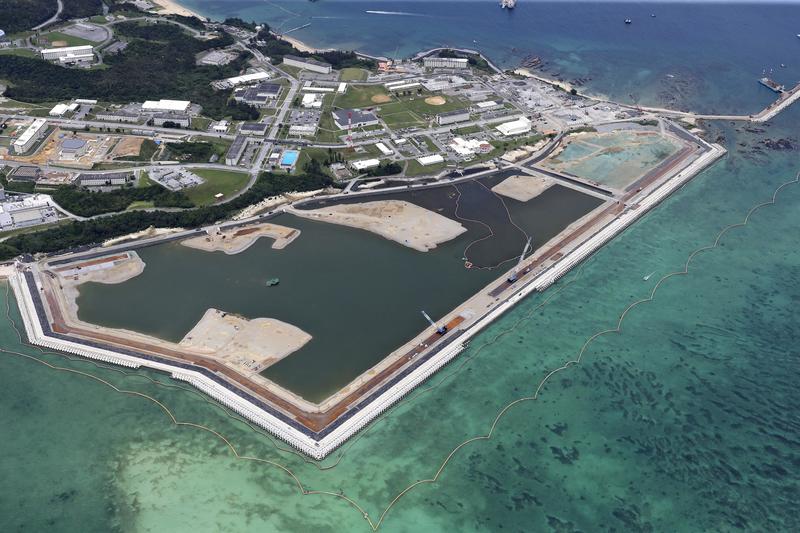
After the agreement on the return of the air base to Japan, Tokyo and Washington reached a consensus in 2006 after twists and turns on a plan to shift the Futenma Air Station to the coastal area of the Henoko district in Nago in the prefecture.
In 2009, however, Yukio Hatoyama, the leader of the then Democratic Party of Japan, declared during his campaign for the House of Representatives election that the air base must be relocated "at least outside the prefecture." After the election, the party for a time took the reins of the central government. Since then, the air base relocation issue has been in turmoil.
The administration led by the then DPJ could not find an alternative place for the relocation and returned to the plan to move the air base to Henoko. However, public opinion in the prefecture calling for the relocation to be outside the prefecture did not halt.
-- Secret meeting
In 2012, when the Liberal Democratic Party returned to power, Suga became chief cabinet secretary, just as his mentor Kajiyama had once been.
Suga has faced the Okinawa issue with the belief that, for Futenma not to be the permanent location for the base, the only realistic solution is to relocate the air base to Henoko.
The first thing Suga had to do as chief cabinet secretary regarding the Okinawa issue was to persuade then Okinawa Gov. Kazuhiro Nakaima.
Nakaima, a bureaucrat from the then International Trade and Industry Ministry and a former chairman of Okinawa Electric Power Co., became governor in 2006 and was originally in favor of the Henoko relocation plan. However, Nakaima, under pressure from Okinawa public opinion, changed his stance in favor of relocating the air base outside the prefecture in the 2010 gubernatorial election during the then DPJ administration.
In the draft budget for promotion and development of Okinawa for fiscal 2014, Suga allocated 346 billion yen, 5.2 billion yen more than the prefectural government's request, giving the maximum possible consideration to Okinawa. In addition, he actively moved toward the shortening of the construction period for the relocation of the air base to Henoko.
In December 2013, Suga met secretly with Nakaima, who had been hospitalized while undergoing checkups, to persuade him to approve the reclamation of the Henoko coastal area and finally obtained Nakaima's approval.
-- Misjudging sentiment
Suga, however, misjudged how the gubernatorial election in November 2014 would turn out. Nakaima lost to former Naha Mayor Takeshi Onaga, who expressed his opposition to the Henoko relocation plan and was supported by an alliance of conservatives and left wingers. The situation forced Suga to review his conventional strategy for Okinawa.
Onaga was a conservative politician who had served as the secretary general of the LDP's Okinawa prefectural chapter and graduated from Hosei University, Suga's alma mater. Believing that if he builds a relationship of trust with Onaga, he could find common ground, Suga attempted to reach out to Onaga.
In July 2015, Suga invited Onaga to a Japanese restaurant in Tokyo, meeting personally to discuss Okinawa issues for about two hours. Although Suga does not drink, as a gesture to Onaga he had the same drink, a highball. On another occasion, although Suga sings poorly, he sang a karaoke song in Onaga's presence.
The gap between them was not bridged, however. In the autumn of 2015, the central government and the Okinawa prefectural government entered into a court battle over the construction for the relocation. After Onaga died in August 2018, Tamaki succeeded to his post and there has been no change in the situation.
With Suga's intention in mind, the central government has not withdrawn even a step, starting the land reclamation work off the coast of the Henoko district in December 2018.
-- Carrot-and-stick policy
While proceeding with the relocation work, Suga has worked hard to produce results in terms of reducing the burden on Okinawa hosting U.S. military bases and the promotion and development of the prefecture.
In December 2016, about 4,000 hectares of the Northern Training Area, which was part of the U.S. facility, was returned to Japan. It was one of the largest areas among the U.S. military facilities that the U.S. has returned to Japan since Okinawa's return in 1972.
This return came about through Suga's efforts behind closed doors, building a relationship with then U.S. Ambassador to Japan Caroline Kennedy through a monthly breakfast meeting.
In addition, Suga reduced by more than one year the construction period for the second runway at Naha Airport, which was initially seven years. The runway started operations in March this year. He also supported the development of Okinawa, including the Nago Higashi (East) Highway, an expressway that aims to have all sections open in 2021.
Suga, after assuming the post of prime minister, appointed Taro Kono, minister in charge of administrative and regulatory reform, as state minister for Okinawa, who is in charge of Okinawa development. He also tapped Chief Cabinet Secretary Katsunobu Kato to be the minister in charge of mitigating the impact of U.S. forces in Okinawa.
On Oct. 1, Suga met Aiko Shimajiri of the LDP, who is a former state minister for Okinawa, and promised her that he would create the next Okinawa development plan to give the people of Okinawa a sense of reassurance, in the same manner as the current development plan that will expire in fiscal 2021. Suga has thus expressed his stance of being actively involved in Okinawa issues even as the prime minister.
The next goal that Suga has in mind regarding Okinawa issues is the gubernatorial election in 2022. The "all-Okinawa" forces that support Tamaki consist partly of conservatives and partly of left-wingers including those from the Japanese Communist Party. But there have been moves among some prefectural assembly members in the conservative camp and some companies to distance themselves from Tamaki, who has been showing a stronger leaning to the left wing.
Amid the Okinawa economy declining due to the novel coronavirus pandemic, it seems that Suga's efforts to produce results in a "visible" manner in terms of reducing the burden on Okinawa hosting U.S. military bases and development measures are obtaining the understanding of the people in Okinawa Prefecture little by little.
However, public sentiment in Okinawa Prefecture, in which about 70% of exclusive-use facilities for the U.S. military in Japan are concentrated, is complicated. There is long-standing criticism of Suga's method of linking the air base relocation issue and development measures as a carrot-and-stick approach, as source related to the Okinawa prefectural government said.
Can Suga's political style win the hearts and minds of the people of Okinawa? There is a rocky road ahead.
Read more from The Japan News at https://japannews.yomiuri.co.jp/