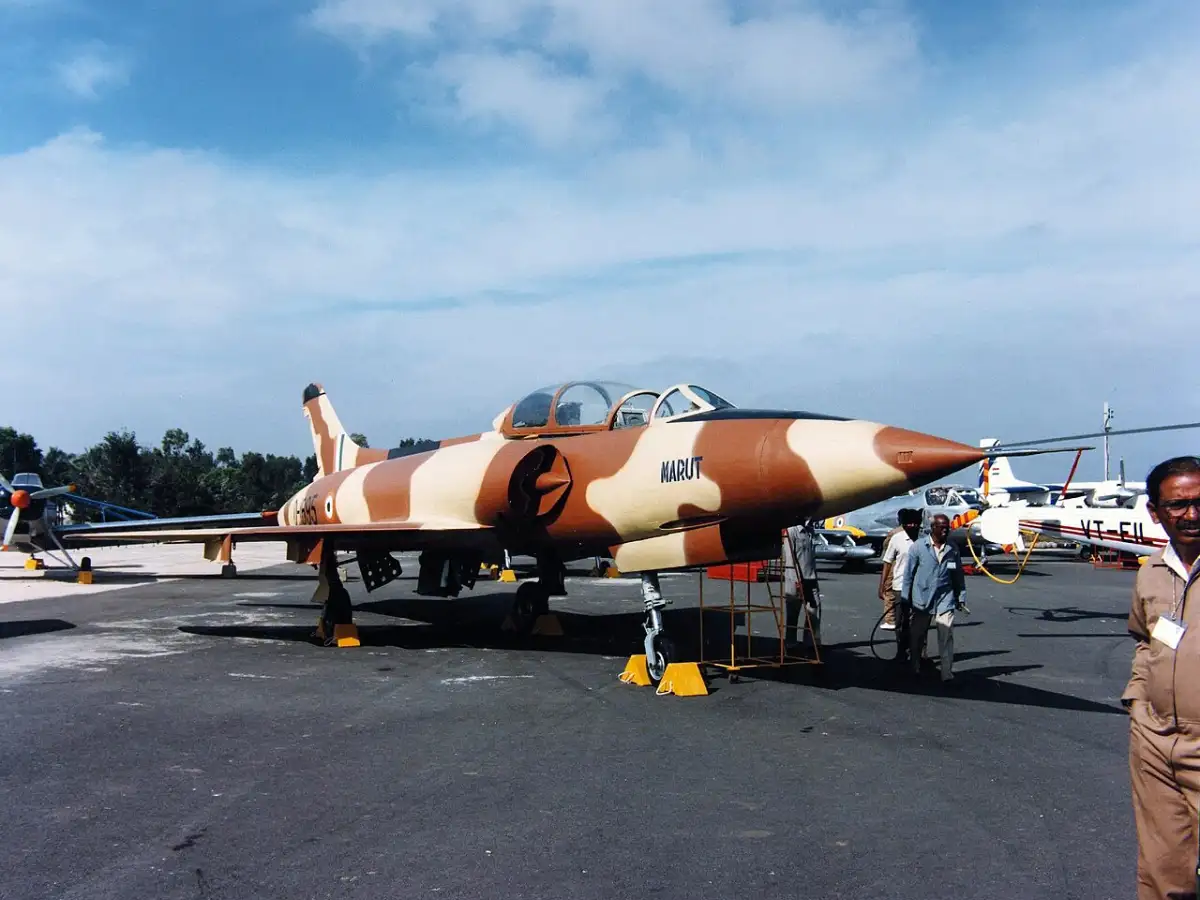
India inducted the HF-24 Marut as its first domestically designed and produced jet fighter, becoming the first Asian country outside Russia to operationally field an indigenous combat jet aircraft.
Developed by Hindustan Aeronautics Limited, the project began in 1956 after Prime Minister Jawaharlal Nehru authorised the development of a Mach 2 multirole fighter aircraft with a 500-mile range. The programme aimed not only to strengthen India’s air power but also to expand the country’s domestic aeronautics industry.
German designer Kurt Tank led ambitious project
To support the programme, India recruited German aircraft designer Kurt Tank, known for designing the Focke-Wulf 190 fighter aircraft during World War II.
By 1959, Tank had developed a full-scale glider mock-up, followed by a flying prototype in 1961. However, the project faced major setbacks due to engine limitations. The aircraft had originally been designed around a more powerful afterburning Bristol Orpheus engine, but India declined to fund its development.
Attempts to source alternative engines from the Soviet Union, Europe, and the United States also failed because of changing political conditions and stalled negotiations.
Engine limitations reduced aircraft capability
As a result, HAL was forced to use weaker non-afterburning Orpheus 703 turbojets. The reduced thrust meant the aircraft could barely achieve Mach 1 speeds, despite originally being envisioned as a Mach 2 fighter.
By the time the Marut entered service in 1967, it was already considered technologically outdated compared to aircraft such as India’s MiG-21s and Pakistan’s F-104 Starfighters. The Indian Air Force eventually abandoned plans for radar and air-to-air missile integration, shifting the aircraft primarily to light attack duties.
Only 147 HF-24 aircraft, including trainer variants, were produced.
Marut played key role during 1971 war
Despite its limitations, the HF-24 earned recognition during the 1971 India-Pakistan war, particularly during the Battle of Longewala.
Jets from No. 10 Squadron, supported by Hawker Hunters, launched attacks on Pakistani armoured formations using rockets and 30-mm cannons. The strikes reportedly destroyed dozens of tanks and over 100 vehicles, helping halt the Pakistani advance and contributing to India’s counteroffensive on the western front.
Throughout the 13-day conflict, Marut aircraft conducted more than 200 sorties targeting airfields, ammunition depots, tanks, and artillery positions. The aircraft reportedly demonstrated strong durability, with several jets returning safely despite suffering engine damage.
One Marut pilot, Major Bakshi of 220 Squadron, also reportedly achieved an air-to-air kill against a Pakistani F-86 Sabre.
Aircraft retired by 1990
Following the war, proposals were made to upgrade the Marut with more powerful engines, but the Indian Air Force instead shifted focus toward Soviet-origin aircraft including the Su-7, MiG-23, and MiG-27.
The HF-24 gradually began retiring from service during the 1980s, with the last aircraft withdrawn in 1990. Many surviving airframes are now preserved as static displays and monuments across India.
Marut programme seen as lesson in defence planning
The HF-24 programme is often viewed as both an ambitious technological achievement and a cautionary example of how poor planning, engine dependency, and bureaucratic delays can undermine defence projects.
At the same time, the aircraft’s combat performance demonstrated that operational effectiveness in war can sometimes outweigh technical shortcomings, particularly when deployed under favourable battlefield conditions.
(With inputs from National Interest)