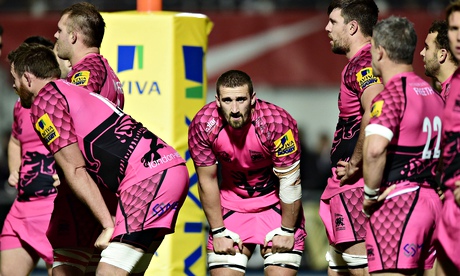
A STAIN ON THE PREMIERSHIP
London Welsh are on course to record the lowest points total in a Premiership campaign having mustered one in their opening 12 matches. There are 10 rounds to go, but the closest they have come to an opponent is 11 points, the margin of defeat against Harlequins last Sunday.
It has been a sobering return to the top flight for the Exiles who two years ago made a bold start to their first season in the Premiership only to be undermined by an administrative mistake that cost them league points and, played out over a period of weeks, had a deflating effect.
A team promoted from the Championship that does not have a Premiership history, so lacking preferential shares, starts with a considerable handicap: London Welsh receive £1.7m from central funds, a portion of which is diverted to the Rugby Football Union’s academy programme even though the club does not have an academy as the franchise in its area is run by Wasps, who now play in Coventry.
The established clubs in the Premiership receive closer to £4m a year from central funds,. The disadvantage can be overcome without the input of a wealthy backer, as Exeter showed when they were promoted in 2010, but the Chiefs had their own ground and the ability to exploit it commercially every day of the year.
The Exiles are tenants at the Kassam Stadium, still based in Richmond where Old Deer Park is not substantially different to the way it was in the amateur era. They feel the difference in central funding keenly and it is an issue Premiership Rugby should be addressing and correcting.
London Welsh have retained 80% of their squad from last season. Only seven players left in the summer: three players who were on loan returned to their clubs, three retired and one was let go. They made some high-profile signings, most notably the New Zealand scrum-half Piri Weepu, but the £2m-plus they missed out on as relative novices would have allowed them to develop a strength that would have enabled them to use their bench in the final 25 minutes of matches rather than collapse.
The London Welsh chairman, Bleddyn Phillips, has written to all the Premiership clubs asking for funding to be made equal and hopes that not only will agreement be reached, but that it would be backdated, allowing his club to bring in players for the final months of the season. There would no danger of the Exiles breaching the salary cap regulations.
He has not ruled out taking legal action if the move fails. London Welsh won an appeal after being denied promotion in 2012 on the basis that the Premiership had one rule for existing members and a different one for aspirants over primacy of tenure. Three QCs decided that Premiership Rugby was effectively operating as a cartel and the same argument could be applied over funding.
If London Welsh are relegated, they would get a parachute payment close to the £1.7m they have received this year, but it would hardly be compensation. If English football’s Premier League, not a collection of clubs known for their altruism, can operate a policy of equal funding, leavened by merit payments based on finishing positions and the number of live television matches they play, and if the Top 14 in France gives the two promoted clubs a shade more than the rest to help them compete, why is the Aviva Premiership living in a darker age?
One of the arguments Premiership Rugby has put forward for the retention of the salary cap, in the face of an attempt by Saracens to have it done away with, is that clubs should live within their means – income they generate and receive from the tournaments they play – and not be reliant on rich owners who may not be in it for the long haul. Think Ashley Levett at Richmond in 1999.
That example is not being set to clubs in the Championship. London Welsh defeated Bristol in last season’s play-off but had the West Country club won, it would not have been as financially constricted as the Exiles, and not just because having spent nine seasons in the Premiership it would have received more in central funds. Its majority shareholder, Steve Lansdown, is one of the wealthiest men in Britain and his stated aim is to take Bristol, who this week announced the signing of the former England wing Tom Varndell from Wasps, to the top of the Premiership and Europe.
Their rivals for promotion, Worcester, have also spent nine seasons in the Premiership and have money behind them. Any increase in funding may come too late for London Welsh this season, but if they were to achieve promotion again they would be in a better position to make a go of it with equal funding.
They are right to fight for the principle and in the year of the 20th anniversary of the shift to professionalism, Premiership Rugby’s stance of rewarding those who have contributed to the tournament through the years has become redundant. It is not a closed shop.
London Welsh’s record this year is a stain on the Premiership. They have conceded 50 points or more five times, losing 71-7 at Wasps and 78-7 at Saracens. Premiership Rugby likes to bill itself as the most competitive league in the world but as long as it makes it difficult for a promoted side that lacks a wealthy backer to compete, the boast will be an idle one.
Perhaps an extra £2m would have made little difference to where London Welsh are in the table given that a better resourced Worcester did not secure their first victory last season until 30 March, although their points difference would surely have been healthier and they would have been better able to exploit the rut London Irish are stuck in. The principle of inequality made it less likely that they would survive.
London Welsh’s appeal to the other clubs will probably not meet with too much sympathy, Exeter apart, because the current system serves them well. As long as it remains, it will scar a competition that otherwise has so much to commend it.
• This is an extract taken from the Breakdown, the Guardian’s weekly rugby union email. Sign up here.