The marathon has undergone no little evolution since the herald Pheidippides dropped dead after running 25 miles from a battlefield to deliver news of a Greek victory against the Persians to Athenian magistrates. For starters the intervention of Queen Alexandra before the 1908 London Olympics led to the official distance being extended by over a mile so the race would begin in her front garden and end under the royal box, minimising the need for her majesty to muddy her royal spats mixing with the riffraff as she watched it. It was a controversial move that led to an enduring tradition whereby weary marathon runners still shout “God Save the Queen!” as they pass the 25-mile mark. Of course at this late stage of the event one suspects the exhortations of many competitors tend to be less felicitous.
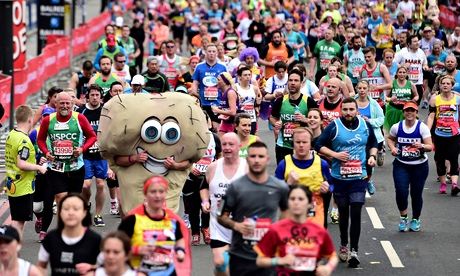
Commercially the race has also mushroomed beyond all recognition. Had the unfortunate Pheidippides enjoyed the benefits afforded to modern-day runners one suspects he might have lived to bask in the glory of becoming the first person to complete the race named after the site of the battle from where he set off on his fatal run. The burgeoning popularity of the event means companies of every stripe and shade are falling over themselves to have their brand attached to the London Marathon, a race that has become increasingly seared on the public consciousness since 7,055 competitors first assembled at the start line in 1981. This year five times as many people took part with an estimated crowd of 750,000 cheering them on.
Upon collecting their race numbers at the ExCeL Centre in the city’s Docklands last week participants were subsequently ushered through the event’s Expo, staged in a cavernous arena transformed to all intents and purposes into a giant sports shop occupied by a dizzying array of big-name retailers hawking all manner of items designed to help ease the pain of taking to the streets a day or two later. “Protect your feet with good training shoes,” advised Chris Brasher, the former Observer athletics correspondent and driving force behind the first London Marathon in the buildup to the inaugural event. “Keep warm – a decent jogging suit can cost as little as £13.95.”
Thirty-four years on, expert advice for runners remains much the same, albeit considerably more technologically advanced and expensive. Last week at the ExCeL Centre, £13.95, or even 10 times that amount, wouldn’t get you too far. Having had his stride and pronation inspected and adjusted courtesy of the many chin-stroking gait analysts present our ancient Greek emissary Pheidippides would surely have delighted in swapping his sandals for some of the more appropriate and garish footwear available. A pair of trainers with padded split tongues perhaps, with bouncy cushioned midsoles and snug uppers finished with a stretchy mesh.
Rumoured to have run the original marathon in full armour, a state of affairs that would almost certainly have contributed to his premature demise, Pheidippides would also have delighted in abandoning his standard-issue kit for one of the many international high-performance brands of ergonomically cut, anatomically engineered activewear available, complete with cutting‑edge medi‑compression to act as a high‑functioning exoskeletal support structure, all the better to prevent blisters, chafing, joggers’ nipple, rashes and odours. T-shirts, in other words. And shorts, not to mention the kind of “decent jogging suits” of which our man Brasher could only have dreamed.
Suitably kitted out, our ancient endurance runner could have topped off his ensemble with any number of accessories to delude himself into thinking his odyssey might become less gruelling. Entrants to this year’s London Marathon were invited to take their pick of expensive tracking devices with in-ear precision heart rate monitors boasting immersive Dolby sound to keep them accurately informed of where they are and how terrible they are feeling at any given time and how much more terrible they are likely to feel at any given point in the future.
To provide respite any number of gloopy energy gels, protein bars, hydration tablets, isotonic sports drinks and streamlined receptacles in which to carry them were also available. With so much artificial assistance available before their epic run participants could be forgiven for wondering if all those long and tedious hours pounding the streets over the winter had been a complete waste of time.
The London Marathon has become big business since, inspired by its New York equivalent, co-founders Brasher and his friend John Disley dreamed up the wheeze of running a similar event over a few pints in the Dysart Arms near Richmond Park. Now the second biggest race of its kind after Tokyo, it is broadcast live on BBC television and staged on a course that is as heavily branded as it is attended.
The economic impact on the city of London is estimated at £110m, which is no bad thing, while a massive £53m was raised for various worthy causes by competitors last year. However, what is not measurable but no less discernible is the general feelgood factor generated by all concerned, an all too rare and convivial atmosphere on the streets of an often unfriendly city which helps in no small way to dwarf the feelbad factor experienced by most of those competing as bitumen bites into leaden legs and the road takes its inevitable toll.
As its founder once said, races don’t get more human.