Afternoon summary
- Meg Hillier, the chair of the Commons public accounts committee, has told two senior civil servants that the flaws in Whitehall’s handling of Kids Company were “staggering”. (See 5.58pm.) She was speaking at the end of a hearing that saw Richard Heaton, the former permanent secretary at the Cabinet Office (and now permanent secretary at the Ministry of Justice) and Chris Wormald, permanent secretary at the Department for Education, admitting there were multiple lessons to be learnt from the way grants were handed to the charity that then when bust. They both claimed it did not receive special treatment. But they both came under repeated criticism from MPs during the hearing, with one saying the handling of the charity was “flawed and flawed and flawed and flawed”. (See 5.24pm.)
- Labour has moved the writ for the Oldham West and Royton byelection to take place on Thursday 3 December. Four candidates have made the shortlist for the Labour selection.
The Labour shortlist for Oldham West and Royton byelection is Mohammed Azam, Jane East, Jim McMahon and Chris Williamson.
— Arif Ansari (@ArifBBC) November 2, 2015
- Gordon Brown, the Labour former prime minister, has said that amendments tabled by the government to the Scotland bill today mean that “the Vow”, the promise of further devolution to Scotland made by the three main UK parties just before the independence referendum, has now been implemented. In a statement he said:
Major Conservative amendments tabled today to the Scotland bill would mean that, if passed into law, the Smith Commission recommendations - which arose from The Vow, signed by the three main UK party leaders in September 2014 - have now been delivered and Scotland can now develop its own social model, including repealing the Tory tax credit cuts.
The total of 100 amendments that have been tabled have come because of Labour pressure from Ian Murray and the new Scottish Labour leadership. This summer I also wrote to the Prime Minister calling for these changes, submitted a paper to his government and made representations across the board.
Faced with allegations of betrayal, the UK Government have not only backed down but now the Scottish Government is under pressure to say what they would do to reverse tax credit cuts planned by the Conservatives.
But the SNP government in Scotland claims the changes to the bill “still fail Scotland”.
That’s all from me for today.
Thanks for the comments.
Updated
Hillier says flaws in the Kids Company affair are 'staggering'
Meg Hillier ended by asking Wormald if he still thought that Kids Company did not get special treatment.
Ministers made it clear they thought Kids Company was doing important work, he said.
But if by “special treatment” you mean were rules broken, the answer is no, he said.
Hillier then wrapped up the session by effectively giving a reprimand to Wormald and Heaton. She said:
You are responsible for watching taxpayers’ money. It has been very instructive to hear what you’ve got to say. Our report will be coming out shortly.
The learning lessons that you’ve highlighted (see 5.49am) frankly strike us as rather staggering that these are things that weren’t asked some time before today when everything has gone belly up, and this hot potato has had problems.
She also said the committee may call Wormald and Heaton back.
Wormald and Heaton identify their 'lessons learnt'
Q: Which ministers decided to back Kids Company?
Heaton says the NAO report says four departments agreed to fund one particular payment.
Wormald says the Department for Education was in charge of that, but other departments contributed.
Q: Did ministers put pressure on you?
Heaton says ministers did not put pressure on him. But it was his job to deliver what ministers wanted to achieve.
Wormald says he did not come under pressure from ministers either.
Q: Why did the Cabinet Office take over responsibility for funding Kids Company in 2013?
Wormald says that is because responsibility for youth policy went to the Cabinet Office.
Q: What lessons have your learnt from this?
Wormald says he has identified four learning points.
First, the department needs to consider whether funding charities on a continual one-off basis is appropriate.
Second, it needs to consider whether it has got the right balance between self-reporting and external evaluation of charities’ performance.
Third, it needs to consider whether it is putting too much focus on outputs instead of outcomes.
Fourth, this has shown how it needs to improve record keeping.
Heaton says he has identified three lessons.
First, this shows the importance of getting evidence first, and taking decision later.
Second, this shows the drawbacks in the “passing the hat round” approach to funding charities (ie, getting several departments to contribute). This reduces accountability, he implies.
Third, the affair shows that things can get “a bit messy” when charities are funded from different routes. Funding commitments should only come from the departments giving the money, he says.
Wormald says it is a matter of public record that prime ministers expressed a view on Kids Company. He is not saying Number 10 did not express a view. But the audit trail shows that normal civil service procedures were followed.
Nigel Mills, a Conservative, is asking questions now.
Q: Did civil servants raise concerns about the threats made by Kids Company about what might happen if they did not get money?
Wormald says civil servants raised some concerns as part of their evaluation.
Q: Did you find “Dear Tony, Dear Gordon, Dear David” letters? Did prime ministers raise concerns with the department?
Wormald says it is a matter of pubic record that prime ministers took an interest in the charity. Letters were forwarded to the department in the normal way.
But he plays down the suggestion that his department came under pressure from Number 10 to keep funding the charity.
Heaton denies coming under political pressure to keep funding Kids Company
Heaton says the committee may think he was being naive, but he decided to approve the £4m for Kids Company.
Q: So you were not motivated by the political interest?
Heaton says he was not unduly motivated by the politics. He knew this was a charity that attracted the interest of the prime minister and other ministers. But he is a fairly robust person, he says, and if he thought a ministerial direction, he would have insisted on one.
- Heaton denies coming under political pressure to keep funding Kids Company.
He says he took over Kids Company with some apprehension. It had innovative methods, and low reserves. he was “apprehensive”. He wanted to get to the bottom of how the charity was run.
Richard Heaton on #kidscompany: "It was an unusual jewel in our funding crown"
— Sebastian Payne (@SebastianEPayne) November 2, 2015
Q: Did you think the Department for Education had funded it in a bad way?
Heaton says he did not come to a judgment on that.
Updated
Anne-Marie Trevelyan, a Conservative, says the handling of Kids Company was “flawed and flawed and flawed and flawed”.
Anne-Marie Trevelyan asks why no ministerial directions before (unsubtle subtext: "you spineless courtiers") #KidsCompany
— Chris Cook (@xtophercook) November 2, 2015
Updated
Q: If Kids Company had not gone insolvent, would you still be funding them today?
It depends, says Heaton. Then he corrects himself and says no; it was meant to become self-funding.
Q: Why did you not impose strict conditions when giving Kids Company the £4m?
Heaton was the department was “getting serious”. There were strict conditions imposed, he says.
David Mowat says the charity only talked about downsizing; it did not make a firm commitment.
Heaton says the company would have gone bust if it had not had the £4m in one go. It was a judgment call.
Q: So you did not have a firm guarantee that they would downsize?
Heaton says that is correct. The downsizing did not happen.
- Heaton says Cabinet Office was told Kids Company would cut costs, but was not given a firm guarantee.
Caroline Flint, the Labour MP, goes next.
Q: It is hard to find out what interventions make a difference. It was felt by civil servants, and maybe ministers, that Kids Company had a model that could provide lessons that might apply nationally. Yet for many years Kids Company did not make this kind of impact.
Wormald says this is disputed.
There was some evidence Kids Company was effective, he says.
Q: Some of those studies they commissioned themselves. In 2011 DWP and DfE seconded staff into the organisation. Who did those civil servants report back to?
Wormald says the DfE civil servant was quite junior. They were not there to audit the organisation, he says.
Heaton says a charity in Sunderland with the same appeal to politicians may have succeeded in getting this kind of funding.
Bridgit Phillipson picks up on the line about “appeal to politcians”, suggesting that is significant.
Labour’s Bridgit Phillipson goes next.
Q: In this case national government seemed to be funding a charity working on a local basis?
Wormald says that happens from time to time.
Heaton says, looking at it from the Cabinet Office, it is unusual for central government to fund local interventions. But in education it may be difficult, he says.
Q: Would a charity in Sunderland receive the same amount of direct funding as a charity in London?
Wormald says he cannot say.
But Kids Company was spreading out to other areas, he says. There was a national outreach.
Heaton says government should be less willing under the Charities Act to use its power to give general grants to charities.
And we should be careful about anyone in government giving funding commitments to charities.
And we should be wary of government departments funding charities by “whip round”, because what happens then is that departments do not focus on value for money.
Wormald says he agrees with these points.
Heaton says ministers are entitled under their powers to back what powers they want.
Wormald says central government can learn from local government.
The Labour MP Karin Smyth goes next.
Q: Should you have asked councils whether funding Kids Company was a good idea?
Probably, says Heaton. He suggests councils have a better idea as to what works in terms of delivering services than central government.
Heaton says he was not “totally comfortable” with the decision to give Kids Company £4.3m.
He did consider asking for a ministerial direction. But he did not ask for one in the end.
When Kids Company later came back and asked for £3m in emergency funding, he thought it was “astonishing” that it needed the money.
The initial reaction was to say no.
The charity then came back with a “very bold” restructuring model, including radical downsizing and the chief executive stepping down.
Ministers took the view that was worth funding. But he personally could not sign up to it, he says, which is why he required a ministerial direction (an order from ministers telling the civil service to act against their better judgment - a formal process triggered by senior civil servants only very rarely when find it hard to justify a ministerial decision.)
Fmr Snr Civil Servant tells MPs he didn't think Kidsco was worth a final £3m but that ministers thought it 'worth a punt' #kidscompany
— Carl Dinnen (@carldinnen) November 2, 2015
Updated
Wormald says, again, there are “learning points” from this affair.
David Mowat says one of the learning points is that the Department for Education should have told the Cabinet Office when it passed over responsibility for Kids Company to the Cabinet Office that the charity had no reserves.
Here’s another Twitter comment on the terminology we’re hearing at the committee.
Heaton's use of "unusual" to describe Kids Co is Sir Humphrey-esque. Up there with "bold" and "courageous" in mandarin speak
— Stuart Millar (@stuartmillar159) November 2, 2015
David Mowat says it seemed to be “quite naive” to think that Kids Company would change the way they operated.
Q: What made you think that, instead of giving them £1m a quarter, by giving them £4m in one go they would change the way they operated?
Heaton says the Cabinet Office thought the charity had turned the corner.
He says he was working with serious philanthropists who were prepared to help the charity reform the way it worked.
Q: You were giving them £4m. Did you know what it was going on?
Yes, says Heaton.
Q: But it went all on staff.
Heaton says if that money had not been paid in one sum, the charity would not have survived. The Cabinet Office thought paying the £4m upfront would enable the charity to become self-sustaining.
He made a judgment call, he says.
It was not an over-optimistic judgment.
But, with hindsight, he might have made a different call.
Heaton concedes it may have been "naive" of him to believe handing KC £4.5m grant in one go would solve its problems
— Stuart Millar (@stuartmillar159) November 2, 2015
Updated
Heaton says Kids Company was “not good at measuring its outcomes”
Heaton says Kids Company was “not good at measuring its oucomes”.
Method Consulting was helping them with this, he says.
But Kids Company improved. “They got the point of outcomes measurement,” he says.
- Heaton says Kids Company was “not good at measuring its outcomes”.
Wormald: "v few people had been doubting the quality of what KC had been achieving" David Mowat MP: "Most people weren’t paid to do it "
— Alan White (@aljwhite) November 2, 2015
Updated
Richard Heaton says the Cabinet Office knew that Kids Company was controversial. It had unusual working methods.
The Kids Company worked with consultants who had been inserted by the Department for Education.
The department wanted to address its financial sustainability and governance.
There was a collective decision in government to continue funding it, he says.
But the Cabinet Office insisted on an “outcomes framework”. And it insisted on sustainability.
It did not want the charity to be an endless receiver of help.
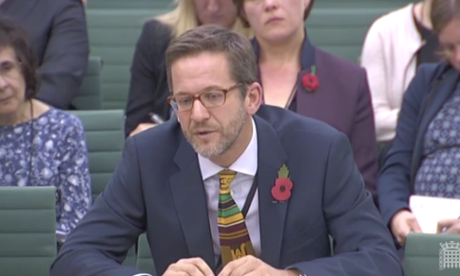
This is a rather good take on one of the phrases Wormald is using.
Perm Secretary Wormald has a novel term for f**k-ups: he calls them 'learning points'. #PAC #kidscompany
— Briefcase Michael (@BriefcaseMike) November 2, 2015
Wormald says Kids Company funding seemed to provide value for money.
Q: The NAO says the Kids Company had a target of 1,347 interventions. Could that target have been higher?
Wormald suggests, with hindsight, it could have been higher.
But at the time that looked like value for money.
Q: How did you know?
Wormald says the negotiation that led to that target was based on the department’s experience of working with Kids Company.
Meg Hellier intervenes. “But you repeatedly raised concerns about the performance of Kids Company?”
Wormald says, until recently, people were not questioning the quality of Kids Company’s work.
The warnings were about its financial management, not the quality of its interventions.
As an example, he cites the youth sector development fund. A report said it was becoming a centre of excellence.
- Wormald says Kids Company funding seemed to provide value for money.
He says most of the monitoring related to outputs, not outcomes.
That is an area where lessons can be learnt, he says.
David Mowat says this does sound like special treatment.
Wormald says the committee can decide what was special treatment.
Q: You had the legal powers to do this. But this was the only charity to go through your evaluation process, lose, and then get money. Were you able to cut the funding?
Wormald says Kids Company got £4m. That was increased when the Cabinet Office.
He says the department funds a number of charities by direct grant. As examples, he cites Teach First, the Holocaust Memorial Trust and Childline.
Q: Before 2013, when was the last successful bid the Kids Company made?
Wormald says they made a successful bid for funding in 2011.
Wormald rejects claim Kids Company got special treatment
David Mowat, a Conservative, goes next.
Q: You said Kids Company did not receive special treatment on your watch. Yet in 2012 you launched a national prospectus. Kids Company bid, but failed because their bid was not considered very good. But in 2013 you made them an award that was larger than those that went to the charities that won. You said that was partly so you did not suffer reputational damage.
Mowat quotes from paragraph 4.2 of the NAO report.
The Public Interest Case recommended that the government continued to support Kids Company’s work with young people on the basis of:
• Precedent (DfE had funded the charity since 2005);
• the quality of the work Kids Company did (particularly with young people who were not in employment, education or training (NEET); and
• the reputational damage to the government’s wider agenda (which would have an impact on delivery) if it withdrew funding.
Q: That implies special treatment?
Wormald says he wanted to be sure it was reasonable to put this to ministers. He asked for a public interest case to see if this was reasonable. He agreed that. It was a reasonable case. It went to ministers, and they took the final decision, he says.
Q: So does that amount to special treatment?
Wormald says the department funds a range of charities by direct grant, like Childline.
- Wormald rejects claim Kids Company got special treatment.
Updated
Q: Were there not issues about how the money was handed over?
Wormald says the NAO report is very good.
In terms of warnings, they were one piece of evidence on the table.
But there was other evidence about Kids Company doing valuable work, he says.
He say he has discussed this with his two predecessors.
When you look at what Kids Company was actually doing, the decision to give it money looks right.
Q: But the money went up?
That’s because Kids Company was successful in a serious of bidding processes, he says.
Q: In 2011 Kids Company bid against other charities, and received far more than the others - 20% of the pot.
Wormald says that is right.
But that is not the same as saying it received 20% of what was given to the voluntary sector.
His department gives £200m a year to the voluntary sector. Kids Company was getting about 2% of that, he says.
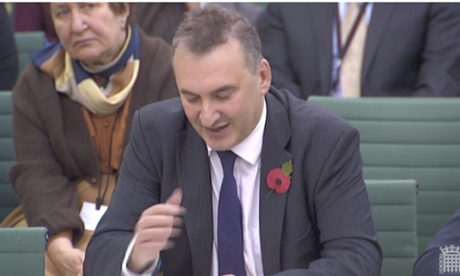
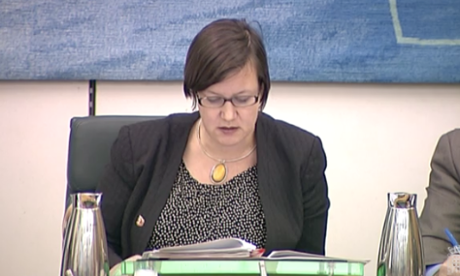
Meg Hillier, the committee chair, starts by quoting Janet Street-Porter saying the NAO report into Kids Company says more about the failings of Whitehall than the failure of the charity.
She says Richard Heaton and Chris Wormald are accounting officers. They are supposed to stand up to ministers to protect public money.
She says councils were far more reluctant to get involved in Kids Company than Whitehall was.
She says she hopes the witnesses will be frank about what happened. “It is hardly an edifying story,” she says.
Q: Did Kids Company received special treatment?
Chris Wormald says he does not think it did. And he does not accept the way Hillier described it, he says.
There are learning points, he says. But he does not think there was a point where civil servants should have insisted on ministerial direction (ie, when they should have refused to pay Kids Company a grant without having an order in writing from ministers.)
Updated
The hearing is about to start.
And here is Chris Cook on Wormald.
Three things to know about Chris Wormald of DfE: (i) he says "I'll write to you about that" about everything he can get away with.
— Chris Cook (@xtophercook) November 2, 2015
(ii) He says "I don't recognise that document/data/figure" as a way of saying "That is true, but awkward".
— Chris Cook (@xtophercook) November 2, 2015
(iii) He reminds me of a policeman from an Ealing comedy. "I was per-amb-you-latin' through White-'all..."
— Chris Cook (@xtophercook) November 2, 2015
The two witnesses giving evidence to the committee are Chris Wormald, who has been permanent secretary at the Department for Education since March 2012, and Richard Heaton, who has been permanent secretary at the Ministry of Justice since September but who is being questioned about his time as permanent secretary at the Cabinet Office for the previous three years.
Here is Newsnight’s Chris Cook on them both.
PAC Kids Company committee includes 2 people routinely talked about as potential successors to @HeadUKCivServ - both have essential...
— Chris Cook (@xtophercook) November 2, 2015
..experience of running departments with absolutely terrible records for failure to comply with transparency laws (DfE and Cabinet Office).
— Chris Cook (@xtophercook) November 2, 2015
Updated
MPs question senior officials about grants to Kids Company
The Commons public accounts committee will soon be taking evidence about government grants to Kids Company. The hearing starts at 4pm.
The witnesses are Richard Heaton, former permanent secretary at the Cabinet Office, and Chris Wormald, permanent secretary at the Department for Education.
Here is some background to the hearing.
- A timeline from the committee
Don't miss today's hearing on #KidsCompany with @cabinetofficeuk & @educationgovuk at 4pm https://t.co/dwSeld3xmg pic.twitter.com/KOdlae4BH5
— Public Accounts Comm (@CommonsPAC) November 2, 2015
A National Audit Office (NAO) report indicates that David Cameron, Michael Gove, Ed Balls and David Blunkett intervened to support Kids Company between 2002 and 2015, in some cases to prevent it from becoming insolvent, and often after being directly lobbied by the charity itself.
Civil servants repeatedly warned ministers that providing financial support toKids Company carried risks because of the charity’s persistently fragile finances. But they were overruled, the NAO reported – though there is no evidence that ministers acted inappropriately or beyond their powers.
Here is a summary of the NAO report (pdf). And here is a full copy of the 39-page report (pdf).
- A BuzzFeed report about a report into Kids Company obtained by BuzzFeed and Newsnight. Here’s an extract.
The confidential report, carried out by auditors at PricewaterhouseCoopers (PWC) in late July this year, details how:
– The charity spent more than £50,000 meeting the cost of a PhD for an individual described as the relative of an Iranian diplomat
– Two children of staff members received over £130,000 in client payments
– Another client received more than £47,000 in tax-free support in 2014
– A client had also been bought a pair of designer shoes for £305
The latest revelations will pile pressure on Cabinet Office ministers Oliver Letwin and Matt Hancock, who overruled their civil servants despite the PWC report and handed millions to the controversial charity just days before it shut its doors on 5 August. The pair are due to appear before the House of Commons public administration committee (PACAC) next month to explain their decision.
- A Huffington Post blog by Chris Evans, a Labour member of the public accounts committee, about what he intends to ask this afternoon. Here’s an extract:
I will be asking the senior officials from both Cabinet Office and the Department of Education what, if any, warnings were given across the years and seeking to establish why this were not followed.
£42million of taxpayers’ money was poured into an organisation which was poorly managed and did not deliver the results expected.
The simple truth is public money belongs to the taxpayer, not to Ministers. Every funding decision has to be viewed through this prism. In the case of Kids Company this was evidently not followed. It is only right that those who made these decisions are held to account.
Rosie Winterton, the Labour chief whip, has moved the writ for the Oldham West and Royton byelection to take place on Thursday 3 December. The byelection was caused by the death of Michael Meacher.
The Labour party’s statement on the government’s adoption proposals is much blander than Ukip’s. (See 3.07pm.) This is from Sharon Hodgson, the shadow minister for children and families.
The recent reports that there has been a marked drop-off in the number of children being placed for adoption are concerning.
We welcome measures that will increase adoption and ensure that action is being taken that is in the best interests of the child. However, if David Cameron marginalises other forms of care such as kinship care and fostering, this will not result in the step-change we need to see in outcomes for looked after children.
Government must develop a strategy for the wholesale improvement of the care system that delivers for all, not just those children being considered for adoption.
Ukip criticises Cameron's plans to increase the number of adoptions
Ukip has criticised David Cameron’s plans to speed up the adoption process. It is particularly critical of the plan to put pressure on councils to increase the use of early placement. (See 9.58am.) It is an interesting critique because it shows two parties from the right (the Conservatives and Ukip) split on an issue relating to the powers of the state.
This is from Douglas Carswell, the Ukip MP.
If we accelerate the adoption process, we need to ensure it is still subject to proper scrutiny. Taking children away from their parents by force is a big deal, and we need to get it right. Evidence needs to be tested in an open court and the evidence of experts open to challenge. This does not happen today.
Setting targets means unintended consequences. 70,000 children are in care, and not enough are adopted. Yet setting adoption targets puts pressure on the system to break up families. It means more easy-to-place infants and toddlers being taken off mum, not necessarily more adoptions of challenging teenagers.
The government is proposing to speed up adoption without due legal process: ‘We want to see more early placement for adoption, so children move in with their prospective new family sooner, without having to wait for the full process to complete.’
Might this lead to more miscarriages of justice like what happened to the Coxes, whose child was removed and legally adopted before medical evidence proved the natural parents were blameless?
(Actually, the government news release does not talk about targets. It proposing encouraging councils to make more use of early placement by making them publish figures showing how often they do this.)
Last week Ukip published a policy paper on the family courts saying there should be more use of special guardianship orders, which enable children in care to stay with relatives. As the Number 10 news release shows, the government wants these to be used less often, not more often. It is concerned that that these are currently being issued when they are not appropriate.

Updated
Lunchtime summary
- David Cameron has reaffirmed the need for the government to be able to change the law to enable the police and security services to keep monitoring communications data. Speaking ahead of the publication of the draft investigatory powers bill on Wednesday, he also seemed to confirm that the government will reject a recommendation for ministers to lose their power to decide surveillance warrants. (See 12.31pm.) Earlier Lord Carlile, the former independent reviewer of terrorism legislation, said it would be glib for the government to require judges to approve warrants to intercept communications.
- Maria Eagle, the shadow defence secretary, has said that the decision of the Scottish Labour party to oppose Trident renewal does not change party policy. Speaking on the World at One, she said:
Let’s be very clear about what this does and does not mean. This does not change our policy. Defence isn’t a devolved matter, so Labour party policy has to be set at a UK level.
The UK party’s policy on Trident was currently the subject of a review, she said. It would be “a serious review, based on evidence and serious consultation”, she said, and, although she did not yet have a timescale, “it won’t be short.” But earlier Diane Abbott, the shadow international development secretary, predicted that the party as a whole would eventually follow Scotland. She said:
I believe that the views of rank and file members, in the rest of the UK, will be found to reflect the views of Scottish colleagues. If the UK Labour party has a review and then a debate, I would assume that people would unite around the policy which is democratically arrived at.
- Frances O’Grady, the TUC general secretary, has said the entire union movement will fight the government’s trade union bill. She was speaking at a Westminster rally against the bill, which is due to get its report stage and third reading in the Commons next week.
"The whole trade union movement is opposed to the #TUBill " says @FrancesOGrady @The_TUC pic.twitter.com/QhZfYGrmgj
— UnionNewsUK (@Union_NewsUK) November 2, 2015
Don't you dare think you can get away with taking away our right to strike - you will never take away our spirit" @FrancesOGrady #TUBill
— UnionNewsUK (@Union_NewsUK) November 2, 2015
"Our message to Tory MPs is simple: you are wrong, wrong, wrong. This is just the start of our opposition," says @FrancesOGrady #TUBill
— UnionNewsUK (@Union_NewsUK) November 2, 2015
The #TUbill is a bad bill | Getting set to lobby MPs: “The #TUbill is A threat to all OUR rights at work” pic.twitter.com/hhOzwxiQGC
— Unite the union (@unitetheunion) November 2, 2015
Shami Chakraborti Director of Liberty tells audience: dissent is not disloyalty. #TUBill
— Unite the union (@unitetheunion) November 2, 2015
- The voluntary living wage has increased further above the compulsory national rate being brought in next year. As Jamie Grierson reports, the living wage, set annually by the Living Wage Foundation and based on the cost of living in the UK, has increased by 40p to £8.25 an hour outside London and by 25p to £9.40 an hour in the capital.
- A second former children’s minister, Beverley Hughes, has revealed she was seriously concerned about the governance and finances of Kids Company as far back as 2008, when the government announced a £12.7m rescue package for the charity. Richard Heaton, the former permanent secretary at the Cabinet Office, and Chris Wormald, permanent secretary at the Department for Education, are giving evidence to the Commons public accounts committee about Kids Company at 4pm and I will be covering the hearing in detail.
Cameron's ITV interview - Summary
Here are the main points from David Cameron’s interview.
- Cameron hinted that the government will reject a recommendation for ministers to lose their power to decide surveillance warrants. A draft investigatory powers bill will be published on Wednesday, and one of the issues ministers have had to decide is whether or not to accept the recommendation from David Anderson, the independent reviewer of terrorism legislation, for judges, not ministers, to authorise surveillance warrants. Asked about whether judges or politicians should have the final say, Cameron replied: “I think politicians do have a role.” This appears to confirm reports that the bill will outline a two-stage approvals process in which a minister would give the initial authorisation for intercept warrants, followed by confirmation of that decision from a senior judge with security clearance.
- Cameron said the government needed to give the police and security services the power to monitor communications data.
As prime minister, I would just say to people, ‘Please let’s not have a situation where we give terrorists, criminals, child abducters safe spaces to communicate.’ It is not a safe space for them to communicate on a fixed-line telephone, or a mobile phone. We shouldn’t allow the internet to be a safe space for them to communicate and do bad things.
- Cameron said that the government was reviewing travel advice in the light of the Sinai plane crash. At the moment official travel advice said flying to Sharm el-Sheikh was safe, he said. But he said a meeting was taking place at the same time as he was giving the interview to consider what was known about the crash.
If certain routes aren’t safe, of course we will act. But you have to act on the basis of evidence.
- He rejected claims that the tax credit cuts showed that he did not care about the poor.
We do care. And the most important thing is getting families into work, and having a strong and stable economy where we are able to provide good health and good schools and the rest of it.
- He rejected a claim that he did not know families on the breadline. When this was put to him, he replied:
I do. I’m a constituency MP. I have people coming to my surgery talking about their problems, their circumstances, how we can help.
- He defended his decision to announce that he would not serve a third term.
I think that 10 years as prime ministers is a good, long time and after 10 years people will probably be happy to have another prime minister. So I think it was the right decision.
- He said that one of his plans to increase the number of children being adopted (see 9.58am) involved allowing people to foster, but to also apply to adopt at the same time. He described this as “concurrency”, and said it could speed up the adoption process massively.
At the living wage announcement this morning, Boris Johnson could not resist a dig at George Osborne’s “national living wage”. This is from Gavin Kelly, now head of the Resolution Trust, which funds the Resolution Foundation thinktank.
Boris has a little swipe at other living wages.....'this is the proper one'.
— Gavin Kelly (@GavinJKelly1) November 2, 2015
Q: Should politicians or judges take the final say over internet surveillance?
Cameron says politicians have a role. They have a role to take the right decision.
The government will set out its plans later this week, he says.
He says the authorities need to be able to monitor communications data. As prime minister, he would say we should not give “terrorists, criminals, child abducters” safe space to communicate, he says.
And that’s it.
That interview contained almost as little as the Number 10 lobby briefing (see 11.29am), but I’ll squeeze out a line or two for a summary in a moment.
Updated
Q: You said you will only serve two terms. Do you regret that?
Cameron says 10 years as prime minister is a long time. After 10 years, people probably want another prime minister. It will be good to have someone new then “to carry the torch forward”.
Q: Is air travel safe, in the light of the Russian crash?
Overall air travel is safe, says Cameron. He says the government is looking very carefully at what happened. A meeting is taking place right now to look at everything we know. If it is not safe, the government will act.
Q: If your family were due to fly to Sharm el-Sheikh this afternoon, would you go?
Cameron says he would follow the travel advice. The advice at the moment is that it is safe, he says.
He says travel advice is kept under constant review.
These are difficult decisions. For example, recently travel advice to Tunisia was changed.
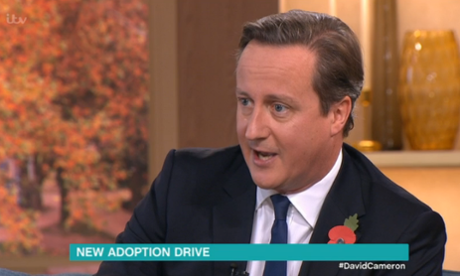
David Cameron on ITV's This Morning
David Cameron is on ITV’s This Morning now. He is talking about his adoption proposals (see 9.58am), and he says the government wants to make it easier for families to foster children while applying to adopt them at the same time.
He wants to double the number of children adopted every year, he says. And that should save money.
Q: How can families afford to adopt when you are making it harder for families by taking tax credits away?
Cameron outlines measures being taken to help families. But we need to do more, he says.
Q: But families will lose £1,000. How do you shake off the claim that you just don’t care?
We do care, says Cameron. The government has to run the economy properly so we can afford good schools and good hospitals and the rest of it, he says.
Q: People say you are out of touch. You don’t know families on the breadline.
I do, says Cameron. He says he has people like this coming to his constituency surgery.
Measures like free childcare, and tax relief for childcare, will help.
But the government has to take difficult decisions.
There was very little of interest at the Number 10 lobby briefing. But we were told that David Cameron will be on ITV’s This Morning any moment now, so I will keep an eye on that.
You can read all today’s Guardian politics stories here.
As for the rest of the papers, here is the PoliticsHome list of top 10 political must-reads, and here is ConservativeHome round-up of today’s political stories.
And here are five articles I found particularly interesting.
The reason people get so aerated about this issue [immigration] is that they feel politicians have somehow tricked them. First there was the Labour Party that decided in the late 1990s to take the brakes off immigration, and to turn a blind eye to illegals, for the utterly cynical reason that they believed that immigrants were more likely to vote Labour ...
Then there has been the general failure of government since to get a grip on the numbers – in spite of repeated promises to do so. It is a painful truth that we said we could cap immigration in the “tens of thousands”; and yet this year alone we have had net immigration at 330,000. It is no wonder, when you have your natural fecundity rate turbo-charged in this way, that we have been struggling to catch up with the homes and the transport infrastructure that we need.
The top civil servant in the business department has formally queried the wisdom of a £1.7m government grant to subsidise the wages of 50 steel apprentices who lost their jobs last month — saying it could set an “unhelpful precedent”.
Martin Donnelly, permanent secretary at the department for Business, Innovation and Skills, issued a written warning to ministers that the support for apprentices at the SSI steelworks in Redcar could fail Whitehall’s value for money tests.
“I am also concerned that spending at this level would be repercussive, and might create an unhelpful precedent,” he told Sajid Javid, business secretary.
Mr Javid subsequently overruled the advice, pushing ahead with the funding because of the “extreme situation” in Teesside.
In comments to Cambridge students reported in the university’sVarsity newspaper, Mr Hunt said: “My fear is algorithmic politics [where because] everyone shares the same views as you on social media and in your social circles you become a sect rather than a party.”
Mr Hunt outlined findings from a study into the election defeat carried out by Jon Cruddas, the Labour MP. It showed that while Labour supporters cared strongly about redistribution and public services, the public at large cared more about deficit reduction and a welfare system they regarded as too generous to “people who aren’t prepared to work hard”.
He said: “If we’re not clear about what happened and why, we’re going to be in trouble.” However, he added that there was “no desire out there for David Cameron”.
Mr Hunt said: “People are going to be smashed by the government’s policies, and we can only help them in government.”
He concluded with a plea to the group: “You are the top 1 per cent. The Labour party is in the s***. It is your job and your responsibility to take leadership going forward.”
A critic of Jeremy Corbyn has been blocked from running for Labour in the first by-election under his leadership after trade unions allegedly “vetoed” her candidacy.
Kate Godfrey, who was a parliamentary candidate at the last election and has attacked Mr Corbyn’s choice of aides, was rejected within hours of applying to run in Oldham West and Royton.
The revelation will increase concerns that Mr Corbyn and his hard-Left backers are attempting to rig the selection process to ensure a supporter wins the safe Labour seat.
Ministers are preparing the ground for a retreat over controversial court fees introduced earlier this year which can force offenders to pay up to £1,200 if they plead not guilty but are then convicted.
The new fees were introduced in the closing days of the last parliament by Chris Grayling, the former justice secretary — and have been described as “outrageous” by Andrew Caplen, president of the Law Society.
Michael Gove, the new justice secretary, has begun a review of the so-called “tax on justice” amid complaints that the new charge has prompted some defendants to plead guilty to crimes they did not commit to avoid the fee.
A guilty plea in a magistrates’ court costs a flat £150 if entered at the start of proceedings and £900 in a Crown court. But if defendants enter a not guilty plea and then lose their case, they are obliged to pay a £1,000 court charge for more serious offences in a magistrates court and £1,200 in a Crown court.
I’m off to the Number 10 lobby briefing now. I will post again after 11.30am.
UPDATE: I’ve corrected this post because earlier it wrongly summarised the FT Redcar story, saying that it was Sajid Javid, the business secretary, who tried to block the payment. As the quote from the story makes clear, it was Martin Donnelly, Javid’s permanent secretary, who tried to block the payment, according to the FT. Javid over-ruled him.
Updated
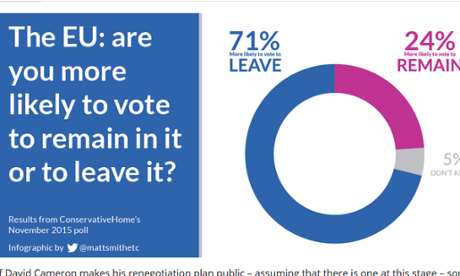
Paul Goodman, ConservativeHome’s editor, says support for Out amongst Tories seems to be getting stronger.
Last month, 66 per cent of respondents said that they are more likely to vote to Leave than Remain, and 30 per cent the opposite. This month, those figures are 71 per cent and 24 per cent respectively.
The auditing firm KPMG is one of the companies committed to paying the living wage. This is from Mike Kelly, its head of living wage, on today’s announcement about the increases in the living wage. (See 9.14am.)
Today’s announcement will see a pay rise for approximately 68,000 employees that work for a Living Wage accredited businesses. The rise of more than two and a half percent in London (£9.15 to £9.40) and five percent nationally (£7.85 to £8.25) may seem like small change to some, but for many it’ll make a huge difference to their lives, helping escape in-work poverty.
Only yesterday, KPMG research found that nearly six million people are still paid less than the Living Wage. With the cost of living higher than it’s ever been, the reality for many is that they are forced to live hand to mouth. Paying a living age will save huge swathes of people being caught between the desire to contribute to society and the inability to afford to do so.
(All credit to KPMG for supporting the living wage, but if you are a firm mainly employing accountants, paying everyone the living wage is unlikely to pose much of a challenge.)
Readers with a good memory will recognise that there is something familiar about David Cameron’s call today for an increase in the number of children in care put up for adoption; it is something that he has been pushing for for some time now, at least since 2012.
One problem is that although the number of children being adopted has been rising, the number of placement orders made by courts giving preliminary permission for adoption to take place has fallen by up to 50% over the past two years. As this Full Fact briefing explains, this is down to two court judgements, and the way they are being intrepreted by councils.
Cameron is announcing various moves today, not just to increase adoptions but to increase the speed at which children are adopted. He is proposing:
- Encouraging councils to use “early placement” (putting children with adoptive families before the full process is complete). Some councils do this already, but figures from March 2015 showed that 68 out of 152 authorities do not.
- Making special guardianship orders more thorough. The government says sometimes these break down under the current arrangements because children are sent to live with distant relatives they do not know.
- Possibly changing the law to promote adoption. Number 10 says it is “actively considering” changes to the law to ensure adoption takes place more often.
- Forcing councils to join regional adoption agencies. Regional adoption agencies are being created by the education and adoption bill and, by forcing councils to join them by 2017, children should have access to up to 10 times more prospective adoptive parents.
In his summer budget George Osborne, the chancellor, announced a new “national living wage” coming in at £7.20 an hour from next April. The title makes it sound like the living wage, the rate intended to reflect the minimum that workers need to earn to be able to live and paid on a voluntary basis by progressive employers. The “national living wage” is really just a new minimum wage rate, paid only to the over 25s.
This morning the Living Wage Foundation has announced that the living wage is going up, from £7.85 an hour to £8.25 an hour. And, as Boris Johnson, the mayor of London, has announced this morning, the London rate is going up from £9.15 an hour to £9.40 an hour.
Boris stacking shelves at Living Wage employer @OliverBonas to announce new rate of £9.40 an hour. pic.twitter.com/24QUu40ztt
— Pippa Crerar (@PippaCrerar) November 2, 2015
Almost 70,000 employees work for companies committed to paying the living wage. And, according to Sarah Vero, director of the Living Wage Foundation, the numbers are growing.
Today we are celebrating those 2,000 responsible businesses that are voluntarily paying the living wage to their staff. These employers are not waiting for government to tell them what to do. Their actions are helping to end the injustice that is in-work poverty in the UK now.
The living wage campaign is growing at pace. More UK businesses are announcing their living wage accreditation. They join a growing list of organisations ranging from FTSE 100 companies to independent businesses, small to medium sized enterprises and third sector employers who all share our belief that work should be the surest way out of poverty. The living wage is good for people and for business.
While Johnson combines his living wage announcement with some shopping, David Cameron will be out today publicising government plans to increase the number of children in care who are adopted. And Osborne is in Germany, where he is holding talks with the German finance minister, Wolfgang Schäuble, and the vice-chancellor, Sigmar Gabriel.
Here is the agenda for today.
11am: Number 10 lobby briefing.
1pm: Trade unionists hold a rally at Westminster to protest against the trade union bill.
2.30pm: Iain Duncan Smith, the work and pensions secretary, takes questions in the Commons.
4pm: Richard Heaton, the former permanent secretary at the Cabinet Office, and Chris Wormald, permanent secretary at the Department for Education, give evidence to the Commons public accounts committee about Kids Company.
As usual, I will also be covering breaking political news as it happens, as well as bringing you the best reaction, comment and analysis from the web. I will post a summary at lunchtime and another in the afternoon.
If you want to follow me or contact me on Twitter, I’m on@AndrewSparrow.