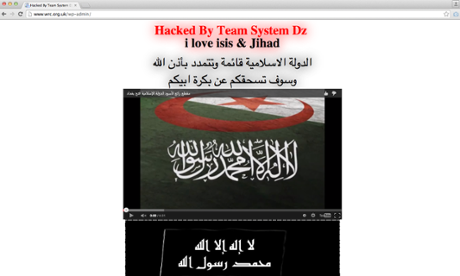
A London-based charity’s website has been hacked by a pro–Isis group claiming to be operating in Algeria, the Guardian Voluntary Sector Network has learned.
The Women’s Resource Centre, an umbrella body for women’s charities in the UK, found that their website homepage had been replaced by a page stating “I love Isis & Jihad” and “Je suis Isis” along with a promotional video, which contains distressing scenes.
The chief executive of the charity, Vivienne Hayes, said: “We have no idea why we were targeted. Our work is nationally based and we have no international links.”
The hack took place on the night of Wednesday 21 January and the charity says it has since received hundreds of phone calls from concerned members of the public, member organisations and service users.
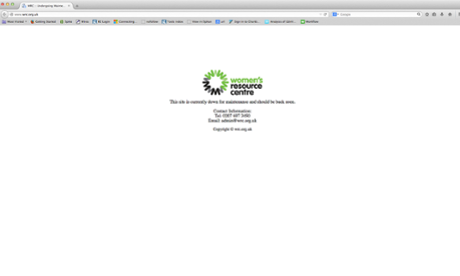
The Women’s Resource Centre is currently working to fix the problem and has replaced the hacked homepage with a maintenance message. However, the hacked version is still visible on some areas of the site.
The charity’s head of communications, Natalie Gyte, said she hopes the site will be back to normal by next week, but cannot be sure. “The [website] hosting company is trying to access back-ups of our site, but we have no in-house technical experts so I’m not 100% sure what the next steps are.
“We didn’t expect it so we only have a normal hosting package. We did not have any extra precautions in place to protect us from hacking.”
The organisation, which has a network of 500 women’s charities, has faced funding cuts recently. Gyte said: “With limited resources, we have to focus on our beneficiaries, not cyber security.”
Hayes said: “It is unbelievable to think that we must be guarded against terrorist activity while struggling against the affects of austerity facing all women’s organisations.”
Amar Singh, founder of Give01Day, an online platform that enables professionals to donate their time to help charities with their cyber security issues, said: “In cyberspace, charities are in the frontline as much as any other organisation. Most of the attacks we see stem from the lack of basic cyber hygiene as most attackers always go for the weakest link in the security control chain. Often, this state of affairs is due to lack of funding and availability of skilled resources.”
Singh advises charities to change their passwords on a regular basis and check the security controls of their third-party hosting systems or cloud providers.
“Charities can often assume because it is a third-party company, everything will be alright,” he said. “It is also important to check who has control to what – some users have more access to IT systems than is required. If their account is compromised the attacker can then have access to everything.”
The hackers, who identify themselves as Team System DZ, also hacked the website of Rugby League team the Keighley Cougars in November 2014.
For more news, opinions and ideas about the voluntary sector, join our community – it’s free!