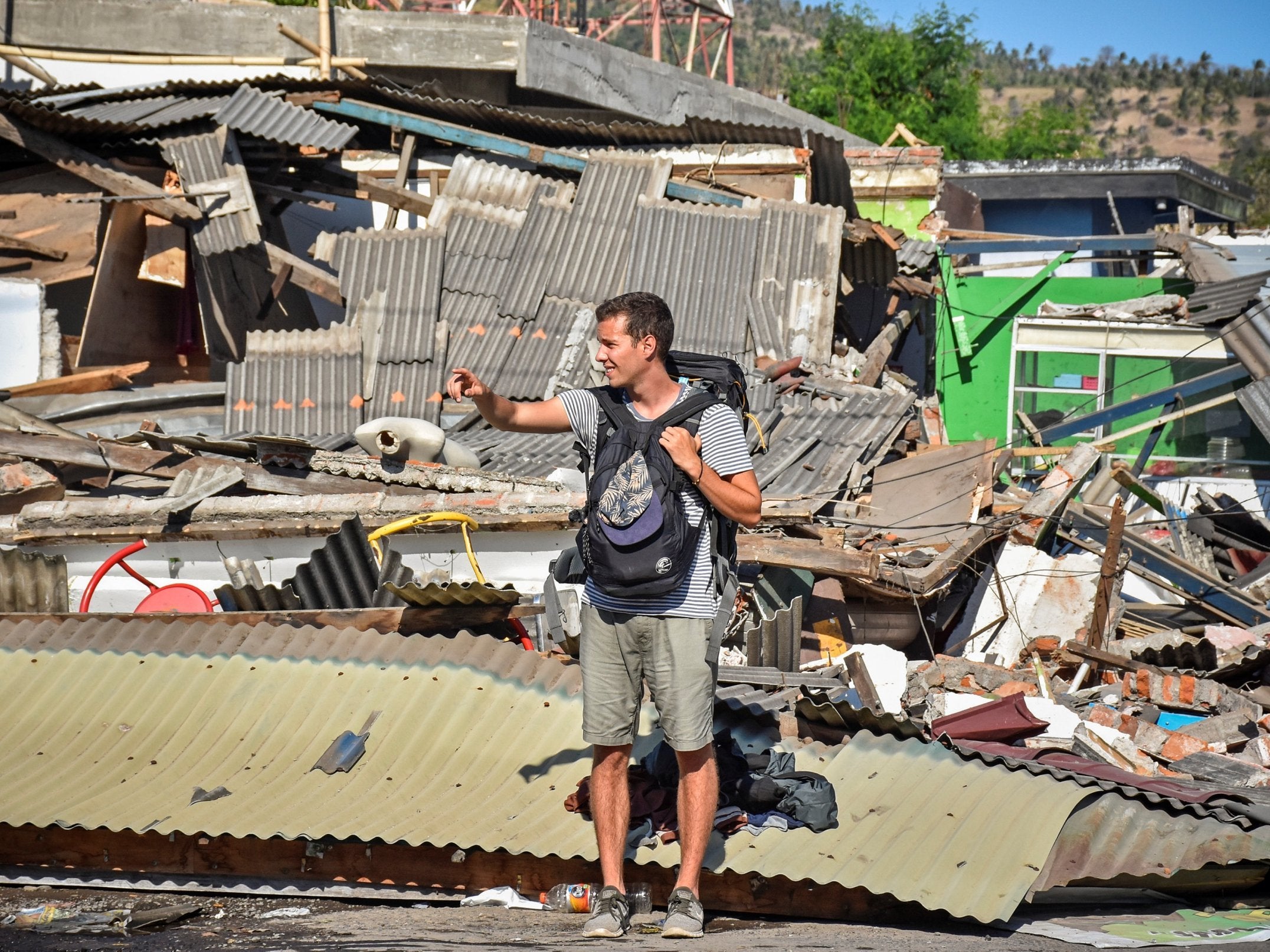
At least 91 people have been killed after a powerful magnitude-7 earthquake struck the Indonesian island of Lombok, prompting tourists to flee.
It was the second deadly quake to hit the island in a week after 16 were killed and hundreds of houses damaged in a 29 July temblor.
A spokesman for the National Disaster Mitigation Agency told a news conference the damage was “massive” in the north of Lombok and the agency said the death toll was expected to rise.
Sutopo Purwo Nugroho said the death toll had risen to 91 and more than 200 had been seriously injured, with thousands of homes and buildings damaged and 20,000 people in temporary shelters.
Some areas are still to be reached, with rescuers hampered by collapsed bridges, electricity blackouts and damaged roads strewn with debris.
The quake, which was measured at a magnitude of 7.0 by Indonesian authorities and a still-powerful 6.9 by the US Geological Survey, struck early on Sunday evening at a depth of 10.5km (6 miles) in the northern part of Lombok.
Soldiers and other rescuers carried injured people on stretchers and carpets to evacuation centres. Many victims were treated outdoors because hospitals were damaged.
“People panicked and scattered on the streets, and buildings and houses that had been damaged by the previous earthquake had become more damaged and collapsed,” Mr Sutopo said.
The Indonesian Agency for Meteorology, Climatology and Geophysics (BMKG) said more than 120 aftershocks were recorded after the tremor.
It triggered a tsunami warning and frightened people poured out of their homes to move to higher ground, particularly in North Lombok and Mataram, the capital of West Nusa Tenggara province, but the warning was lifted on Sunday after only small waves were recorded.
Mr Sutopo said there were no fatalities among the local and foreign tourists and a joint search and rescue team had deployed three ships to evacuate people.
Australia’s home affairs minister tweeted to say he and his delegation were safely evacuated in darkness from a Lombok hotel where they had been staying during a regional security conference.
Peter Dutton told Fairfax Media he was on the hotel’s 12th floor when the quake struck. He said the quake “was powerful enough to put us on the floor” and cut power.
Singapore’s law and home affairs minister, K Shanmugam, who was on the 10th floor of a hotel in Mataram when the quake struck, said his room shook violently and walls cracked.
“It was quite impossible to stand up. Heard screams. Came out, and made my way down a staircase, while building was still shaking. Power went out for a while. Lots of cracks, fallen doors,” he wrote on Facebook.
Silverius Tasman, from Yayasan Sayangi Tunas Cilik, a partner of Save the Children in Indonesia, said: “There were a significant number of aftershocks throughout the night so our staff on the ground are scared and traumatised – not to mention the children living on the island who have now experienced their second earthquake in a week.
“Despite the tsunami threat being removed, people are still confused and fleeing in fear. Across Lombok there is no power, which is making communications challenging.
He added: ”It’s quite clear the death toll will increase in the coming days as authorities continue to conduct search and rescue operations.
“During all emergencies, children are the most vulnerable and we hold concerns for their safety, security and overall wellbeing. Their particular needs must be taken into account as agencies and the government responds in the aftermath of this disaster.
“We have launched a response and are sending supplies. We will continue to help children in the immediate vicinity to make sure they are safe and protected during this difficult time.”
Chrissy Teigen, who was in Bali with her husband, John Legend, and their two children, live tweeted the shaking.
“Bali. Trembling. So long,” the model tweeted to her 10.6 million followers.
Like Bali, Lombok is known for its pristine beaches and mountains, with hotels and other buildings not allowed to exceed the height of coconut trees.
Indonesia sits on the geographically active Pacific ‘Ring of Fire‘, an arc of volcanoes and fault lines which is regularly hit by earthquake.
In December 2004, a massive 9.1 magnitude earthquake off Sumatra triggered a tsunami which killed 226,000 people in 13 countries, including more than 120,000 in Indonesia.
Additional reporting by agencies