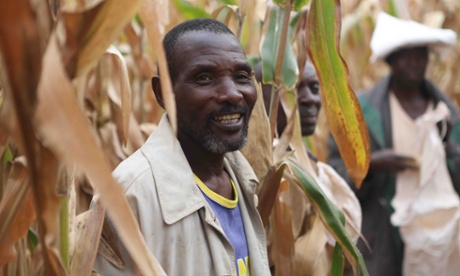
Ask someone to name the ingredients in beer, and it’s likely they will mention barley, hops or maybe wheat. But how about rice? Or sorghum? Today, these are some of the crops being used in Heineken’s African breweries, and it’s African smallholders who are growing them.
Heineken operates 56 production sites across Africa, producing a range of beer brands for local markets. Those markets are growing bigger by the day, with the continent’s overall middle-class population forecast to grow from 350 million in 2010 to 1.1 billion by 2060. The challenge is how to serve that market in the most sustainable way.
Local sourcing is a key part of the solution. Heineken began operations in what is now the Democratic Republic of Congo back in 1923, and until fairly recently it was common practice to import ingredients such as barley from Europe, for local brewing all over Africa. That has now changed, with the company setting itself an ambition to source 60% of all its agricultural raw materials from African farmers by 2020.
Since 2011, that target has translated into various different projects on the ground: farmers are being supported to grow maize in Rwanda, sorghum in Sierra Leone, and barley in Ethiopia, all of which are being used in Heineken’s local beer brewing processes. Prior to 2011, other local sourcing projects had already kicked off in; Nigeria in 1989 and in both the DRC and Burundi in 2009, involving more than 100,000 smallholders farmers in total.
Local sourcing has clear benefits for both Heineken and the smallholders in its host countries, says Paul Stanger, local sourcing director for Africa and the Middle East.
“In the DRC, for example, rice production was previously very fragmented and farmers were achieving low yields. We’re working with our partners on the ground to organise these farmers into groups and provide them with training and access to better seeds. By providing a market that wasn’t there before, we’ve enabled them to grow more, sell some to us, and improve their own food security and livelihoods.”
Heineken itself also benefits from having a stable local value chain for its raw ingredients. Importing barley means transport costs, and the goods are subject to import duties, which costs more money and can cause delays. There’s also the carbon footprint of transportation to take into account. African currencies are also more prone to fluctuation, so local sourcing removes that impact from the equation. Overall, it simply creates a more stable sourcing platform.
Making this work on the ground does require strong partnerships, however. The DRC project is a public-private partnership (PPP) between Heineken, the Dutch government and the development organisation EU-Cord. Heineken is currently running 5 others PPPs within Africa - in Ethiopia, Nigeria, South Africa, Sierra Leone and Burundi.
These partnerships have been essential to getting the necessary inputs to farmers, such as improved seeds and fertilisers. The improved seeds are often existing varieties already being used elsewhere in the country or in the world, but which haven’t been used in these particular communities before. This approach has already provided good results in Ethiopia where improved barley seeds have doubled the yields per hectare. Information and training on these inputs and modern farming methods has been delivered by EU-Cord’s partners, who are closer to the communities and better equipped to share information in local languages.
“We have six breweries dotted around DRC and you have to look at each one as its own supply chain,” says Stanger. “It takes thousands of individual smallholders to supply a brewery. Our lead NGO partner, EU-Cord, has worked with smaller NGO partners in each region to identify, organise and support farmers. Agronomists go to these communities, often setting up demonstration plots and talking about the importance of effective planting, weeding and applying fertilizer at the right time.”
Results from a 2013 impact study showed that between 2009 and 2012, total rice production and yield per farmer both increased by 62%. In Kinshasa alone, average income per farmer went up by 323%. The project is estimated to have injected 26m euros into the DRC’s economy.
For participating smallholders, these investments places them on a more secure footing, both in terms of their own livelihoods and as participants in a value chain. And if the providers of raw materials are more secure, that translates into a more secure value chain for those further along – such as Heineken.
“Africa and the Middle East accounts for about 15% of our volume and 15% of our revenue,” says Stanger. “But it’s growing quite significantly, so over time it will become even more important.”
Stanger acknowledges that building up a value chain in relatively unstable countries is challenging. The lack of infrastructure in many countries adds to that complexity. But at the same time, investing in local sourcing on a continent where 70% of the population lives in rural areas is an important part of ensuring the business can meet growing demand sustainably and support the inclusive growth of Africa.
“We are continuing to grow as the African beer market grows. And every African government has agricultural development as a key priority, so we have a dialogue now with agriculture ministers in many countries which we wouldn’t otherwise have had. It’s definitely hard work, and not an easy journey. But the benefits to the farmer, and to the business, are what drives us. We are truly growing together.”
Content managed and produced by Heineken
Read more from the Partnering with African smallholder farmers series.


.png?w=600)