TALK about a real blast from the past.
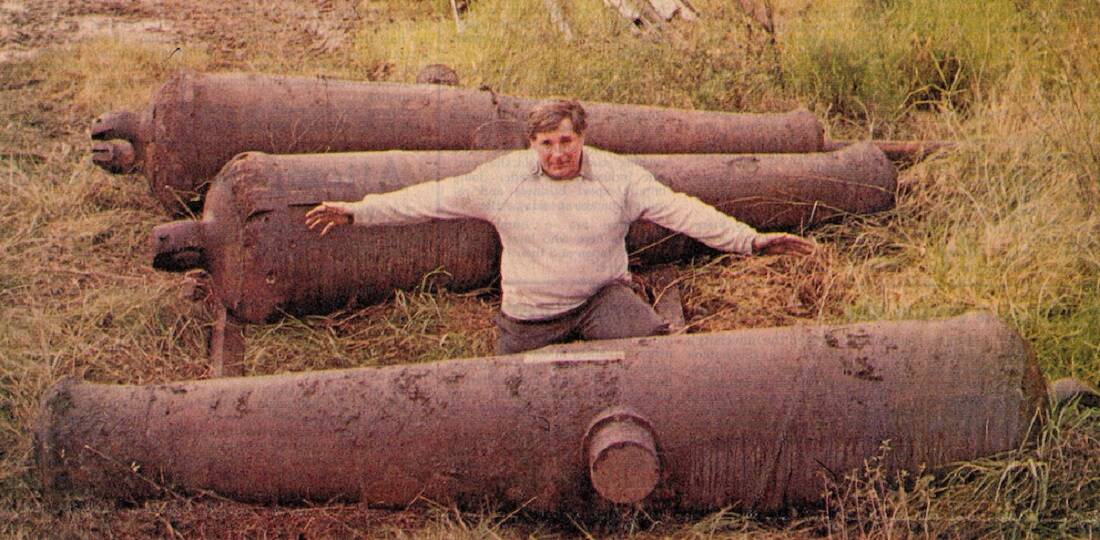
Reader Murray Cameron recently contacted me after discovering a photograph of him once saving historic Fort Scratchley cannons being reprinted in my new book.
The unusual incident occurred 32 years ago at Balcomb Industries' scrap metal yard at Wallsend.
Murray was Balcomb's yard foreman in May 1989 when he noticed an 1870s cannon fall from a large metal tank split open to be reprocessed into a smaller size for the BHP steel furnaces.
In all, three five-ton, monster-size old muzzle loaders were discovered hidden inside steel cylindrical tanks earlier removed from the Dyke End State Dockyard (1942-1987).
"It was lucky any of the (3.3metre) guns survived after being encased inside these steel cylinders. A Newcastle Herald news reporter came to view the guns and asked me to pose alongside a gun to give an indication of its size," he said.
His photo with the guns (pictured) appears in my book, The Hidden Hunter.
Murray said everyone was "pretty chuffed" the historic guns were saved.
A fourth cannon had been already sent to BHP but was saved from the jaws of the BOS furnace by the quick thinking of a crane driver.
Back in 1989, Balcomb's Wallsend general manager Paul Pratten said solid steel shafts had been inserted up each cannon barrel for them to be used to compress water.
"The idea (of using them as hydraulic accumulators) was ingenious," Pratten said.
"Thank God they were used that way. I suspect the cannons without their gun cradles would be a nuisance and normally they might have been dumped in the river and lost," he said.
The four big guns were originally sent to Newcastle's Fort Scratchley in the East End to defend the port during the 1877 Russian-Turkish war.
The guns were made obsolete in 1907 then vanished. Somehow they then ended up as concealed weights inside tanks at the now defunct Walsh Island dockyard (1913-1932) before it was relocated down to the harbour's Dyke End in 1942.
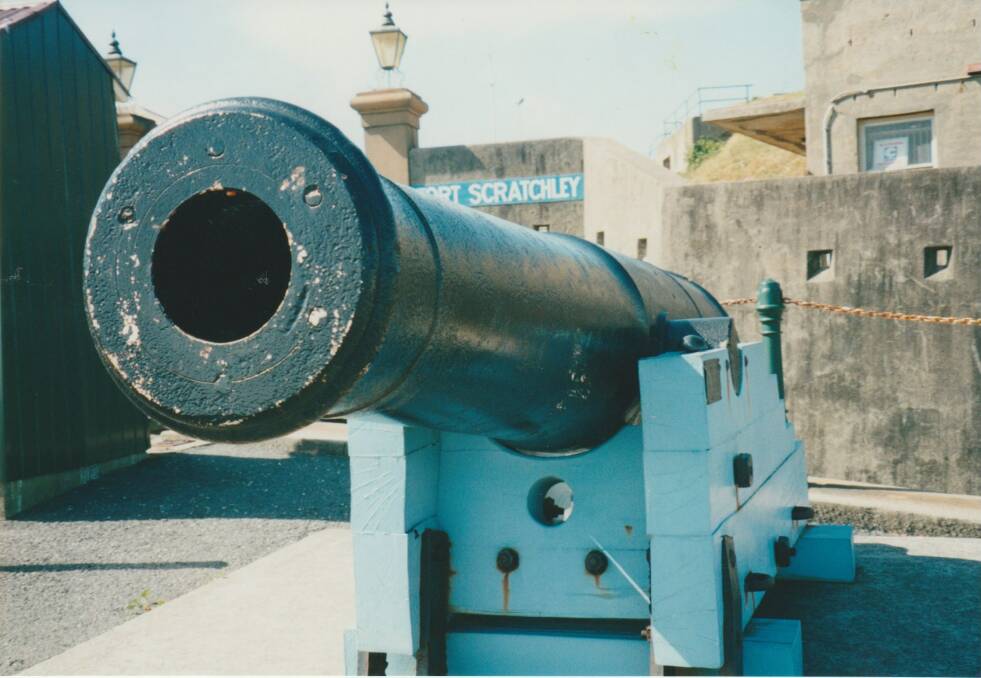
Later, all four restored cannons were returned to Fort Scratchley, where two today are now on public display on replica gun carriages outside the fort gate.
And here, Frank Carter, president of Fort Scratchley Historical Society, takes up the tale.
"A third restored cannon went down inside the fort (to the casement) where it was fired by Australian prime minister John Howard years ago," Carter said.
"The fourth fully restored gun, now also on a gun carriage, is in the fort's western barbette (roofless area).
"Like the casement gun, it can also be fired, unlike the two out front just for show.
"And it's possible the cannons are older than 1872. Our guns are the same as the 64-pounder cannons still on show up at Silo Hill, at Stroud.
"In fact, these guns came from our fort before it was a fort, as we know it today, guarding the port in the very early days."
Carter said Fort Scratchley's cannons though were converted from 64-pounder guns to 80-pounders by inserting a sleeve with rifling down the barrels.
This enabled the now converted guns to fire shells rather than old-fashioned cannon balls originally designed to sink wooden vessels but would bounce off the sides of the new steel warships.
The fort's 19th century 80-pounders were also not the only military items to ever leave the historic site.
The fort's major drawcard - its famous six-inch Mark V11 guns from World War II - were once surprisingly shifted to below The Obelisk, near King Edward Park, as a static display before being returned to the fort in 1973.
Now firing again on special occasions, Frank Carter said they were formidable weapons in their heyday.
Under a full black powder charge, the guns could hurl shells an amazing 13kilometres out to sea to deter any lurking enemy.
REVEALING INSIGHTS
Memories were revived recently for Duncan Brown, of Jewells, also regarding a yarn in The Hidden Hunter.
That particular chapter told of a disguised giant 19th century underground water tank inside the city's former James Fletcher psychiatric hospital (JFH) behind the old Newcastle Courthouse on Church Street.
"I was there when the (buried) tank was accidentally re-discovered back in 1969. I was site clerk of works then," he said.
Believed built in the 1840s, this deep colonial cistern measured about 17 metres (55ft) long, nine metres (30ft) wide and consisted of six chambers. It was built to supply water to soldiers in nearby barracks.
"Finding it surprised everyone. There must have been two metres of water still left down there. We had to pump it out," Brown said.
"I remember the (forgotten) reservoir being so huge that some chef wanted to even set up a restaurant down there, but nothing came of that."
But the dark, connecting brick barrel vaults and another site close by still hide secrets after more than 100 years, according to Brown.
"I was told by those who inspected inside that there were metal circles embedded in the walls.
"Maybe they were used to keep some convicts quiet overnight as a punishment.
"That's what was said on site at the time anyway. I don't know if there's any truth to it," he said.
While this does seem highly unlikely, another mystery unfolded while plumbers were checking the tank.
Brown said workers found a small tunnel inside apparently leading off towards Christ Church Cathedral.
It was assumed this passage might have allowed churchgoers to use the cistern as an air raid shelter in WWII.
However, as the passage was only a metre high by a metre wide, it was probably instead just part of a stormwater system to top up the water tank.
Brown, now 81, said he supervised various projects on site between 1965 and 1972.
Here, he kept finding out site secrets, as well as military buttons and coins uncovered during demolition.
"A former old nurse told us there had also once been police stables, now long gone, right behind the old Newcastle Courthouse," he said.