Concerns have been voiced among heads of local governments about the risk of spreading the new coronavirus as there has been an increase in the number of people from urban areas visiting tourist spots in local areas where a small number of infections have been reported.
While Tokyo, Osaka and other big cities have called on residents to refrain from nonessential and nonurgent outings as part of efforts to fight a surge in infections, an increasing number of people are going to local tourist spots and campsites in suburban areas.
The most likely reason people are doing so is that they are tired of refraining from activities, with the phrase "korona sokai" (coronavirus evacuation) spreading on social media.
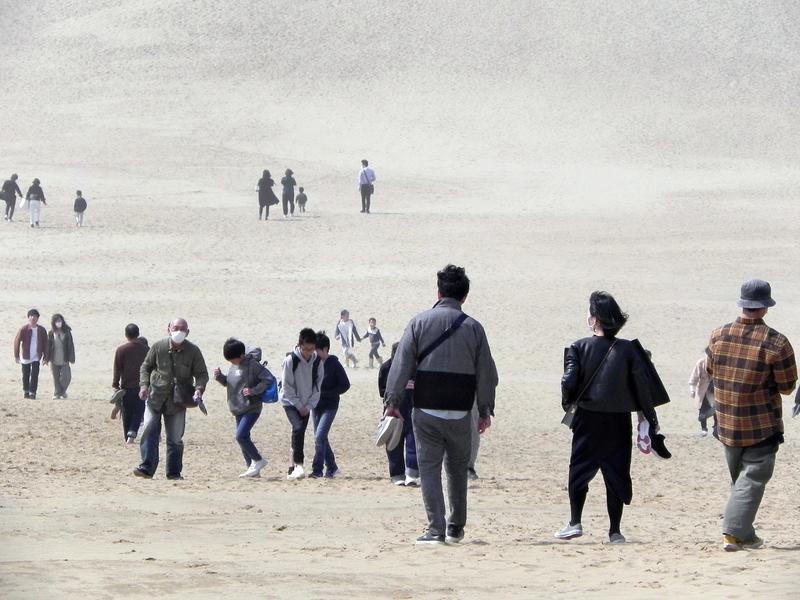
"The children were becoming tired of the coronavirus fuss, but we can enjoy ourselves here without worry," said a 51-year-old company employee from Matsubara, Osaka Prefecture, who visited the Tottori Sand Dunes in Tottori with his family of five.
According to a local souvenir shop, there have been few foreign visitors or group bus tours coming to the Tottori Sand Dunes since the new coronavirus spread nationwide. The parking lot was almost full on Saturday, with many private cars bearing the license plate of major cities such as Osaka and Kobe.
A similar case was seen at Forest Park Takebe's auto campground in Okayama City. In March, the number of groups visiting the campground was 134, about five times more than a year ago -- with about 60% from places outside the prefecture, including Kyoto, Osaka and Kobe.
"I stay at home except for work. I think the risk of infection is low here because it's outside," said a 50-year-old man from Naniwa Ward, Osaka Prefecture.
Maiamihama Auto Campground in Yasu, Shiga Prefecture, is also fully booked through the end of May. About half of the reservations are filled even on weekdays.
"We've received reservations to make up for some cancellations due to the refraining from activities," the facility's manager said.
Osaka Gov. Hirofumi Yoshimura called on residents to refrain from nonessential and nonurgent outings over the past weekend, as did Tokyo and Fukuoka Prefecture.
Perhaps this is why there have been posts on Twitter and other social media such as, "Getting away from an urban city, I'm relaxing in an open-air bath to get rid of the tiredness of self-restraint" and "I'm camping as it is so stressful to refrain from activities due to the coronavirus."
But the people in these local areas the urbanites visit have mixed feelings.
"I'm thankful for such visitors, but honestly, I'm worried about those from areas where there are many infected people," said a 72-year-old man who runs a souvenir shop at Tottori Sand Dunes.
"If people follow the rule of refrain from nonessential and nonurgent outings in areas subject to self-restraint, they should not come here," Tottori Gov. Shinji Hirai said at a press conference Thursday.
Enormous number of cars have descended on Karuizawa, Nagano Prefecture, which has about 16,000 villas and a population of about 20,000. On March 31, Karuizawa Mayor Susumu Fujimaki called on residents as well as villa users to refrain from going outside for nonessential and nonurgent matters because of fears that the disease could spread in the town.
Concerns are growing among tourist spots on remote islands as well over the possible breakdown in the medical system caused by the spread of the disease.
On the island of Ishigaki, Okinawa Prefecture, there are only three beds available for patients infected with the virus at a prefectural hospital.
"Those who are not feeling well should refrain from visiting the island," Ishigaki Mayor Yoshitaka Nakayama said.
"The risk of infection is not high outdoors, but people have chance to be in a crowded situation, such as at a restroom or shops while traveling," Kindai University Prof. Koichiro Yoshida said.
"As the infection spreads in urban areas, people should know that there is a risk of infection spreading in rural areas. I understand that people might drop their guard after prolonged self-restraint from outings, but we hope people act with restraint to prevent the collapse of medical services due to the spread of infections."
Read more from The Japan News at https://japannews.yomiuri.co.jp/