In a bid to more effectively utilize properties designated by the government as cultural assets, the central government will transfer some of its authority in this area to municipalities, The Yomiuri Shimbun has learned.
The changes are stipulated in a draft revision of the Law on Protection of Cultural Properties. The main point of the revision is to shift from giving priority to the protection of cultural properties to striking a balance between protection and utilization.
Meant to promote local revitalization by making various procedures more flexible, the revised law was to be submitted to the current Diet session. The government intends to enact the revised law during the current Diet session and put it into effect from fiscal 2019.
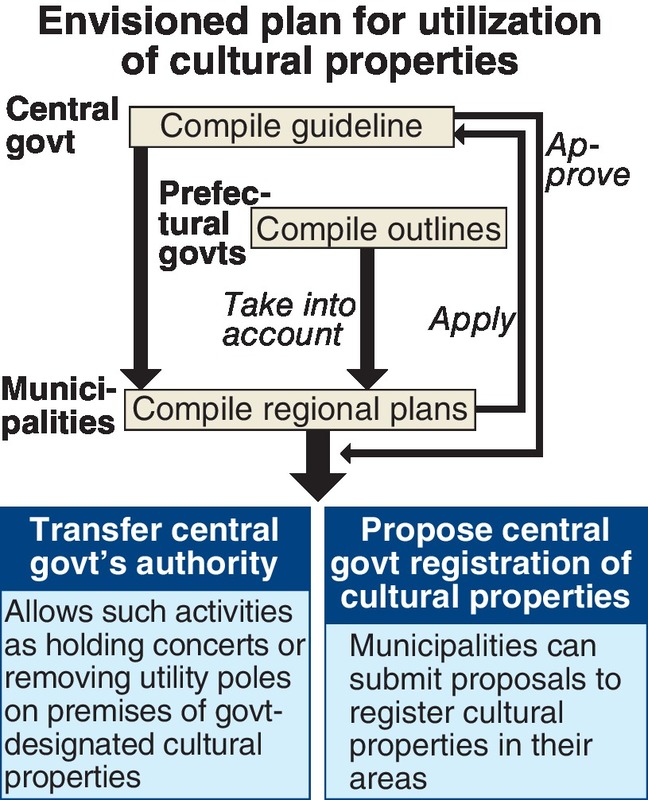
Under the new framework, municipalities would compile regional plans, based on a government guideline, containing measures to preserve and utilize government-designated cultural properties located in each region. They would then make an application to the government.
Prefectural governments could compile an outline for a comprehensive policy, which municipalities would take into consideration when compiling their own regional plans.
If the central government approves a regional plan, the relevant municipality could implement changes involving government-designated cultural properties under the scope and during the period stipulated in its plan. It could also propose to the central government that certain properties be registered as cultural assets.
Currently, municipalities must get permission from the Cultural Affairs Agency whenever they make changes involving cultural properties, such as burying electric wires underground to improve scenery that includes buildings and historical sites, or setting up a temporary installation on the premises of a temple or shrine in order to hold a concert.
If the law is revised, municipalities will be able to make such changes at their own initiative, as long as the changes are within the scope of the regional plan approved by the central government.
The government also intends to revise the local education administration law so the head of a municipality can take charge, through an ordinance, of the administrative duties related to protecting cultural properties. Such tasks currently fall under the jurisdiction of boards of education.
The aim is to make it easier to implement effective regional revitalization measures -- such as combining visits to historical monuments and sightseeing tours -- by transferring to municipality heads the administrative duties connected to obtaining government permission regarding cultural properties.
The draft revision of the Law on Protection of Cultural Properties also clarifies a special situation, in which payment of inheritance tax would be deferred if a private owner of fine art or crafts designated as important cultural properties opens them to the public as part of a regional plan. The measure is aimed at facilitating the utilization of such properties by museums, as well as preventing them from being scattered about after being sold to pay high inheritance taxes.
The draft also includes a provision to increase the maximum fine for damaging important cultural properties, raising the top amount from 300,000 yen to 1 million yen.
Read more from The Japan News at https://japannews.yomiuri.co.jp/