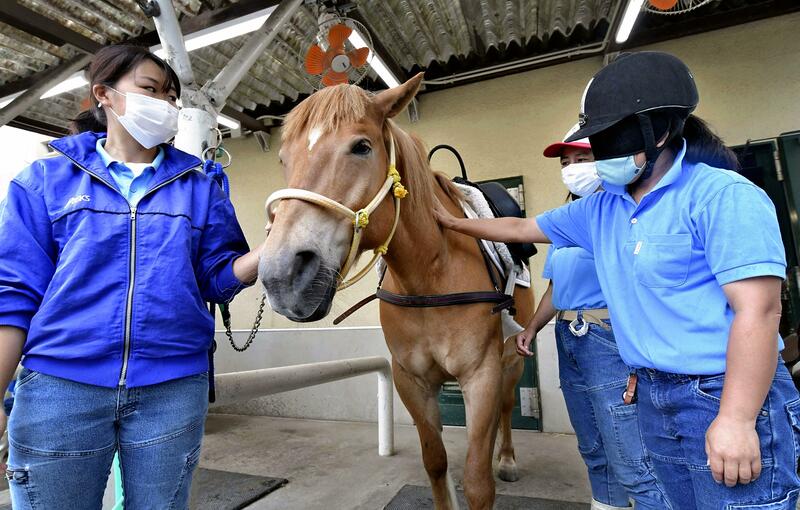
The staff member takes the hand of her colleague wearing an eye mask and moves it toward the neck of the pony named Gonta. "This is the pony's neck," she says. "There's nothing to be afraid of."
It is early July at the Shinozaki Ponyland in Edogawa Ward, Tokyo, and the staff and the pony are getting special training to give rides to people with disabilities.
With the opening of the Tokyo Paralympics less than two weeks away, municipalities are making efforts to promote para-sports and support athletes in the long run.
The number of places where people can casually experience paralympic sports is increasing, although it is still limited nationwide, and whether the momentum will continue after the Games remains an issue.
At Ponyland, the staff also dares to touch Gonta's flanks, buttocks and other parts that could easily make the animal feel stress. "Stay calm," the worker says.
The ward is training Gonta so that people with disabilities can get a hands-on experience of the Para-equestrian dressage event, and aims to debut him by the end of the fiscal year. "We want to do everything we can to ensure a safe experience," says the staff member in charge of training Gonta.
In December last year, the ward announced a commitment to a program in which all 22 events of the Tokyo Paralympics can be tried. The ward has been creating an environment in which people can experience boccia, goalball and the other sports at both ward-run and private facilities in the ward. "We want to realize a society in which everyone is encouraged to participate in sports," a ward official said.
-- Target not reached
The Japan Sports Agency has been providing financial support to local governments working to promote sports for the disabled since fiscal 2015, but the infrastructure is still a work in progress.
There are 50,000 public sports facilities across the country, but according to a 2018 survey by the Sasakawa Sports Foundation, only 141 are exclusively for or give priority to people with disabilities.
According to Japan Sports Agency statistics for fiscal 2020, the percentage of adults with disabilities who participate in sports at least once a week is 25%, falling short of the agency's target of around 40%.
-- After the Games
There is also concern about how to maintain interest in para-sports after the Tokyo Games.
Nagano Prefecture was the host for the 1998 Winter Paralympics. In 2005, it also hosted the Special Olympics World Winter Games, a sports festival for the mentally disabled, which boosted interest in para-sports.
However, the prefectural sports event for the disabled, which peaked at 1,574 participants in 2005, has seen a steady decline down to 1,193 in 2019, a 24% drop. The prefectural government survey of all 77 municipalities in 2019 found that only eight were holding para-sporting events on a regular basis.
From fiscal 2018, the prefecture began stepping up efforts to grow interest in para-sports again and, by the next fiscal year, 90% of municipalities in the prefecture held events allowing people to try boccia and other para-sports.
Some municipalities are moving to strengthen competitiveness in post-Tokyo Paralympic athletes.
This fiscal year, Aichi Prefecture provided subsidies of up to 500,000 yen for 30 members of the Japan national team and others to attend training camps and competitions.
It also started the Aichi Top Athlete Academy to provide specialized instruction in five sports, including swimming and athletics, for fourth-grade elementary school students and above. About 10 students will be selected for the academy, which is scheduled to start in the fall.
Read more from The Japan News at https://japannews.yomiuri.co.jp/