With the enactment May 24 of a law to promote the reduction of food waste, local governments and members of the food service industry are among those introducing various measures to cut back on the amount thrown away.
There was estimated to be 6.43 million tons of food waste overall in fiscal 2016. According to the Agriculture, Forestry and Fisheries Ministry and others, food waste from households was estimated at 2.91 million tons in fiscal 2016, that from food manufacturers at 1.37 million tons and that from the food service industry, such as restaurants, at 1.33 million tons.
The law requires the central government to establish a basic policy for the reduction of food waste. It also makes it mandatory for companies to make efforts to actively work toward reduction, and for consumers to promote efforts on their own by improving how they buy and prepare food.
Local governments are urged in the law to support food banks, which collect leftover food from companies and households and distribute it to households experiencing financial difficulty.
Smaller servings
To reduce food waste at restaurants, the Fuchu city government in Tokyo has since 2018 been introducing on its website restaurants that offer small servings or allow customers to take home food they have not finished eating.
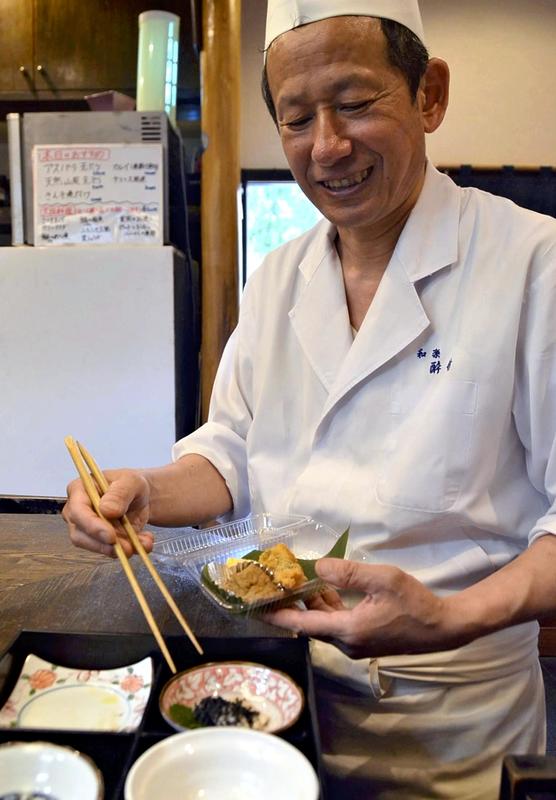
In late May, Hideo Takeuchi, the 54-year-old owner of Waraku Yoitake, a Japanese restaurant in Fuchu, was transferring dishes such as white fish fries and simmered food into take-home packs.
Takeuchi would prefer for customers to finish everything at the restaurant, but he also wants people to value food, so he has been getting his customers to take leftover food home for over a decade. In recent years, he said, an increasing number of customers have been asking for small servings when they order.
"Awareness about not leaving food has become established among customers," Takeuchi said.
In 2015, the Kyoto city government enacted an ordinance for waste reduction and appropriate disposal, called the "Shimatsu no Kokoro" ordinance. It obliges restaurants to make efforts to meet the requests of customers who want to take food home, as long as there are no concerns about sanitation. In the Kansai region, the word "shimatsu" means caring for things and using them up.
The Kyoto city government has a recognition system for restaurants working on food waste reduction. As of February, 940 restaurants have been recognized under the system.
Since 2018, the Fukushima prefectural government has been inviting applications for businesses to cooperate in achieving zero leftovers. To date, 275 businesses have been recognized.
Restaurants are asked to "call on customers for zero leftovers" and "devise ways for buying and using up ingredients," while retail stores are asked to "sell individual pieces, sell by weight and sell small-quantity packs," and "offer discounts on products that are nearing their expiration or best-by dates."
The program subsidizes recognized businesses up to half the cost of the purchase of tableware for small servings.
Donating to food banks
One initiative is to reduce waste by extending expiration dates, which show the period of time in which a food item can be eaten safely, for products like bento boxes, which do not keep for long.
In April, Salad Club, a company that manufactures and sells salads that can be eaten as they are without having to be washed, extended the use by date for its shredded cabbage by one day to five days. Damage to the food has been reduced by washing the cabbage gently after cutting it.
Food drive services, in which people donate food items for individuals to eat, are also effective in reducing food waste.
The Setagaya Ward government in Tokyo began accepting donations of food in 2017. In fiscal 2018, it collected 1,095 kilograms of food and donated it to welfare facilities and kodomo shokudo -- children's cafeterias where meals are offered for free or at low prices. The number of places where donations are accepted increased to four from two in 2017.
A ward official in charge said: "As awareness of the program has increased, the amount of food donations are increasing. We want people to take this opportunity to raise their consciousness about valuing food."
Try this at home
Sachika Takeda, a staff member at the Tokyo-based nationwide food bank Second Harvest Japan, recommends these ways to reduce food waste at home:
-- Buy food whose expiration date is near, so as to eat it within the day.
-- Select preservation methods that do not damage the food.
-- When you have leftovers, browse recipe sites online for ways to use it.
-- The expiration date on non-perishable foods indicates how long it will taste good. Do not immediately dispose of such food when the expiration date comes around; determine whether you can eat it.
-- Donate food you will not eat to food banks or other organizations.
-- Use apps and other means of cheaply buying food that is expected to be left over at restaurants and elsewhere.
-- When you eat out, only order as much food as you can finish.
Read more from The Japan News at https://japannews.yomiuri.co.jp/